
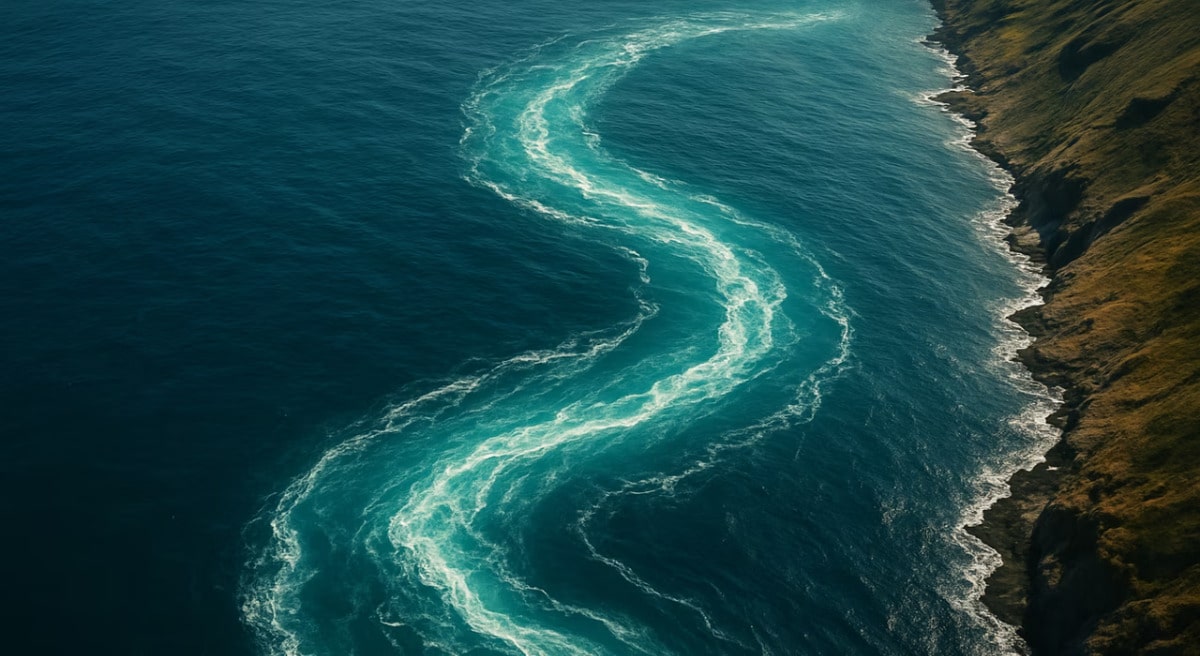
It carries 182 million cubic meters of water every second and connects the planet’s three major oceans. Today, scientists believe this invisible giant—the Antarctic Circumpolar Current—is changing. And that shift could disrupt global climate patterns and marine ecosystems.
A Gigantic Ocean Engine That Shapes Climate
The Antarctic Circumpolar Current (ACC) forms a massive loop around the frozen continent. Driven by powerful westerly winds, it flows clockwise—from west to east—without encountering any continental barriers. This uninterrupted flow links the Atlantic, Pacific, and Indian Oceans, playing a vital role in regulating heat, carbon, and nutrients across the globe.
But contrary to previous assumptions, this climatic “engine” may not be as stable as once believed.
An international team of scientists reconstructed the ACC’s history using sediment cores collected from depths of 3,000 to 4,000 meters in the Scotia Sea, north of Antarctica. These cores—several hundred meters long—allowed researchers to estimate the current’s velocity over time by analyzing the size of sediment particles: the stronger the current, the farther it carries fine particles before they settle on the seafloor.
Their findings were striking. The ACC was far more powerful during past warm periods. “The flow speed during the penultimate interglacial period, about 130,000 years ago, was more than three times faster than in recent millennia,” explained Dr. Michael Weber of the University of Bonn’s Institute of Geosciences, lead author of the study published in Nature Communications.
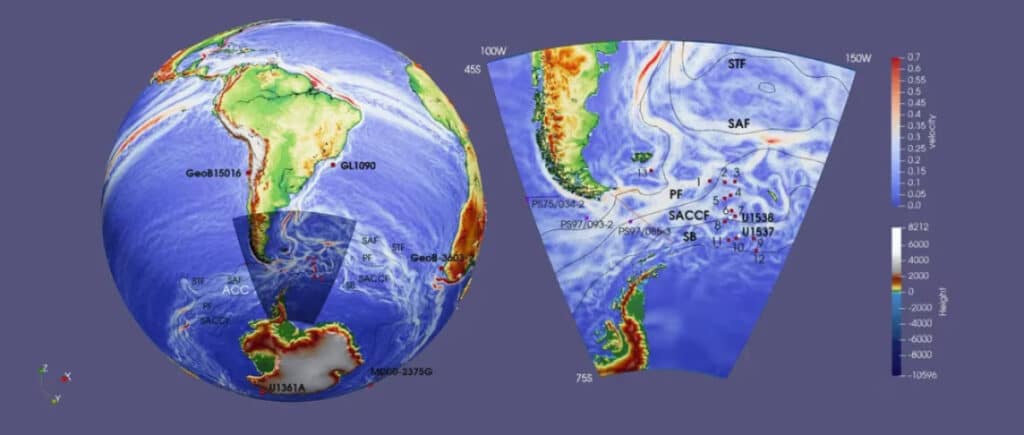
The maps show current Holocene ocean surface currents: the red shades indicate areas with the highest velocities. The black lines represent the five main fronts of the Antarctic Circumpolar Current (ACC), from north to south. © Xufeng Zheng
When the Ocean Moves, the Planet Responds
The researchers attribute this ancient acceleration to cyclical shifts in Earth’s orbit around the Sun. These variations—known as Milankovitch cycles—occur every 21,000 to 100,000 years, altering the planet’s tilt and orbital eccentricity. The result is a change in the amount of solar energy Earth receives, triggering major climate swings.
During the last interglacial period, the ACC didn’t just speed up—it also shifted southward by roughly 600 kilometers. As it moved closer to Antarctica, it likely transported warmer waters into contact with the ice sheets, contributing to a sea-level rise estimated between six and nine meters.
Today, global warming once again appears to be influencing this vast current. Some early indicators suggest the ACC may already be accelerating. However, new climate models predict a possible northward drift this time—an unexpected shift that could drastically alter the planet’s thermal and biological exchanges between oceans.
A Climate System at a Crossroads
As the central artery of the global ocean circulation, any change in the speed or trajectory of the Antarctic Circumpolar Current could trigger cascading effects: disruptions in marine ecosystems, shifts in oceanic circulation patterns, and long-term consequences for coastal and global climates alike.
What happens in the Southern Ocean, it seems, will not stay there.

Cécile Breton
Journalist
Since childhood, books, photography, and travel have been part of my world. Fascinated by life, by the stars, by landscapes that tell stories without a single word, I quickly realized that I needed to express what I saw and felt.
Passionate about the world around me, I first pursued a degree in History at university, driven by my fascination with the stories of the past and the great civilizations that shaped our world. But over the years, another truth became clear: I didn’t want to spend my life in archives or research. I wanted to be out in the field, behind a camera or in front of a microphone, sharing what I learned.
So, I took a new path. I chose journalism, to learn how to tell stories differently—with rigor and clarity. I learned how to write, to interview, to edit, to capture both attention and emotion.
Giving meaning and sharing what matters
Since then, I’ve worked across different media: print, web, radio, television, and video. All of this has allowed me to bring to life topics that matter deeply to me: nature, animals, space, and the major environmental and human issues of our time.
Today, I continue my journey as a journalist at Futura. As part of the editorial team, I strive to share knowledge with curiosity, clarity, and passion. My guiding thread? To make visible what deserves to be seen, understood, and shared—and to keep my sense of wonder alive.