
Lea este artículo en español aquí.
It now appears San Benito County Water District customers could be on the hook for more than $730,000—or its roughly equivalent in stored water under a proposed deal—in sunk costs for the ill-fated, multibillion-dollar Pacheco Reservoir Expansion Project.
Once touted as the top water storage project in the state, and heralded in BenitoLink as a “modern solution to the age-old challenge” of addressing expanding water supply needs, the massive project planned for a site off of Pacheco Pass collapsed under its own weight after years of ballooning costs and other challenges as state and federal agencies ultimately chose to withdraw or withhold support.
On Oct. 29, the county water district board of directors is set to consider a proposal to cover the district’s share of environmental review costs through December 2021, set at 2.5%, for the $3.2 billion Pacheco expansion, which was dropped by the Santa Clara Valley Water District last month.
The water district board will meet at 5 p.m. at the district offices at 30 Mansfield Road in Hollister.
Under the proposal on the district board’s agenda, the county water district would allow Valley Water to keep about 3,500 acre feet of stored water owed to the district in lieu of the $732,000 that is supposed to represent the district’s 2.5% share of costs for the project under a 2018 agreement which helped establish a partnership between the district and giant Valley Water.
That suggests Valley Water spent more than $29 million on environmental reviews for the project apart from grant funding.
Asked earlier this year how much the district could owe for the project, Valley Water representatives said none of the expansion project expenses were considered to be “invoiceable” to the district.
But Valley Water officials now say the partnership agreement always presumed the county water district would share a portion of the expansion project costs.
According to county water district general manager Dana Jacobson, Valley Water never actually submitted an invoice for the district’s project costs but once Valley Water officials dropped it, “they said what do you want to do [about the district’s share] and this is what we came up with.”
Jacobson, who previously worked at Valley Water, argues that it makes more sense to transfer ownership of the 3,500 acre feet of stored water to Valley Water rather than dipping into district reserves to pay the cost in cash.
“It’s sunk cost, out the door and we don’t have to come up with the money,” Jacobson said. “It’s easier on [customer] rates.”
In 2011, the San Benito County Water District agreed to store 5,000 acre feet of its Central Valley Water Project water for emergency use purposes through Valley Water with the Semitropic Water Storage District. With a loss of 10% applied to that amount, the county water district has the rights to 4,500 acre feet.
None of this water has been transferred to the county water district because of Valley Water’s “internal needs,” even though the county water district paid more than $862,000 in Semitropic operations and maintenance costs during the period in question, according to a staff report.
Under the proposed exchange, the county water district would retain 1,000 acre feet of stored water with Valley Water and Semitropic.
Despite the potential loss of cash or stored water and essentially nothing to show for it, Jacobson said the Pacheco Reservoir expansion partnership was worth the risk.
“It was, absolutely,” he said. “Every large project carries risk. It was a screaming deal at the time and a fairly low cost compared to other options. It was worth the risk but it didn’t work out.”
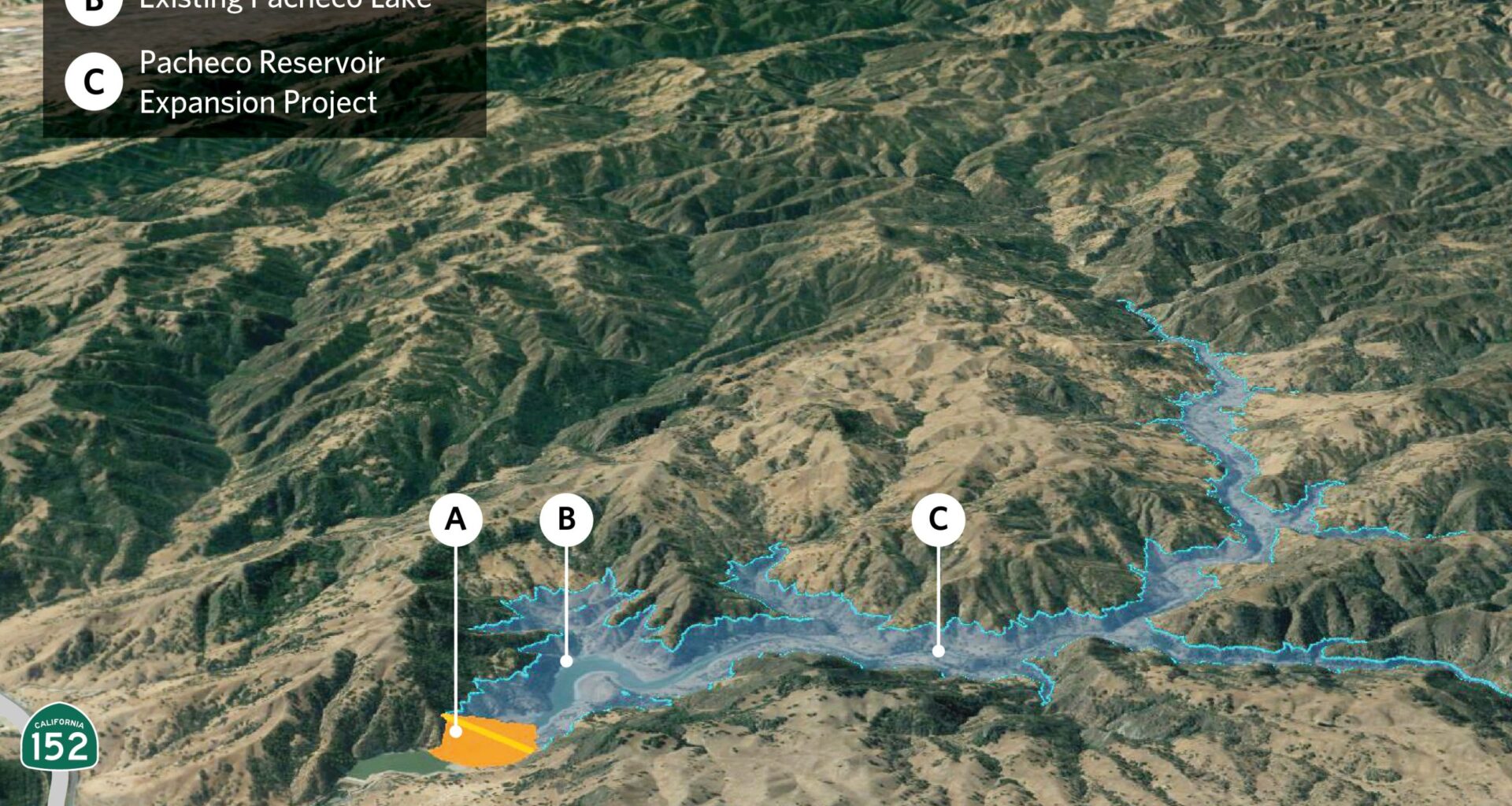
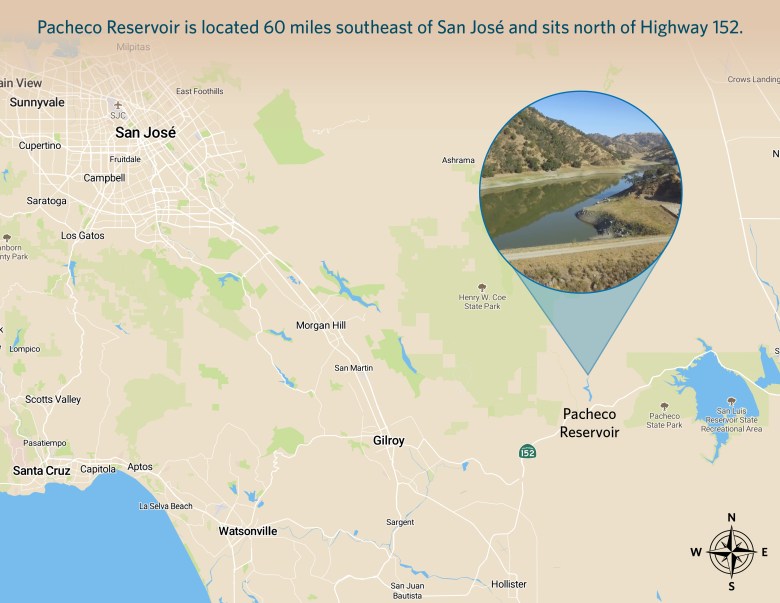 The reservoir expansion project was located off Hwy 152 in the Pacheco Pass area. Photo contributed by Valley Water.
Under the original proposal, the Pacheco Reservoir expansion project was estimated to cost about $969 million to build a new 319-foot dam, expanding the existing reservoir from 6,000 acre-feet to 140,000 acre-feet of water storage capacity for “emergency” supply needs. The project was bolstered by nearly $500,000 from a state Prop. 1 grant.
When the water district signed on as a project partner, Water Resources Association of San Benito County water conservation manager Shawn Novack wrote a commentary for BenitoLink praising the effort, calling it a “much-needed project that will improve the long-term water supply of the northern San Benito County region.” He described it as a “modern solution to the age-old challenge of providing a sustainable water supply for our expanding population, agricultural uses, and businesses.”
Novack also supported the project’s potential benefits for improving ecosystems in the region. He said it would restore running water in Pacheco Creek for endangered Central Coast steelhead and prevent flooding in the Lovers Lane area which occurs intermittently.
But early on, the project that would have inundated a large portion of Henry Coe State Park with stored water drew opposition from a coalition of groups calling itself Stop Pacheco Dam due to a range of environmental concerns about the project. The group ultimately sued successfully to force additional environmental review of the project.
The project was also forced to revise its plan to build a concrete dam on the site in favor of an earthen dam after the Division of Safety of Dams indicated support for the latter.
Those challenges and others forced a series of delays and drove up the project’s cost to more than three times its original estimate, even as Valley Water failed to find partners willing to purchase the stored water.
Despite the challenges, Jacobson spoke on behalf of the project before the California Water Commission in the spring, as commissioners began asking questions about the project’s progress, its rising cost, and its continued viability.
Jacobson’s testimony in support for the project came as San Benito County Water District Board President Doug Williams told BenitoLink the board had not received an update on the project or discussed it for some time, and had begun focusing on alternative water storage projects such as the BF Sisk Dam raise proposal at San Luis Reservoir, which Valley Water is also involved in.
This past summer, the federal Bureau of Reclamation declined to allow Valley Water to store Central Valley Water Project water in the proposed new reservoir, a mortal blow to the proposal which relied heavily on that water source.
In August, state water commissioners declined to provide the reservoir expansion project with additional funding, citing uncertainty over its future.
Finally, in late August, the Valley Water board agreed to discontinue the project and withdraw its application to the state for the Prop. 1 funding in a stunning though largely anticipated reversal after spending eight years and $100 million on the proposal.
Jacobson acknowledged the project’s exponentially increasing cost had made it considerably less desirable to the county water district, but said the district continues to support it and suggested it could eventually be revived many years from now.
“When it became a $3.2 billion project it was a whole different thing,” he said. “2.5% of $600,000 is one thing but $3.2 billion is a different thing. We still support the project because it’s beneficial to our partner [Valley Water] and to us. I don’t think you can ever rule [the project] out in the future but it will be many, many years before it could make sense. Now we’ll turn to other options.”
Jacobson said there are no plans to conduct a review of the county water district’s involvement in the project and said he didn’t know how to answer how the district could have avoided the risk of spending hundreds of thousands of dollars with no return on its investment.
Sierra Club Loma Prieta Guadalupe Group conservation chair Katja Irvin said it was always a concern that the county water district would get caught up in the project’s “exploding costs” at least partly due to impacts on habitat and wildlife, as well as traffic on Hwy 152 during years of construction. She suggested the district commit to evaluating such environmental concerns before participating in future projects. Irvin has previously requested the district conduct a review of its participation in the project.
We need your help. Support local, nonprofit news! BenitoLink is a nonprofit news website that reports on San Benito County. Our team is committed to this community and providing essential, accurate information to our fellow residents. Producing local news is expensive, and community support keeps the news flowing. Please consider supporting BenitoLink, San Benito County’s public service nonprofit news.