
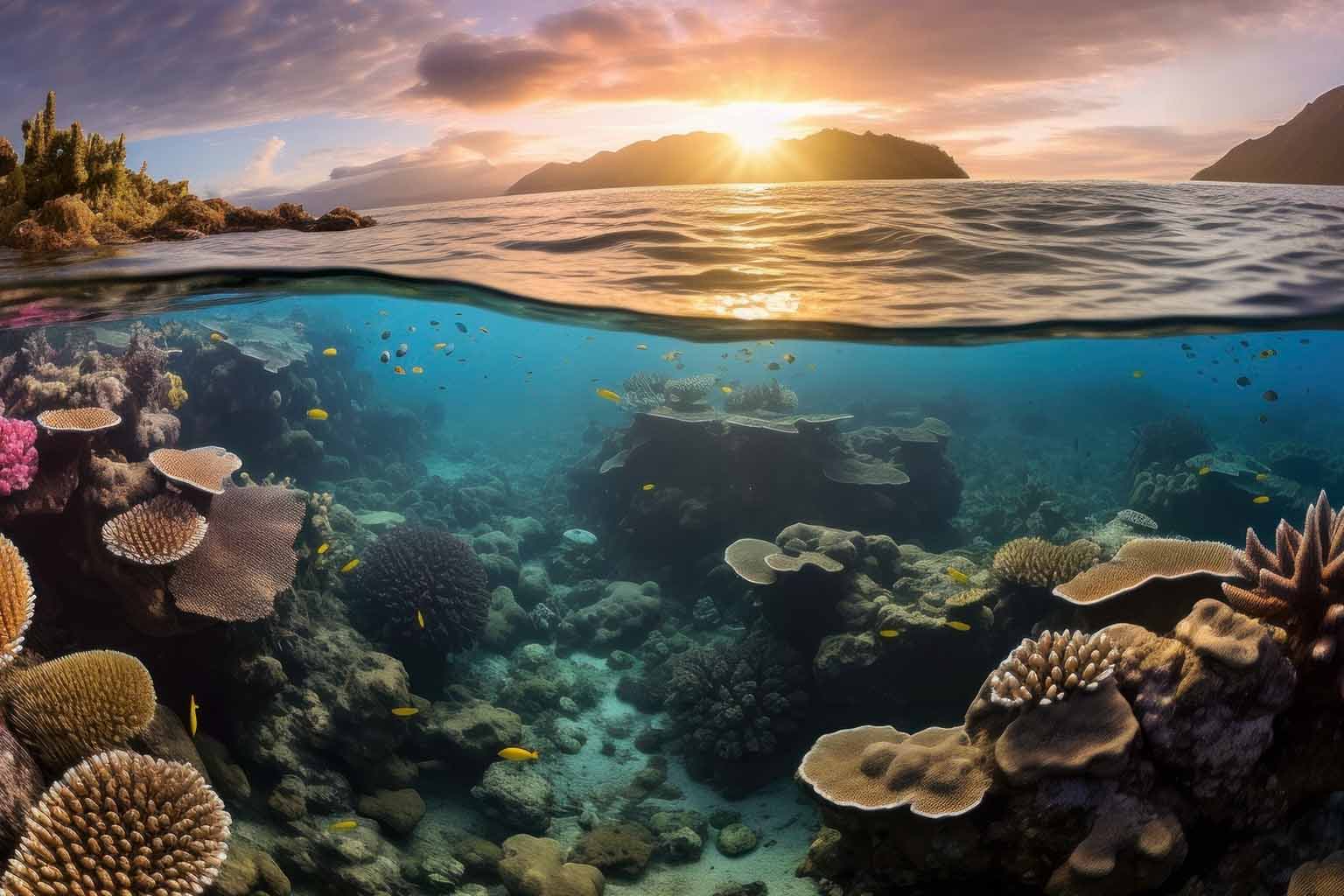
Sometimes the biggest scientific surprises come from the most unexpected places—like an ancient ocean that vanished millions of years ago. Yet its ghost is still shaping the living world today in ways we’re only beginning to understand. And now, a new global study has revealed just how deeply this lost sea continues to influence the diversity of soft corals across our planet.
Published in Scientific Reports, the research pulls back the curtain on a hidden world scientists have struggled to decode for decades. After examining more than 4,400 museum specimens collected from every corner of the globe, an international team uncovered two major centers of diversity for soft corals—and one of them was completely unexpected.
Why soft corals are so hard to understand
Soft corals may look delicate and dreamlike underwater, but scientifically, they’re incredibly tough to classify. Unlike hard corals, they lack a rigid skeleton, making it nearly impossible to rely on structure alone for identification. Instead, researchers often depend on visual clues—like the arrangement of polyps—even though many species look almost identical.
This is why biologist Gustav Paulay from the Florida Museum of Natural History calls them a “taxonomic nightmare.” Imagine trying to identify thousands of species based on subtle variations in shape, movement, or color, all while knowing those traits can overlap dramatically.
To stay upright, soft corals pump water into internal cavities to create a flexible, living skeleton. They’re also filled with tiny calcium structures called sclerites, which are wildly diverse. As lead author Catherine McFadden puts it, “they’re like snowflakes—each one different.” That beautiful complexity has long made it incredibly difficult to distinguish one species from another with confidence.
I remember snorkeling off the coast of Mauritius years ago and being mesmerized by a cloud-like forest of soft corals swaying beneath me. At the time, I assumed each shape and color marked a different species. Learning about this study made me rethink that moment—had I really seen dozens of species, or perhaps just a handful taking on different forms ? It’s a humbling reminder of how much the ocean still keeps hidden from us.
DNA steps in to solve a long-standing mystery
For decades, scientists relied mostly on morphology—especially the shape of sclerites—to build species lists. But as DNA sequencing became more accessible, it revealed a reality far more complex than anyone expected.
Often, what appeared to be one widespread species turned out to be six or eight genetically distinct species, each with its own evolutionary story. And in other cases, colonies that looked dramatically different across environments turned out to be genetically identical.
This mismatch between appearance and genetics complicates everything from cataloging species to mapping their global distribution. But it also opens a door : DNA finally allows researchers to uncover hidden relationships, revealing cryptic diversity that would otherwise remain invisible.
McFadden’s team used DNA sequencing to connect the dots between thousands of specimens. Their efforts produced the largest dataset ever assembled for soft corals—and with it, surprising patterns began to emerge.
Two hotspots of coral diversity, not one
For years, scientists believed the heart of soft coral diversity lay squarely in the Indo-Pacific Coral Triangle, a region famed for its marine richness. Stretching across parts of Indonesia, the Philippines, and Papua New Guinea, the Coral Triangle hosts more than 70% of the world’s coral species.
But as the new analysis unfolded, a second hotspot emerged—one that caught the team completely off guard.
Along the coasts of Madagascar and southeast Africa, researchers found levels of diversity that rival, and in some cases exceed, those of the Coral Triangle. This region has long been understudied, its reefs overshadowed by more famous ecosystems. Yet the findings suggest it may hold one of the world’s most remarkable reservoirs of soft coral biodiversity.
This discovery challenges long-standing assumptions about how coral biodiversity is distributed across the planet. It also highlights how little attention has been given to the western Indian Ocean, despite its potential ecological importance.
McFadden notes that part of the richness detected may reflect sampling intensity, since her team collected more specimens there than in some parts of the Coral Triangle. But even with that caveat, the diversity uncovered is impossible to ignore.
The ghost of the Tethys Sea
To truly understand these patterns, we have to travel back millions of years to the age of the Tethys Sea—a vast ancient ocean that once stretched between the early northern and southern continents. This prehistoric sea acted as a massive corridor for marine life, allowing species to spread, mingle, and evolve across enormous distances.
As the continents drifted and the Tethys Sea slowly closed, its once-connected ecosystems fragmented. Coral populations were pushed into new regions, isolated from one another, forced to adapt to different environmental pressures. Over time, these isolated pockets evolved into distinct species-rich communities.
The rise of the Indonesian archipelago intensified these shifts even further. “When the archipelago formed, reefs colonized it, and diversity shifted,” explains Paulay. The Coral Triangle blossomed as a result, becoming one of the richest marine hubs on Earth.
Meanwhile, regions around Madagascar and East Africa became evolutionary islands of their own—separated, but still vibrant. The study suggests soft corals there have been evolving independently for millions of years, contributing to their high endemism and unique species profiles.
What do you think—should scientists explore more overlooked regions like the western Indian Ocean ? I’d love to hear your thoughts, reactions, or questions, so feel free to share them below.