
About once a month, 11-year-old Gideon Dobson goes to sleep-away “camp,” a special place that is only 40 minutes from home in Peoria, Ariz.
The “camp” is actually a non-profit in Phoenix called Ryan House, which provides caregiving at no cost to Gideon’s family and others navigating life-limiting or end-of-life journeys.
It’s something his mom, Kathleen Muldoon, and dad, Seth Dobson, rely on for their mental health. Gideon has 42 diagnoses, including deafness, blindness, epilepsy, and cerebral palsy. He requires 24-hour, round-the-clock nursing care.
“Gideon is an amazing person, but literally a million-dollar kid,” says Kathleen, referring to the high cost of caring for his medical needs. And although nurses provide invaluable help, much of his care is handled by his family. “When you have something so stressful in your life all the time without having respite, it can be devastating.”
Gideon Dobson.
Courtesy of Kathleen Muldoon
Respite facilities like Ryan House offer short-term caregiving for children with medical complexities. They give caregivers a much-needed break — as well as peace of mind that their children are safe, happy and being looked after by trained professionals.
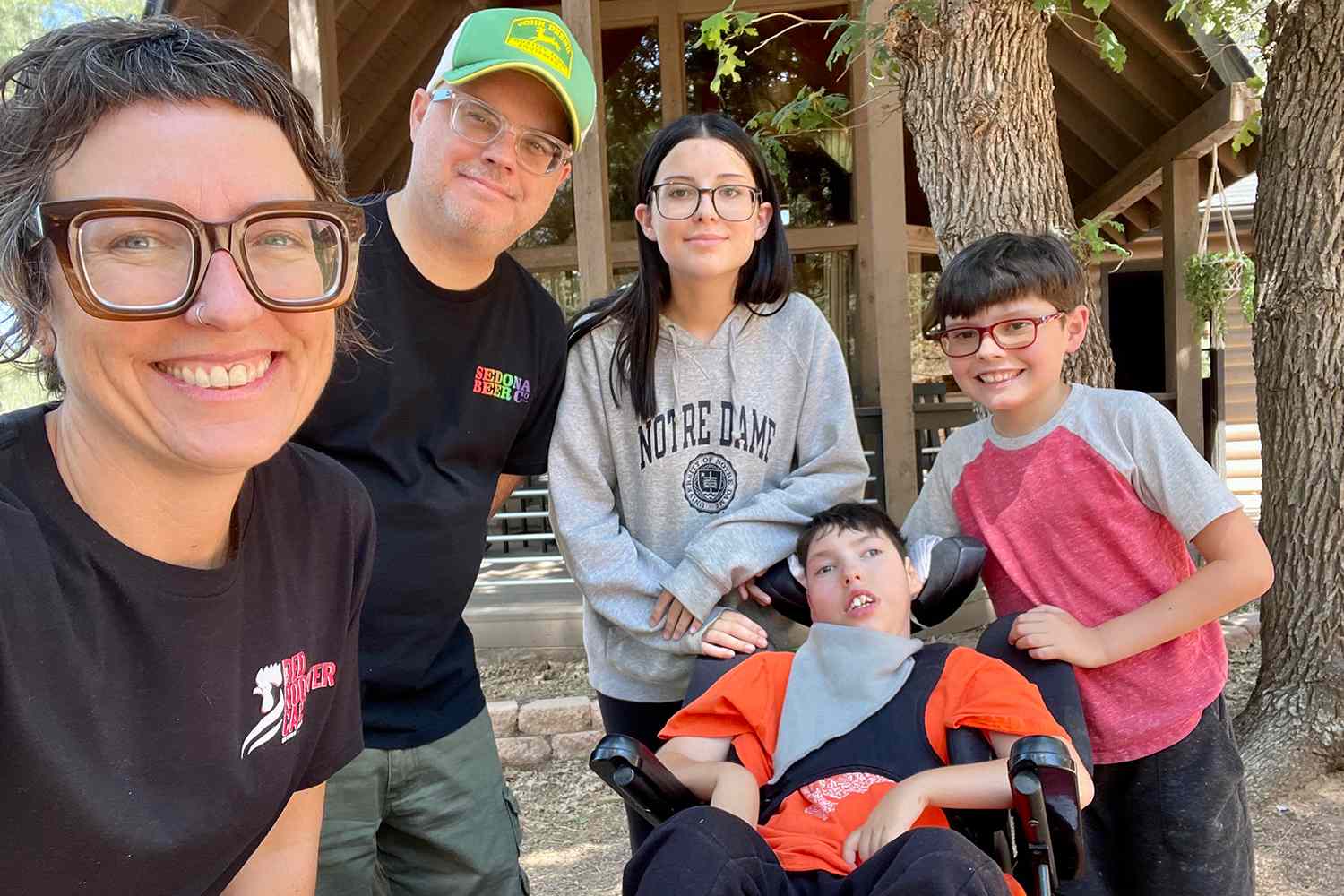
While Gideon is at Ryan House, Kathleen, 48, and Seth, 48, can take Gideon’s siblings, Genevieve, 14, and Cormac, 9, to do things that Gideon can’t do, like go camping or hiking.
Kathleen doesn’t want them to feel like they are less of a priority, even though Gideon’s needs “are so intense.” She says they need — and deserve — their parents’ full attention. Ryan House makes it possible.
The Dobson Family.
Courtesy of Kathleen Muldoon
Kathleen is sharing her family’s story with PEOPLE as part of Children’s Respite Homes of America, a national movement working to expand pediatric respite and hospice care across the United States.
“Parents just need a break,” says Jonathan Cottor, CEO and founder of the National Center for Pediatric Palliative Care Homes, which is another name for Children’s Respite Homes of America. He and his wife, who live in Scottsdale, Ariz., opened Ryan House in 2010. It’s named after their 17-year-old son, Ryan, who died in December 2018 after battling the neuromuscular condition spinal muscular atrophy.
He explains the thinking behind the facility: “The number one thing that a family who has a child with a very significant complex medical condition wants more than anything in the world is a cure for their child,” Cottor says.
“The second-biggest wish that families have: ‘Just give me a good night’s sleep. Just give me a break every once in a while so that I can rest and recharge. Then I can get back to this very difficult journey, tackle the next challenge, and the one after that.’ These homes give families a respite from the exhaustive nature of caregiving a child with severe medical needs. They can reconnect as a couple and as a family.”
There are currently fewer than 10 homes like Ryan House across the country. Cottor’s goal is 50 in the next five years.
Gideon Dobson when he was born on November 12, 2013.
Courtesy of Kathleen Muldoon
Looking back, Kathleen never thought her family would be affected by severe disability. As a professor of anatomy at the Geisel School of Medicine at Dartmouth (Seth was a professor of anthropology at Dartmouth College), she was well-versed in embryo health. “My specialty in teaching was embryology, or the formation of people before they’re born,” she says. “I knew too much, but not enough — I didn’t know the lived experience of disability, I knew the textbook experience.”
And although she had a textbook pregnancy and delivery with Gideon, 18 hours after he was born, he had a rash, his belly was enlarged and he was jaundiced, all signs of a viral infection congenital cytomegalovirus (cCMV.) It’s a condition caused by a virus that can be passed from mom to baby during pregnancy, according to Mayo Clinic. Once transmitted, it stays in the body for life.
Gideon’s diagnosis, his mother knew, was not curable — and it would likely lead to many more health problems.
“You can’t fix a brain,” she explains.
Gideon as a toddler.
Courtesy of Kathleen Muldoon
Never miss a story — sign up for PEOPLE’s free daily newsletter to stay up-to-date on the best of what PEOPLE has to offer, from celebrity news to compelling human interest stories.
At the time of his diagnosis, they were living in Vermont. “I think the first question I asked Seth was, ‘How are we going to afford this kid? What are we going to do?’ ” Kathleen recalls, while acknowledging her privilege of being a medical school professor with good health insurance.
Gideon was initially approved for one hour a week of home health care occupational therapy, which his parents knew would not be enough. He needed trained nurses 24 hours a day, and that was cost-prohibitive. Kathleen and Seth couldn’t ever take a night off; his conditions were too complex for a babysitter. And while the state would cover one evening of care, Kathleen says, they had to wait another 2 years to use the benefit again.
Through research, the couple found a cerebral palsy inclusion report that ranked each state’s approaches to promoting independence and productivity, ensuring quality and safety, and keeping families together.
The No.1 state on the list in 2013? Arizona.
Gideon Dobson.
Courtesy of Kathleen Muldoon
So, even though Kathleen and her husband loved their jobs at Dartmouth and living in Vermont, she applied for a teaching job at the medical school at Midwestern University in Glendale, Ariz. The family moved to Peoria, outside of Phoenix, in June 2014. Seth changed industries to work as a data analyst at Hills Science Diet.
About three years later, in 2017, Gideon had his first stay at Ryan House, which offers 28 overnight stays per year.
“Respite breaks for parents are necessary if you have kids who have significant disabilities, because we have essentially become indispensable medical providers,” Kathleen says. Gideon’s complex care still means no babysitters, and even his big sister can’t watch him. Without Ryan House, his parents could never step away.
Now almost 12, Gideon is non-verbal. He cannot talk but can communicate with a device he controls with his eyes. He uses a feeding tube to eat. He can’t walk and uses a wheelchair that he drives with his head. His brain is smaller than average, his mother says. Unrelated to his CMV diagnosis, he also has Type 1 diabetes. Currently, he has a team of 18 doctors and medical professionals overseeing his care.
Kathleen and Gideon in March 2023.
Courtesy of Kathleen Muldoon
Overnight stays at Ryan House also allow Kathleen and her husband to travel for work, like when she went to Madagascar to study lemurs. But she’s also had to turn down dream jobs out of state because the jobs were in other states which didn’t have a place like Ryan House.
The facility also allows the couple to focus on their marriage and their relationship. Sometimes they take long weekends to reconnect with each other; they are proud of the fact that they recently celebrated their 20th wedding anniversary.
“There’s no way that I could be fully present in my career and my family without a respite home like Ryan House,” says Kathleen, who serves on the board of Care 4 the Caregivers, a program dedicated to supporting caregiver mental health. “It wouldn’t be possible.”