
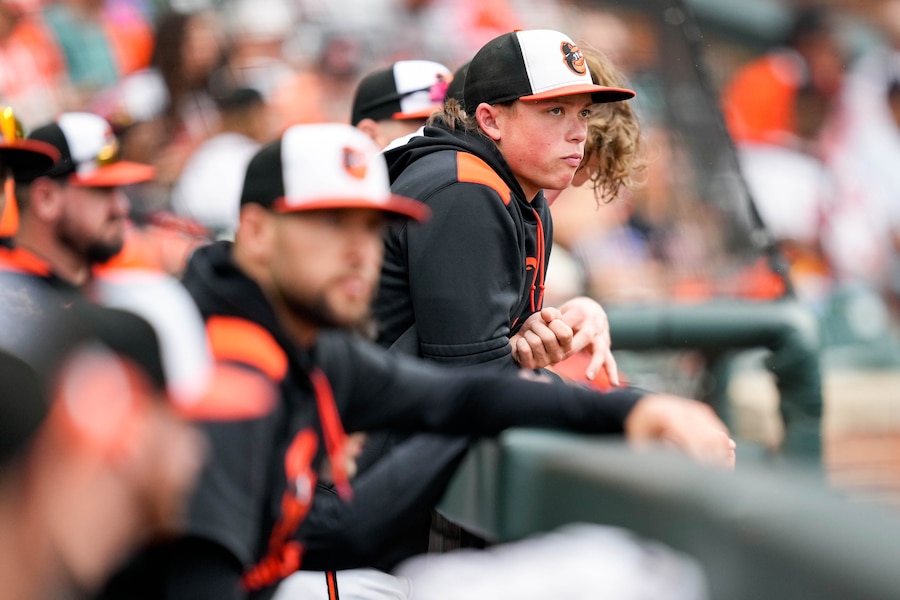
Jackson Holliday isn’t far removed from receiving a report card, so when he was asked to turn the task around and grade himself, he was fairly quick with the assessment. The 21-year-old, standing in the visiting clubhouse at Yankee Stadium during the last series of the Orioles’ season, settled on a middle-of-the-road evaluation.
“I’d probably give myself a C,” said Holliday, who then succinctly summarized the volatility of his first full major league season. “I’ve learned a lot and obviously had some pretty good moments in the season and struggled at the same time.”
That does not come as a shock, considering the results of many young players establishing themselves at the highest level. But when said player is the first overall pick from the 2022 draft — and the son of a seven-time All-Star — the expectation, whether fair or not, is to earn a higher grade.
So as Holliday put together a season that was equal parts impressive and disappointing, his interim manager, Tony Mansolino, attempted to account for every variable when deliberating on his own analysis of the infielder.
“That ceiling that was put upon him when he was drafted is unrealistic,” Mansolino said at the end of September. “Is he going to get there? He might. I don’t think you can put that ceiling on anybody. I don’t think that’s fair. But if there is a kid with the mental fortitude and makeup to handle it, it’s Jackson.”
What Mansolino means is that Holliday may be deserving of his C-grade now. But he won’t be forever.
“He’s going to get there,” said Mansolino. “It might not be as fast as the public wants him to, but he’s going to get there soon.”
Mansolino is not expected to return next season to see it now that the Orioles have hired Craig Albernaz to manage the club.
The positives for Holliday start with the 17 home runs. He also swiped 17 bases, although he was caught stealing 11 times as part of the trial and error in developing a more aggressive approach on the basepaths. Holliday also drew 56 walks, the second most on the Orioles, and he became one of six players in Baltimore’s history to record 21 or more doubles at age 21 or younger.
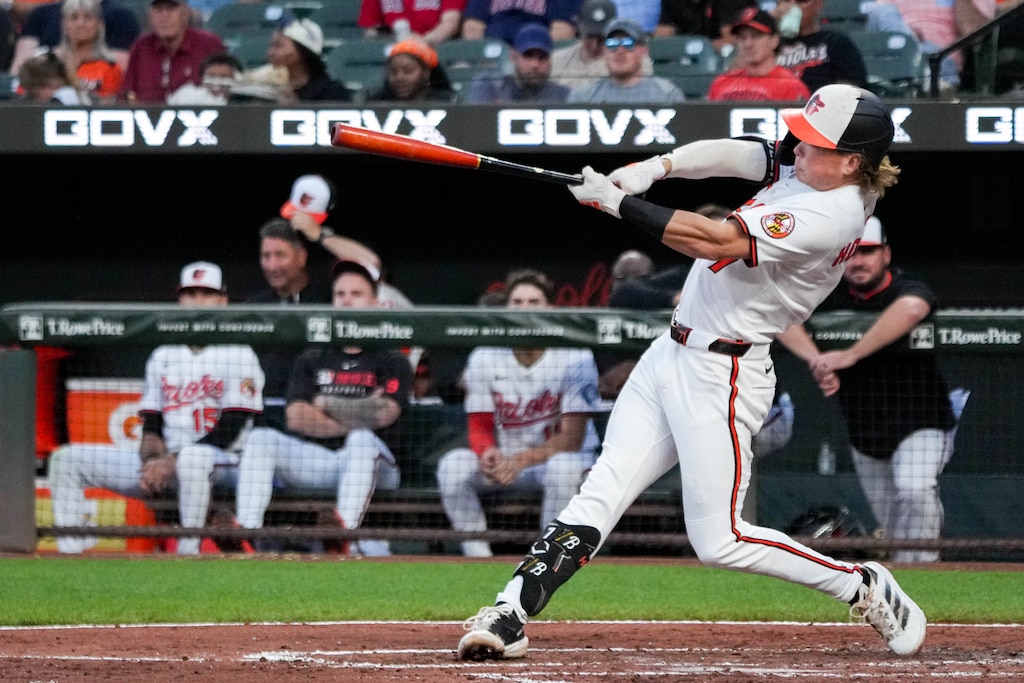
Orioles second baseman Jackson Holliday connects with a pitch in the third inning against the Boston Red Sox on Aug. 25. (Ulysses Muñoz/The Banner)
Those marks, when standing alone, shine a positive light on what Holliday produced in 2025. The other side of the coin is not so bright, however.
Even with 17 home runs, Holliday’s on-base-plus-slugging percentage in 149 games was just .690. He drew walks, but Holliday still struck out at an elevated clip, producing a team-high 140 of them. And much of the time, the contact Holliday made was weak. His average exit velocity of 88.8 mph ranked in the 30th percentile.
Holliday also struggled against fastballs, with a .220 average against four-seamers and a negative-8 run value (a Statcast metric that measures how much production a player creates at the plate based on various outcomes, such as hits and walks).
That is all before dissecting his defense at second base.
“I’m excited to improve next year and learn how to stay consistent, and that’s something that I’ll be thinking about a lot in the offseason, how I can perform the entire year opposed to a month here and there,” Holliday said.
So, again, he summarized his season justly: “Not bad, but not great.”
His defensive work at second base leans more heavily on the “not great” side of the spectrum, but he showed improvement there as well. Mansolino said that by the end of the season, he considered Holliday a top-10 double-play-turning infielder. The most obvious hitch in his game came when attempting to backhand balls.
When moving to his right, up the middle of the diamond, Holliday graded out poorly. He finished with a negative-12 outs above average rating, per Statcast, on balls to his right. That is the lowest of any qualified second baseman in Major League Baseball.
Overall, Holliday finished with negative-8 outs above average on all plays, which finished third worst.
“Oh yeah, still an area of focus, especially the backhand,” Holliday said.
Holliday recalled a conversation with former Oriole Brian Roberts about the transition from shortstop to second base. Roberts told Holliday that the backhand play up the middle gave him a “hard time” in his first full year of playing second in the big leagues.
“That gave me some good encouragement, because it is different from playing shortstop,” Holliday said. “But it’s been good to learn, play a whole year over there, play a whole year with Gunn [Gunnar Henderson], getting comfortable and just really building for next year.”
Shortly after Brandon Hyde was fired as manager in May, Mansolino vowed to emphasize Holliday’s development in what was already appearing to be a lost season. Gone were the platoon matchups; Holliday played just about every day, moving into the leadoff spot with the backing that a poor night wouldn’t lead to the bench.
In the long run, that may well prove to be the sink-or-swim experience necessary for Holliday to flourish — and maybe then he’ll grade himself out better than a C.
“What we’ve asked of this kid this year has been a lot, and I do feel like he’s answered in a lot of ways,” Mansolino said. “The stress on this season in particular, how it’s been here in Baltimore this year and just not meeting expectations as a team, the pressure and stress and everything and having to play every day and be a focal point, lead off and be in the middle of the field every single day — it’s a big ask for a 21-year-old kid.”