
The enduring agony of Trump 2.0 has been on full display this past month. Most of us can cite a litany of negative impacts from the regime’s actions and inactions. Many of us know people or are people whose livelihood and very lives are harmed by his actions. And based on the polls, the destruction of the White House East Wing has had a negative psychological impact on the majority of Americans.
Plenty more is yet to come from the guy the Supreme Court has given carte blanche to for taking the backhoe to fairness, justice, academic independence, what’s left of corporate accountability, access to and gathering of data, democracy, U.S. altruism, the economic well-being of the bottom 90%, and, of course, the environment. Indeed, it seems as if just about every federal department is now a department of war, undermining people and businesses that previously benefited from agencies’ missions to serve and protect.
On climate, most of the language and policies that have come from the regime since January stink like the environmental version of Secretary of Defense Pete Hegseth’s tough-guy barroom lecture to the generals and admirals last month. Trump’s pick for Secretary of Energy, former fracking CEO Chris Wright, chose five notorious, longtime climate science critics to deliver a deeply fallacious report that challenges the work of thousands of climatologists, doing so in a way that mirrors Hegseth’s ignorant arrogance before the military brass. And Trump himself told the U.N. General Assembly last month that climate change is “the greatest con job ever perpetrated on the world.” If that were true, he’d be jealous someone else got the crown.
But while his regime fires environmentally oriented staff, kills grants, sabotages programs, and stops gathering data, there has been a general retreat elsewhere, too. Only about a third of the signatories of the Paris Agreement had provided their updated pledges to reduce greenhouse gas emissions by the deadline last month. Corporations are also retreating on climate. As are consultants.
Crossposted from The Journal of Uncharted Blue Places
You can also find me at meteorblades.bsky.social
As John Kostyack, a senior fellow at the Center for Energy and Environmental Analysis, posted on Bluesky about energy consultant Wood-Mackenzie’s Energy Transition Outlook 2025-2026:
Last year Wood MacKenzie said that “decisive action” is needed to achieve net zero emissions by 2050. Today it’s promoting its “AI-powered analysis” to help the oil industry “unlock hundreds of billions of barrels of additional supply.” It even has a catchy marketing slogan: “Every Last Drop.”

Using AI for recovery enhancement would produce an extra trillion barrels of oil, according to WoodMac. Based on Environmental Protection Agency data, the extraction, refining, and combustion of a single barrel of oil generates, on average, 1,080 pounds of carbon dioxide and methane emissions. Times a trillion.
This the consultancy proposes, even as it finds the world currently on track for about 2.6 °C (4.7°F) of warming under current trends. That would be disastrous. Emissions from that trillion extra barrels of oil would not help cool the planet.
The transition Outlook posits four scenarios — a Base Case, Country Pledges, Net Zero by 2050, and Delayed Transition — showing that the global shift to low-carbon energy remains too slow to meet climate goals.
Fossil fuels will, it predicts, still dominate most energy mixes through 2030–2040, with oil demand peaking around 2032. Electricity demand doubles by 2050 as renewables rise from 20% to roughly 60% of generation. Even so, global investment must climb to nearly $4 trillion annually to align with a 2°C (3.6°F) pathway. That works out to about 3.3 % of world gross domestic product.
The report stresses energy security, cost, and geopolitics as major barriers. Delays in the transition could push oil and gas demand higher for decades, requiring more upstream spending. Clean-tech deployment—solar, wind, hydrogen, carbon capture — must accelerate dramatically.
Geopolitics, indeed. As WoodMac notes, “Global cooperation on climate finance and technology remains elusive. No major country and only a handful of smaller nations are on track to meet their 2030 emissions targets.”
Meanwhile, as reported by The Guardian today:
The 2025 edition of the Lancet Countdown on Health and Climate Change was led by UCL in collaboration with the World Health Organization and produced by 128 experts from more than 70 academic institutions and UN agencies.
In the past four years, the average person has been exposed to 19 days a year of life-threatening heat and 16 of those days would not have happened without human-caused global heating, the report says. Overall, exposure to high temperatures resulted in a record 639 [billion] hours of lost labour in 2024, which caused losses of 6% of national GDP in the least developed nations.
The continued burning of fossil fuels not only heats the planet but also produces air pollution, causing millions of deaths a year. Wildfires, stoked by increasingly hot and dry conditions, are adding to the deaths caused by smoke, with a record 154,000 deaths recorded in 2024, the report says. Droughts and heatwaves damage crops and livestock and 123 million more people endured food insecurity in 2023, compared with the annual average between 1981 and 2010.
But these guys don’t see the problem with going after every last drop.
—Meteor Blades
WEEKLY ECO-VIDEO
Green Oceans group may not be so green.
GREEN BRIEFS
Canary Media publishes a weekly chart. Here’s the latest
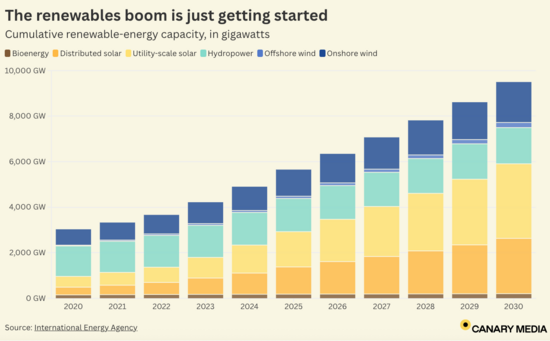
From Dan McCarthy at Canary:
Between 2025 and 2030, the world is expected to build nearly 4,600 gigawatts — or 4.6 terawatts, if you please — of clean power, according to a new report from the International Energy Agency.
That’s nearly double the amount built over the previous five-year period, which was in turn more than double the amount built across the five years before that. Put differently, the growth has essentially been exponential.
Related:
UN: World’s Emissions NOW SLATED TO FALL 10% by 2035. not nearly enough
For the first time, the United Nations has forecast a drop in greenhouse gas emissions—10% lower in 2035 that they were in 1990. A decline is certainly good news. Just one problem: That predicted drop is based on country pledges, and those pledges aren’t all being met. Plus, it’s not a 10% reduction but rather 60% that climatologists have told us we need to make by 2035 if we’re to have any chance of keeping warming at or below 1.5°C (2.7°F) by century’s end. A growing number of scientists think we’re on a warming trajectory that will see temperature rise nearly double that by 2100. If that happens, the impacts will be cataclysmic.
Simon Stiell, executive secretary at the UN Framework Convention on Climate Change, said on Tuesday, “Humanity is now clearly bending the emissions curve downwards for the first time, although still not nearly fast enough. We have a serious need for more speed.”
However, while many scientists believe climate change is accelerating, while many nations around the world have backed off from previous goals in the face of green backlash, much of its initiated or exacerbated by rightwing governments. Unlike the United States, however, most of them have not taken an actively hostile stance against renewable energy sources. In January, President Donald Trump began the year-long withdrawal process from the 2015 Paris Agreement. It’s the second time he’s done so, having taken the same lame, greed-spawned, counterproductive, China-boosting path in his first term.
Earlier this week, the UNFCCC released its annual NDC Synthesis Report 2025. This evaluates the impacts of nations’ National Determined Contributions toward greenhouse gas emissions under the Paris Agreement. These are meant to be updated every five years, but of the 197 signators of the agreement, only 64 submitted NDC updates by the Sept. 30 deadline.
In a written statement, Melanie Robinson, the global climate, economics and finance program director at the World Resources Institute, said: “This report lays bare a frightening gap between what governments have promised and what is needed to protect people and planet. While the transition to a low-carbon economy is underway, it’s clear that countries need to shift from a jog to an all-out sprint.”
—MB
Related:
GREEN QUOTE
“One can see from space how the human race has changed the Earth. Nearly all of the available land has been cleared of forest and is now used for agriculture or urban development. The polar icecaps are shrinking and the desert areas are increasing. At night, the Earth is no longer dark, but large areas are lit up. All of this is evidence that human exploitation of the planet is reaching a critical limit. But human demands and expectations are ever-increasing. We cannot continue to pollute the atmosphere, poison the ocean and exhaust the land. There isn’t any more available.” —Stephen Hawking
HALF A DOZEN OTHER THINGS TO READ (OR LISTEN TO)
A Hostile Trump Administration Has Put Offshore Wind Into Reverse by Andrew S. Lewis at Yale 360. Optimism about the future of U.S. offshore wind has collapsed since President Trump, a vehement critic of the industry, returned to office in January. In the ensuing nine months, his administration has accelerated the end of federal tax credits for wind development, imposed tariffs on turbines and other needed parts, and eliminated funds for building onshore port facilities for servicing wind farms. This has had a devastating effect on offshore wind, especially on the East Coast, where just two years ago some 30 utility-scale wind farm lease areas, spread across the continental shelf waters from Maine to South Carolina, were in the permitting and planning stages of development. According to a July 2024 report by the American Clean Power Association, investment in U.S. offshore wind projects was predicted to hit $65 billion by 2030. By 2050, the report said, the country could be generating 86,000 megawatts of offshore-wind-generated electricity, enough to power roughly 40 million homes. But analysts say the administration’s policies will lead to $114 billion in offshore wind investments being canceled or delayed.
Sowing Resilience: Nine stories about food insecurity in rural America. Ben Felder at Investigate Midwest introduces us to a timely series. Rural communities across the country are grappling with food insecurity. Schoolchildren, seniors, grocers and even farmers face a food crisis compounded by government cuts and soaring costs. These nine stories reveal how communities are navigating — and reimagining — the systems that have left them hungry.This series, called Sowing Resilience, is a collaboration between the Institute for Nonprofit News’ Rural News Network and The Associated Press. Nine nonprofit newsrooms were involved: The Beacon, Capital B, Enlace Latino NC, Investigate Midwest, The Jefferson County Beacon, KOSU, Louisville Public Media, The Maine Monitor and MinnPost. The Rural News Network is funded by Google News Initiative and Knight Foundation, among others.
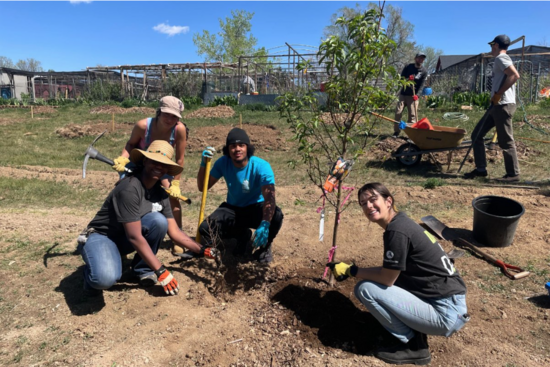
Denver Urban Garden staff and volunteers plant a peach tree alongside a silver buffalo berry, a nitrogen-fixing plant, at the Living Light of Peace Food Forest in the Denver suburb of Arvada.
Denver’s Food Forests Provide Free Fruit While Greening the Environment by Riley Ramirez at Civil Eats. The urban tree canopy in Denver is one of the sparsest in the country. In 2020, when Linda Appel Lipsius became executive director of the decades-old Denver Urban Gardens network, which oversees more than 200 community vegetable gardens throughout six metro Denver counties, she wanted to continue increasing community access to fresh food—a longtime goal of the garden program. But she had another aim, too: increasing the city’s tree coverage.“Trees are so beneficial for mental health, neighborhood security, and certainly temperatures. You walk off the street into one of our food forests and it’s five to 15 degrees cooler.” Appel Lipsius decided to build a system of food forests throughout the Denver area. These dense, layered plantings incorporate fruit-bearing trees with other perennials to mimic natural forests. Now, DUG oversees 26 food forests, with 600 or so fruit and nut trees and 600 berry bushes. While urban trees are recognized for their multiple benefits, including cooling and carbon drawdown, “there are not a lot of players in Denver, or even in most cities around the country, who are focused on food trees,” Appel Lipsius said.

Juan López, an environmental activist in Honduras, was shot dead in front of his family, friends and neighbors last year as he was leaving a religious service.
The political killings you don’t hear about by Siri Chilukuri at Heated. Across the globe, standing up for the planet can be a death sentence—and the perpetrators are almost never held accountable. Many people in America consider Charlie Kirk’s murder a shocking, unprecedented act of political violence. But the reality is, activists across the world are brutally gunned down and disappeared almost every day for their political speech. They just don’t have Kirk’s power or platform. Take Juan López, an environmental activist from Honduras. He was shot dead in front of his family, friends and neighbors last fall as he was traveling home from church—six shots to the chest, one to the head. López had been fighting to protect the Carlos Mejía Escaleras National Park from iron oxide mining which has ravaged the area with pollution. Having faced years of prior threats and even jail time over his activism, López was supposed to be under special protection by authorities in Honduras. But those protections failed to materialize. Or take Alberto Ortula Cuartero, a vocal environmental activist from the Philippines. The local government leader was publicly gunned down last fall by a passing motorbike rider. He was murdered after testifying against the Tribu Manobo Mining Corporation, alleging they were working on a falsified permit for nickel exploration. Cuartero was known in his community for mobilizing people against nickel mining, which is poisoning water and farmland in the region. His killer remains unidentified.
The Coming Ecological Cold War by Nils Gilman at Foreign Policy. As the green transition gathers momentum, underpinned by Chinese technological prowess, a reactionary counter-bloc has already begun to coalesce—not around a commitment to liberal democracy or human rights, but to the continued extraction and political centrality of hydrocarbons. Call it the axis of petrostates: a nascent coalition of states—notably, the United States, Russia, and Saudi Arabia—whose economic models, geopolitical power, and civilizational narratives are inextricably tied to fossil fuels. Each of these countries is responding to the decarbonization agenda not as a technical challenge to be managed, but as an existential threat to be resisted. At first glance, these countries differ in regime type: The Trumpified United States remains formally democratic (though increasingly authoritarian), while Russia is a post-Soviet autocracy, and Saudi Arabia is a near-absolute monarchy. Though all are authoritarian, what unites them is not political form, but a shared vision of national sovereignty that subordinates environmental constraints to national identity, economic primacy, and civilizational pride. Each rejects the premise that climate imperatives should dictate economic or political reordering. In their shared rejection of the green transition, they are forming not merely an economic alignment, but also a reactionary ideological bloc—one rooted in ethnonationalism, energy dominance, and revanchist nostalgia.

Simpler Solar Regulations Would Save Americans $1.2 Trillion by Alexander C. Kaufman at Heatmap. Liberty-loving Americans are prone to poke fun at the bureaucratic nightmares Australians and Germans face when attempting to do just about anything. But try installing solar panels on your roof in the U.S. Americans pay a median price of $28,000 for a 7-kilowatt system. The typical Australian, meanwhile, spends just $4,000, and the German — after filling out a mere two-page application — pays $10,000 per project. How is this possible? Blame state and local governments, and even homeowners associations, for holding back Americans from generating their own carbon-free electricity from the sun with onerous permitting regimes, inspection requirements, and interconnection processes. It doesn’t have to be this way. A new analysis by the research group Permit Power, shared exclusively with Heatmap, outlines a path toward slashing the red tape.The nonprofit, which advocates for fewer restrictions on renewables, proposed that states adopt several policies already popular in other countries. Those include adopting software that will allow for virtually instantaneous permitting of solar and battery projects, allowing for remote inspections verified via photos or video submitted online, and automatic grid interconnections for residential systems that use smart inverters that manage voltage and frequency to keep energy flowing safely back and forth onto power lines.
WEEKLY BLUESKY POST
x
A bunch of people from the forestry industry replying to or quoting this post along the lines of, ‘Don’t believe your own senses, plantations of alien trees are actually great.’
My response?
“It’s hard to get a man to understand something when his salary depends on his not understanding it.”
— Eoghan Daltun 🌍 (@irishrainforest.bsky.social) 2025-10-29T15:50:56.819Z
ECOPINION
If AI Knows the Planet Is Dying, Why Can’t It Tell Us Who’s Drowning? by David Sathuluri at Common Dreams. A technological revolution is underway. Artificial intelligence now processes vast satellite datasets to deliver near-real-time indicators of Earth’s health. Initiatives from the Potsdam Institute and Stockholm Resilience Centre envision leveraging the latest satellite data and AI to create enhanced Earth monitoring systems, where machine-learning algorithms track carbon dioxide emissions, detect deforestation as it happens, and flag ecosystem stress long before human eyes register the crisis. AI promises faster, more precise environmental intelligence than ever before. But there is a troubling blind spot in this approach. These powerful systems can quantify atmospheric CO2 down to decimal points, yet they cannot capture which communities suffer first when planetary boundaries break. They report that 22.6% of global land faces freshwater disturbance in streamflow, yet satellite dashboards remain silent on who lacks safe drinking water. They classify aerosol loading as within “safe” global limits even as monsoon disruptions devastate millions of farmers. Precise metrics obscure systemic inequities.

Bill Gates
7 New Takes From Bill Gates on Climate ‘Doomsday’ Talk and Global Health, an interview conducted by Robinson Meyer at Heatmap. Why he says innovation is the key to solving climate change: “The thesis I had was that middle income countries — who were already, at that time, the majority of all emissions — would never pay a premium for greenness. And so you could say, well, maybe the rich countries should subsidize that. But you know, the amounts involved would get you up to, like, 4% of rich country budgets would have to be transferred to do that. And we’re at 1% and going down. And there are some other worthy things that that money goes for, other than subsidizing positive green premium type approaches. So the thesis in the book [How to Avoid a Climate Disaster, published in 2021] is we had to innovate our way to negative green premiums for the middle income countries.” Where he differs with climate activists: Climate [change] is an evil thing in that it’s caused by rich countries and high middle-income countries and the primary burden [falls on poor countries]. When I looked into climate activists, I said, Well, this is incredible. They care about poor countries so much. That’s wonderful, that they feel guilty about it. But in fact, a lot of climate activists, they have such an extreme view of what’s going to happen in rich countries — their climate activism is not because they care about poor farmers and Africa, it’s because they have some purported view that, like, New York City, can’t deal with the flooding or the heat.
Look Out for These 8 Big Ag Greenwashing Terms at COP30 by Rachel Sherrington and Hazel Healy at DeSmog. Representatives from nearly every nation will gather from November 6-21 in Belém, a regional capital and gateway to the Amazon, with most countries far off target to deliver deep cuts to carbon emissions — the only way to halt the worst impacts of catastrophic climate change. Some food and climate groups hope this 30th annual Conference of the Parties (called COP30) summit can be a game changer for reforming food systems, which emit around a third of all a third of all greenhouse gases. After all, Brazil — which holds the presidency of COP30 — has a reputation for skilled diplomacy, and has made agriculture objective number three on the conference agenda. At home, President Luiz Inácio Lula da Silva has lifted millions out of hunger, and pledged to protect endangered ecosystems in the Amazon rainforest and Cerrado savannah. Brazil also has clout as the world’s eleventh largest economy, as well as an agriculture powerhouse where multi-billion-grossing beef and grain exporters rub shoulders with the state-supported family farms that produce most of the nation’s food. But advocates for ambitious food system transformation will have their work cut out in Belém, where they will run up against entrenched opposition led by Brazilian agribusiness, which has been preparing its lines of attack throughout 2025.

Abdul El-Sayed
Abdul El-Sayed on Climate Complexities and Benevolent Masculinity, an interview conducted wtih the candidate by Daniel Waite Penn at Drilled. An excerpt:
Abdul El-Sayed: One of the hard parts of the climate crisis is that it’s like a really challenging problem to clearly connect cause and effect, and that’s because it exists because of a whole system of energy production in which any of our participation is really actually quite small, but exists at a level that’s higher than us, which is the level of the factory that burns stuff that comes out of the ground to heat and provide energy for our homes. And then it happens on a time horizon that’s not direct in the sense that a lot of what we’re experiencing now is a function of things that happened five to 10 years ago, and then there’s a lot of money being spent to push back on a clear understanding of cause and effect. So like this is one of the knottiest problems to solve. And the problem with that is that people who want to actually solve the climate crisis too often fixate on emblems of that crisis that people have no actual connection to. So like for a long time the emblem was like starving polar bears.
Daniel Penny: Yeah.
El-Sayed: I’m not gonna like change my whole life around some polar bears, but the thing we ignore is that every moment that we’re releasing climate gases into the atmosphere, they’re being sieved through the lungs of our children. So you can see not too far from where I am right now, images of kids playing in a playground with a smoke stack right behind them. And we failed that in large part because, I hate to say it, for a lot of us who have the privilege to be insulated from those smokestacks, right? Like to me, the thing that is so pressing both about that smokestack and about climate change more generally is that these are gonna have profound impacts on the lives of people.
The imperative for the global community to save the Paris Climate Agreement by Shilu Tong and team at The Lancet. Considering the U.S. withdrawal from the Paris Agreement, other countries must intensify their efforts. The EU, China, and India can increase their emission reduction targets and accelerate their transition to renewable energy. We highlight four measures that need to be prioritized by the Intergovernmental Panel on Climate Change: 1) The reaction to the U.S. withdrawal must be to stand firm rather than follow suit, to have more ambitious targets, and to support each other in the means to reach them. This includes increasing ambition for adaptation financing to protect and promote health and well-being in the most vulnerable countries that contributed the least to climate change. 2) Political leadership on climate action needs to be established to address the urgency and build cohesion. We should not hold on to the belief that the USA will return in 4 years because we do not have enough time. 3) An integrative approach is needed to protect the natural environment. The three major global crises—climate change, biodiversity loss, and environmental pollution (e.g, microplastics and emerging chemicals)—should be tackled in an integrated and coordinated way. 4) International cooperation is a key to achieving the 1.5°C (2.7° F) goal, as global warming will probably worsen other environmental problems. Low-income and middle-income countries must be included in these international efforts because they have been affected most and will be increasingly impacted by climate change.

An Abrams tank fires during a test exercise
The U.S. Military Is Destroying the Planet Beyond Imagination by Abe Asher at Jacobin. The U.S. military is a behemoth that covers nearly the entirety of the planet, and the extent of the damage it is doing to the environment is difficult to comprehend. The military emits more carbon pollution than any other single institution and, depending on which estimates you trust, more than a vast number of countries in their entirety. As the world continues to hurtle toward climate disaster, the military is disproportionately responsible. Earth’s Greatest Enemy, a new documentary project from journalist and activist Abby Martin, makes sure you won’t forget it. Martin, host of The Empire Files, has long been an outspoken critic of American imperialism and US militarism. Around 2020, however, Martin’s focus shifted: she and her co-director, Mike Prysner, had a baby and began worrying about the future and the climate catastrophe threatening it: “What would it be like when our son is our age?” Martin asks. The new parents made the link between the war machine they’d spent their professional lives opposing and the climate crisis threatening their son’s future. The result is a film that interrogates the American military’s disregard for the environment and culpability for its destruction — not only in a macro sense but also in individual towns, cities, and ecosystems all over the world.
The 21 Republicans Who Flouted Their Voters’ Wishes on Clean Energy by Aaron Regunberg at The New Republic. Back in March, as the GOP drafted President Trump’s One Big Beautiful Bill, 21 House Republicans sent a letter to the chairman of the House Ways and Means Committee urging him to preserve the Inflation Reduction Act’s clean energy tax credits. The letter argued that the Biden-era credits were already helping to “increase domestic manufacturing, promote energy innovation, and keep utility costs down.” On July 3, every one of those 21 Republicans voted for the final version of the legislation, which eviscerated those credits. I was curious how these representatives would justify their votes, so I asked them. Only one member, Don Bacon of Nebraska, got back to me. He pointed to the OBBB’s nuclear and biofuels provisions, admitted he didn’t get all he wanted on wind and solar, and explained that he “had to weigh the bill in its entirety” because “in the end, America needed the tax rates for individuals to become permanent.” Translation: Decreasing domestic manufacturing, undermining energy innovation, and raising utility costs is just the price you pay for cutting taxes for millionaires and billionaires.
RESEARCH & STUDIES
Earth has hit its first climate tipping point, scientists warn. A team of international climate scientists at the Alfred Wegener Institute, Helmholtz Center for Polar and Marine Research at Goethe University Frankfurt warns that saving many tropical coral reefs from destruction caused by rising ocean temperatures will now require extraordinary effort. The researchers also conclude that some regions of the polar ice sheets may have already crossed their tipping points. If this melting continues, it could cause irreversible sea level rise measured in several meters. The study, included in a chapter of the Global Tipping Points Report 2025, was authored by Nico Wunderling, a professor of Computational Earth System Sciences, and his colleagues.
Electric vehicles outperform gasoline cars in lifetime environmental impact researched by Pankaj Sadavarte of Duke University and colleagues, and published by PLOS Climate. After two years of use, lithium-ion battery electric vehicles result in a reduction in cumulative carbon dioxide emissions compared to fossil-based internal combustion engine vehicles,
Multi-century global and regional sea-level rise commitments from cumulative greenhouse gas emissions in the coming decades researched by Alexander Nauels et al. and published by Nature Climate Change. Sea levels respond to climate change on timescales from decades to millennia. To isolate the sea-level contribution of historical and near-term greenhouse gas emissions, the researchers employed a scenario and modeling framework to quantify global and regional sea-level rise commitments of 21st Century cumulative emissions. Each additional ton of GHGs emitted in the coming decades locks in more multi-century regional sea-level rise.
Emissions reductions of rooftop solar are overstated by approaches that inadequately capture substitution effects researched by John E. T. Bistline & Asa Watten and published by Nature Climate Change. The researchers concluded that including effects like structure, scale, and policy context can lower the mitigation benefits of rooftop solar by 41–98% in a US case study.
Advancing sustainable agricultural transformation through the synergy of automated experimental platforms and living labs researched by Mattias Hoffman and published by Nature Communications. Transforming agricultural landscapes to be more sustainable and resilient requires integrated and multidisciplinary approaches. Linking automated experimental platforms with living labs can accelerate knowledge gain, enhance interdisciplinary collaboration, and support real-world change by addressing key challenges in current agricultural systems.
OTHER GREEN (AND NOT SO GREEN) STUFF