
Unlock the White House Watch newsletter for free
Your guide to what Trump’s second term means for Washington, business and the world
What do you think about wetlands? Once that was a question mostly just found in geography exams — or documentaries with the beloved biologist David Attenborough.
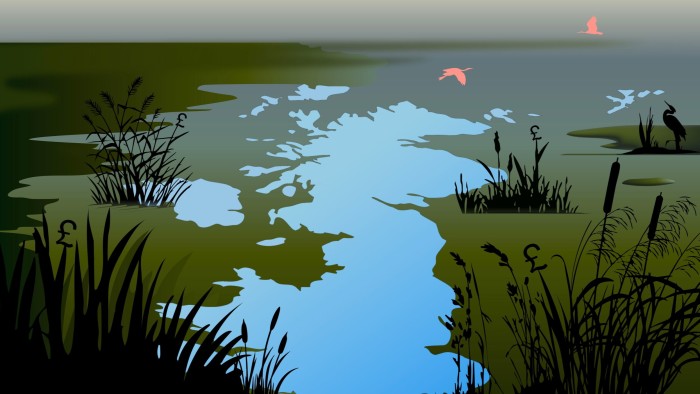
No longer. Next week, a public-private British group called FloodAction Coalition will urge investors to fund £1bn-worth of infrastructure for natural resilience. This is co-lead by Aviva, the insurance group, and The Conduit, a non-profit network, with three dozen companies such as UBS, the Crown Estate and Anglian Water.
Humble wetlands are central to this campaign, since expanding these can divert excess water from residential areas. This is badly needed since scientists reckon that flood risk has become so grave in the UK, due to climate change and poor planning, that it threatens 8mn households, and costs £6bn each year.
So, too, in continental Europe: weather events like the flash floods that killed over 230 in Spain a year ago are generating annual costs of €40bn, nearly triple a decade ago, FloodAction says. And in the US a quarter of all homes face weather threats, mostly flooding, say real estate groups. Last year, weather disasters cost $182bn.
Hence why building buffers — like wetlands — is now “an economic imperative”, says FloodAction. “Insurers are signalling that without stronger resilience measures some areas may become increasingly difficult to protect” — ie insure at all.
Will this campaign work? It is unclear. But it should be roundly welcomed, not least because it offers a sign of two bigger shifts needed ahead of November’s UN Climate Change Conference and US President Donald Trump’s shameful attacks on climate initiatives, science and data.
The first point is that the green movement needs to widen its focus beyond the carbon emissions issue — which activists such as Greta Thunberg focus on — to a more holistic message about biodiversity.
Biodiversity and global warming problems are tightly entwined; so much so that it is odd the UN holds two separate summits each year to discuss them.
Right now there is also a strong political imperative to focus on biodiversity. The topic has more bipartisan support, since while right-wing groups tend to hate net zero goals they seem more open to protecting nature. After all, it was a Republican (Richard Nixon) who first created the US Environmental Protection Agency. And while Trump is now gutting the EPA, he has previously championed tree planting.
The second key point is that green activists need to start talking more about adaptation (ie how to handle existing climate shocks), as well as mitigation (ie stopping them from happening).
After all, it is now tragically clear that the battle to keep global warming below 1.5C of pre-industrial averages has been lost, since countries such as the US and China are not cutting emissions as rapidly as needed.
“We have failed to avoid an overshooting above 1.5C in the next few years,” António Guterres, UN secretary-general, admitted this week, warning of “devastating consequences”. Indeed, Bill Gates predicted a rise of at least 2C in an open letter.
So “worsening extreme weather events are literally baked in for the next decade or more”, Mark Cliffe, an environmental economist, tells me. “Adaptation is therefore essential.”
Green activists and investors have hitherto given surprisingly little focus to adaptation compared to mitigation. That is partly due to the Thunberg effect. But it also reflects fears that talking about adaptation might normalise global warming — and thus reduce pressure to act.
That is understandable. However, with Trump in office, more realism is needed. This seems to be starting to emerge. Next month McKinsey Global Institute will release its first major report on adaptation strategies to determine why rollouts have been so slow, Olivia White, its head analyst, says.
Allstate, the US insurance group, and the US Chamber of Commerce are calling for more infrastructure adaptation. “Each dollar not invested in disaster resilience today could result in up to $33 of lost future economic activity,” they write in a new report.
Gates is now urging green activists to focus less on “doomsday” warnings and more on efforts to create liveable habitats. “Every time governments rebuild [after disaster], whether it’s homes in Los Angeles or highways in Delhi, they’ll have to build smarter: fire-resistant materials, rooftop sprinklers, better land management to keep flames from spreading, and infrastructure designed to withstand harsh winds and heavy rainfall,” he notes. “It won’t be cheap, but it will be possible in most cases.”
Gates’ shift horrifies some green activists. But entrepreneurs are responding by launching high-tech adaptation. The FloodAction coalition represents a twist on this — albeit one based on old-fashioned land management techniques.
Let us hope wetlands can indeed be wondrous. If not, we are heading for more tragedies — and ever higher insurance costs.