
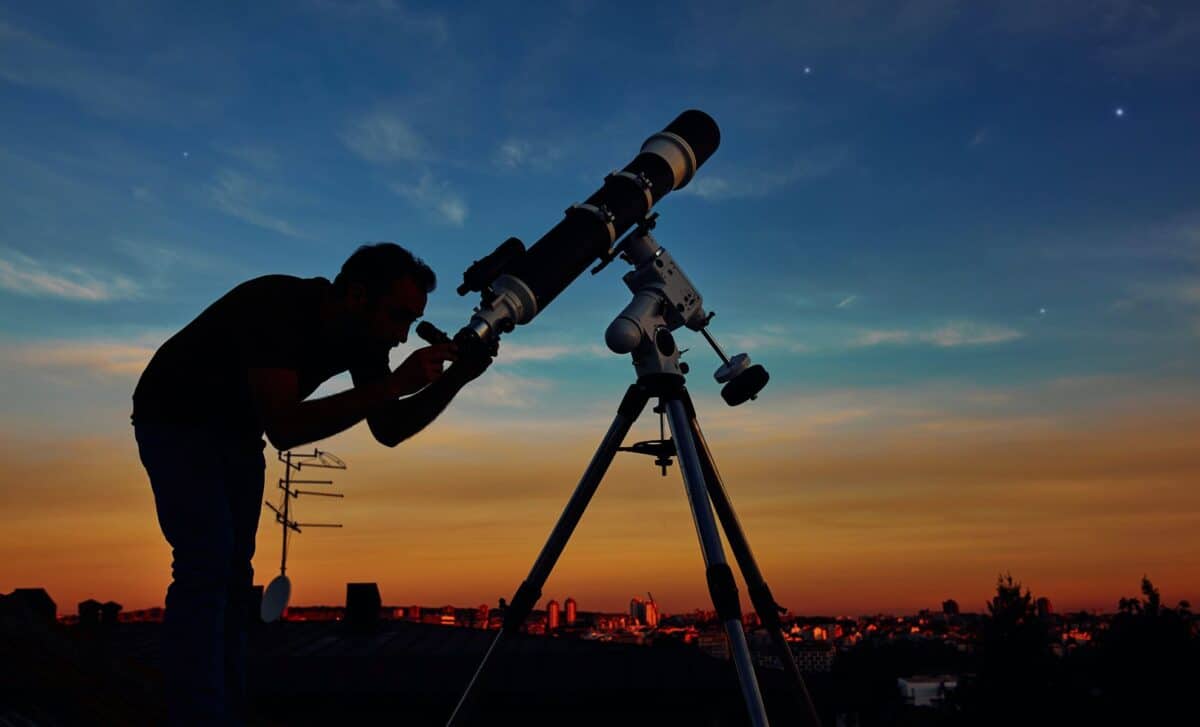
Skywatchers across the Northern Hemisphere have caught a fleeting glimpse of Mercury as it made one of its final visible appearances of the year. Appearing low on the southwestern horizon just after sunset, the smallest planet in the solar system offered a short-lived but striking show during its greatest elongation.
According to El Diario 24, Mercury’s display marks the last time in 2025 the planet will be seen shining brightly before disappearing behind the Sun. Despite being the closest planet to the Sun, Mercury rarely graces the evening sky with enough clarity to be easily seen. Its visibility is usually obscured by daylight or twilight haze.
That’s why these elongation events, where the the Sun’s closest companion appears furthest from the Sun from Earth’s perspective, draw attention from both amateur stargazers and professional astronomers.
Why Mercury Is Hard To See
As stated by El Diario, the viewing angle during the planet’s elongation was particularly steep this season, making the observation unusually difficult. As the Sun dipped below the horizon, Mercury remained just 10 degrees above it, dropping by about 3 degrees within thirty minutes. The ecliptic plane, which dictates the apparent path of the planets in the sky, currently forms a shallow angle with the western horizon during northern autumn, causing Mercury to appear lower and fade more quickly into twilight.
Complicating matters further, Mercury’s position 3° below the ecliptic made it even harder to spot under regular viewing conditions. Even in clear skies, the combination of low angle, dusk brightness, and short visibility window meant that only prepared observers with an unobstructed western view could reliably see the planet.
Mercury, the closest planet to the Sun & the smallest in our solar system, presents a myriad of contradictions. Bathed in scorching sunlight during the day and enduring bone-chilling darkness at night, its surface experiences tº swings that would melt lead and shatter steel. 1/ pic.twitter.com/x8aSgpYx0D
— Erika (@ExploreCosmos_) February 19, 2024
Mercury’s Orbit And Extremes Exposed
Despite its modest size, Mercury exhibits some of the most extreme surface and orbital conditions in the solar system. El Diario 24 reports that the planet reaches surface temperatures of up to 480°C at sunrise, dropping to 120°C by night due to its lack of atmosphere. During elongation, sunlight reflects off this volatile surface, giving Mercury a faint golden shimmer—especially when viewed beside Mars, which also featured briefly in the same sky segment.
Its rapid 88-day orbit is the shortest of any planet, and the tight proximity to the Sun typically keeps Mercury hidden. Only during these wide-angle elongations does it break free from the Sun’s overpowering glow. This brief appearance will come to an end by November, as the tiny world nearest the Sun descends to its original orbit behind the Sun.
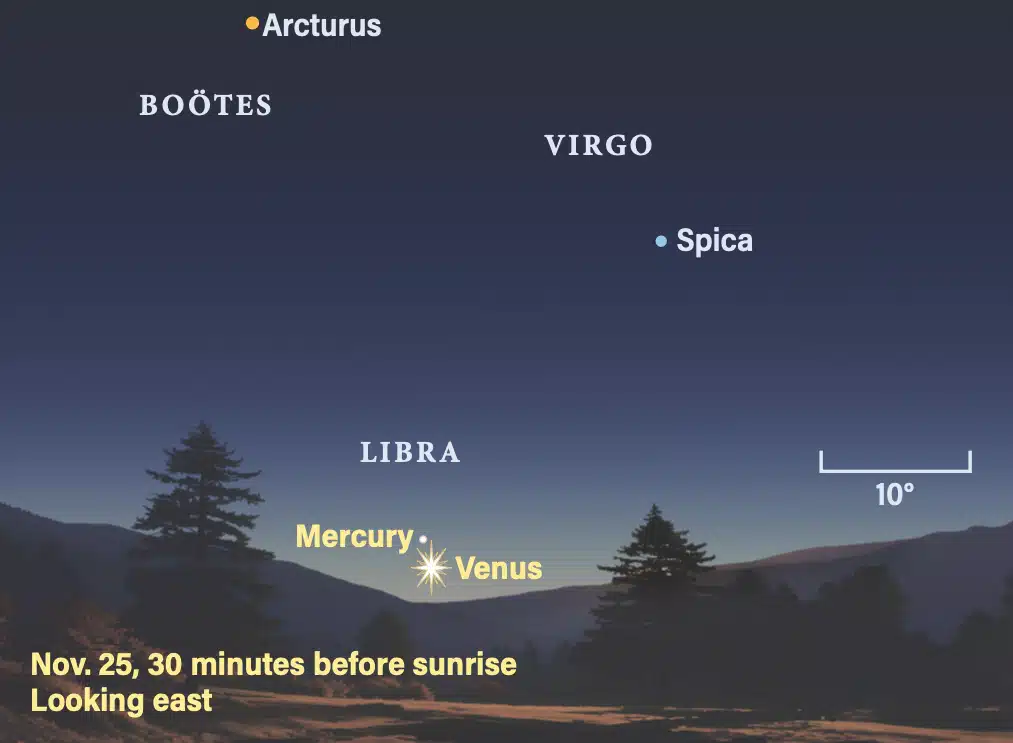 Mercury will reemerge in the eastern sky around November 25, 2025, about 30 minutes before sunrise. Credit: Astronomy/Roen Kelly.
Studying The Smallest Planet’s Moment
Astronomers value elongation events like this one as critical opportunities to study inner planet dynamics. According to the outlet El Diario 24, this angular separation allows researchers to examine the number one planet’s axial tilt, radiation exposure, and the gravitational forces at play in its orbit, data that can’t be easily gathered when the planet is lost in the solar glare.
These observations are essential for comparing the fast-orbiting world with other terrestrial planets, particularly those orbiting close to other stars. Since Venus and Mercury share the trait of orbiting closer to the Sun than Earth, both are only visible during twilight periods, an alignment that demands precise observation planning.