
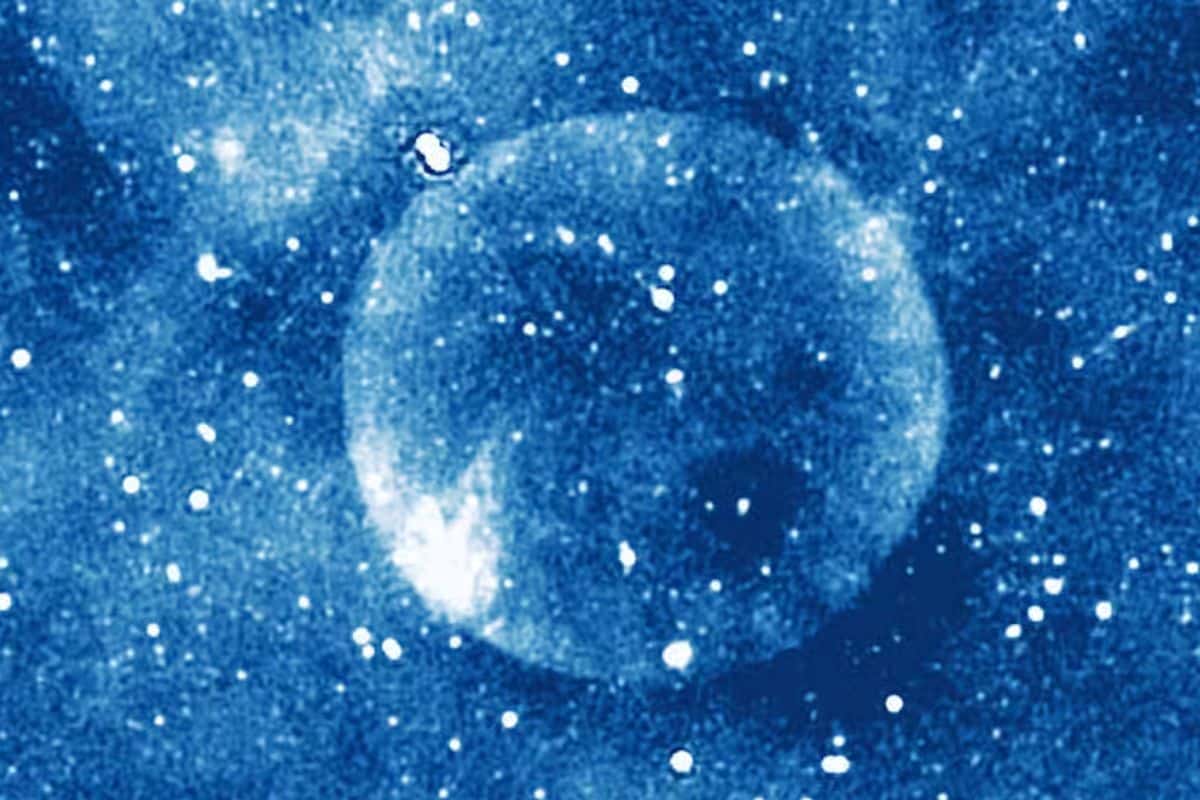
At the end of 2019, astronomers discovered strange objects in our sky. These surprisingly circular objects appeared in radio wave data. Odd Radio Circles, or ORCs, which researchers had linked to colossal explosions in galaxies billions of light-years away from ours. Since then, only a handful of these objects have been observed. And the discovery of one of these ORCs in our own Milky Way galaxy ultimately shook our certainties.
However, the object described today by researchers at the University of Western Sydney (Australia) in a study submitted to the Publications of the Astronomical Society of Australia may be puzzling, but it is not one of those “strange radio circles”. Astronomers are convinced of this, even though G305.4-2.2 also appears in the sky as an almost perfect sphere, visible only in the radio wave domain. They also rule out a number of other potential sources. From planetary nebulae – formed by stars at the end of their lives – to Wolf-Rayet bubbles – formed by gas released by the most massive stars in the universe. And even the Dyson sphere. Understand this as a megastructure built by an extraterrestrial civilization. This hypothesis has been ruled out due to the lack of infrared emissions detected inside the object.
The trail of the supernova remnant
After that, all that remained for astronomers to follow was the trail of the supernova remnant. To understand this properly, we must remember that when a star explodes in a supernova, it ejects a bubbleof matter that then expands into space and can be observed by astronomers with their instruments. These bubbles are called supernova remnants. They can take the form of shells, but are rarely truly spherical because the explosion is usually asymmetrically. Or because the interstellar medium in which the matter expands is rarely homogeneous.
G305.4-2.2, on the other hand, appears almost perfectly spherical. So much so that researchers immediately nicknamed it Teleios, from the Greek meaning “perfection”. For astronomers, this is puzzling. But they did not stop there. Using data collected by the Australian Square Kilometre Array Pathfinder (ASKAP), they were able to determine a few other characteristics of the strange object.
New observations to solve the mystery
The luminosity– which is quite low, incidentally – enabled them to estimate the distance between it and Earth. Either approximately 7,175 light-years. Or perhaps some 25,114 light-years. Astronomers have been unable to decide. And so they are left with the idea of a Teleios whose diameter should be either 46 or 157 light years. As the size of a supernova remnant is linked to its age, it could just as easily be less than 1,000 years old as more than 10,000 years old.
Having completed all their calculations, researchers at the University of Western Sydney describe the scenario of a Type Ia supernova remnant – which occurs when a white dwarf has absorbed enough matter from a companion to explode – as “more likely”. However, more direct evidence still needs to be found, which astronomers hope will come from new high-resolution, multi-frequency observations of the object. This is because the study of these remnants is important. They play an essential role in the evolution of galaxies, enriching the interstellar medium and influencing its structure and physical properties . So far, astronomers have identified only about 300, while they estimate that there could be more than 2,000 in our Milky Way alone…