
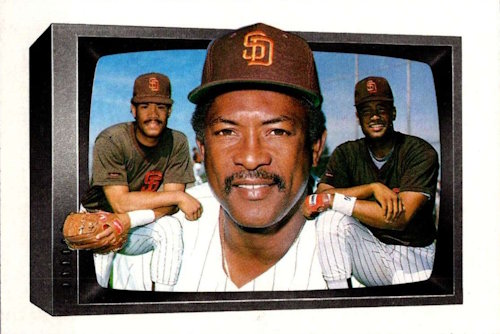
To more recent generations, Sandy Alomar Sr. is best known as the father of two All-Star ballplayers. If you know of Sandy Alomar before the “Sr.” was added to his name, you likely remember him as an All-Star major-leaguer in his own right. The elder Alomar played for 15 years in the majors and coached for many more. He died on October 13 at the age of 81, just 6 days shy of his birthday. Alomar played for the Milwaukee/Atlanta Braves (1964-66), New York Mets (1967), Chicago White Sox (1967-69), California Angels (1969-74), New York Yankees (1974-76) and Texas Rangers (1977-78). He later coached in the big leagues for the San Diego Padres, Chicago Cubs, Colorado Rockies and New York Mets.
Santos Alomar was born in Salinas, Puerto Rico, on October 19, 1943. He may have been the first of the Alomar family to reach the majors, but he was far from the only ballplayer in the family. Santos (who didn’t go by his Americanized name until later) was 16 years old when he signed a contract with Milwaukee Braves scout Luis Olmo, who signed his older brother Demetrio, 21, at the same time. In addition, brothers Antonio and Rafael played in the minor leagues, and a cousin, Ramon Conde, played for the 1962 Chicago White Sox as part of a lengthy professional career. Both Santos and Demetrio were signed to the Eau Claire Braves, but only the older brother actually played for the team. The younger Alomar was too young to play and spent the year at Class-D Wellsville, where he worked on his hitting and fielding abilities and assisted manager Harry Minor in the dugout. He didn’t make his debut as a pro player until 1961 with the Davenport Braves, when he was 17 years old. Alomar hit very well and batted .278, doubled 19 times and drove in 31 runs. The downside to his season came when he missed time due to an injured leg. Demetrio Alomar was moved to Davenport to fill his brother’s roster spot. When Santos was well enough to return to the roster, Demetrio was released and went back home to Puerto Rico.
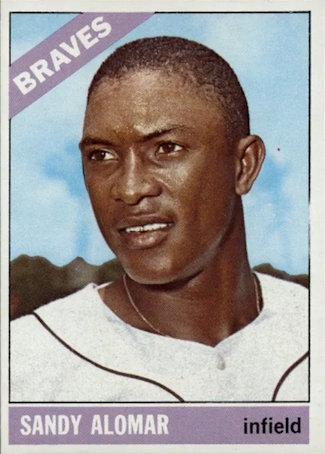
Alomar had very good speed and was a productive batter, though he lacked power. He moved up to Class-C Boise in 1962 and led the team with a .329 batting average. He also drove in 72 runs and scored 83 times, and his .411 slugging percentage was largely due to his 31 doubles and not his 3 home runs. The Braves played him exclusively as a shortstop, though he would spend time at almost every position on the field before his career ended. He was capable of being a brilliant fielder, though he was occasionally error-prone. He committed more than 60 errors at shortstop in 1962 with Boise and 1963 with Austin of the Texas League. However, his defense improved as he matured as a ballplayer. Alomar’s offense, on the other hand, played well at virtually every level. He hit .292 for Austin in 1963, with a career-high 5 home runs. He then moved up to Triple-A Denver in 1964 and hit .263 with 22 triples and 20 stolen bases. Alomar struggled through the first part of the season as a new switch-hitter before the Braves execs gave him permission to go back to hitting right-handed. Alomar hit so well that he was promoted to the majors in September, with manager Bobby Bragan putting him right into the lineup as the new starting shortstop. Denis Menke moved to second base and Frank Bolling moved to the bench to accommodate the newcomer. Alomar started both ends of a doubleheader against St. Louis on September 15, 1964. In his first major-league at-bat, he singled against Ray Sadecki, driving in Miguel de la Hoz from second base. He was his only hit in 3 at-bats, and he committed an error in 7 chances at shortstop. In the second game, Alomar struck out twice against Bob Gibson before he was taken out of the game. He played regularly through the end of the season and ended with a .245/.245/.264 slash line in 19 games. He didn’t draw a walk and had just 1 extra-base hit, a double, among his 13 base hits. But his defense was solid, and the Braves considered the 20-year-old a legitimate infield prospect.
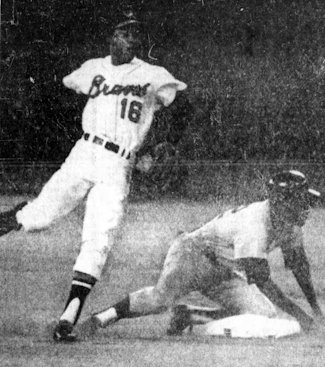 Sandy Alomar makes a throw to first during a Braves-Twins exhibition game. Cesar Tovar of the Twins looks on. Source: The Atlanta Constitution, May 3, 1966.
The Braves, though, never fully committed to Alomar. The team gave the bulk of the middle infield playing time in 1965 to Bolling, Menke and Woody Woodward. Alomar played for the Braves at the start and end of the season, spending most of July and August with the Atlanta Crackers of the International League. In 67 games for Milwaukee, he hit .241 and drove in 8 runs — 3 of them in one game against the New York Mets on May 19. His pair of run-scoring singles helped led the Braves to a 7-5 win. Despite the lack of playing time, Alomar managed to steal 12 bases in 17 attempts, and he was one of two Braves players with double-digit stolen base totals — Henry Aaron stole 24. He played even less in 1966, when the Braves moved to Atlanta. Alomar had 4 hits in 44 at-bats as a middle-infielder/pinch-runner, and he once against spent the bulk of the summer playing ball in Triple-A.
The young infielder then had a whirlwind 1967. On January 6, Alomar was the player to be named later in a deal that also saw pitcher Arnold Umbach and aging slugger Eddie Mathews headed to the Houston Astros for pitcher Bob Bruce and outfielder Dave Nicholson. He was then traded to the New York Mets on March 24 for utility player Derrell Griffith. Alomar started the season with the Mets and played a bit of second base, shortstop and third base, but he was hitless in 15 games and 22 at-bats. He was dispatched to the minors and then traded to the Chicago White Sox on August 15. Once again, he was the player to be named later in an earlier deal that sent third basemen Ken Boyer to the Sox and Bill Southworth to the Mets. Alomar joined his fourth major-league club of the year and celebrated by getting 3 hits in his first two games with Chicago. Those were his only hits of the season, as he sat on the bench for most of the rest of the season. He was the starting shortstop of the team’s final game of the year against Washington on October 1, he was 0-for-2 but drew his only two walks of the year and stole his only 2 bases. He ended up with 3 hits in 37 at-bats for an .081 mark. Things would improve for Alomar, but he later referred to 1967 as a nightmare and said he came close to quitting when the Mets sent him to the minor leagues. “And then I look at my four mouths to feed and one on the way, and I think that for one last chance Sandy will go to the minors,” he told the Los Angeles Times in a 1970 interview. Fortunately for Alomar and his growing family, his fortunes would turn.
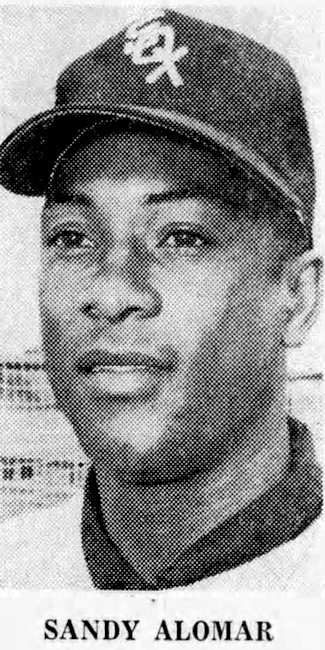 Source: Sarasota Herald-Tribune, June 21, 1970.
Now in his age 24 season, Alomar stuck with the White Sox for all of 1968 and never returned to the minors again, but it took some time for him to push his way into the starting lineup. He remained a pinch-runner and backup infielder until late June. On June 30, Chicago beat eventual world champs Detroit 12-0 behind the 5-hit pitching of Tommy John. The star of the game, though, was Alomar, who had 3 singles and a double in 5 at-bats, scored 4 runs and stole 3 bases. He drew a walk as well, and he accomplished all that while playing 5 innings at second base, 2 innings at third base and 2 at shortstop. He was a regular for the rest of the season, eventually securing second base as his primary position. In Alomar’s first four seasons in the majors, he had batted .190 in 144 games. In 1968 alone, he appeared in 133 games and slashed .253/.292/.287. He drove in 12 runs, scored 41 times and stole a team-leading 21 bases. He also led the AL with 18 errors at second base, which may explain why he opened 1969 as a part-time player. Alomar split time at second base with Ron Hansen before he and reliever Bob Priddy were traded to the California Angels in May for second baseman Bobby Knoop. The trade wasn’t popular with the Angels fans or players, as Knoop was a Gold Glove fielder, though not much of a hitter. Alomar was installed as the team’s leadoff hitter and second baseman. Alomar’s fielding didn’t compare well to Knoop, as he again led the AL with 23 errors for a .970 fielding percentage. But his bat began to heat up, and he even hit his first career home run on June 23, 1969, in his 334th major-league game. It was a leadoff inside-the-park homer against Minnesota’s Dick Woodson that started the Angels’ scoring in a 5-2 victory. Alomar got a little assist from Twins center fielder Tony Oliva, who briefly caught Alomar’s line drive before dropping it and kicking it to the center field wall. When asked when he knew the ball was a home run, Alomar said, “When I saw Oliva kick it the first time.” Alomar batted .250 for California to finish with a .248 batting average, and he stole a total of 20 bases.
If there were any concerns that the 5’9″ Alomar was too small to be a durable ballplayer, he put them aside by appearing in 162 games in each of the next two seasons, leading the American League in plate appearances in 1970 and ’71. He silenced critics of the Knoop trade by becoming an excellent second baseman. And any questions about his ability to hit in the majors were answered when he set an Angels team record with a 22-game hitting streak in 1970. Power never became a serious part of his game, but his speed and hit tool got him extra-base hits. He contributed to a 10-3 win over Milwaukee on June 29, 1970, with 4 hits that included a double and 2 triples. Alomar slashed .251/.302/.293 in ’70 and was named to his only career All-Star Game. He flew out in his only ASG at-bat and made a pair of assists as a late-inning replacement at second base. Alomar reached career highs in many offensive categories in 1971, with a .260 batting average, .321 slugging percentage, 179 hits, 24 doubles, 4 homers, 42 RBIs and 39 stolen bases.
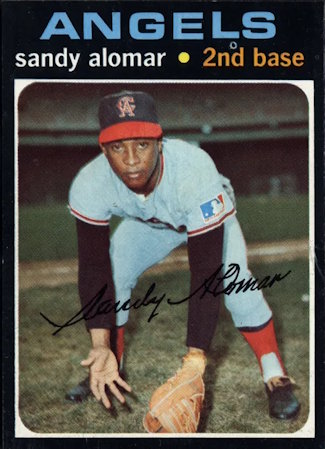
At one point, Alomar had a consecutive games streak of 648 games, the longest such streak in baseball at the time. That streak only counts his major-league games; he was a regular in winter ball in Puerto Rico, too. Angels manager Bobby Winkles finally rested Alomar in 1973, because the infielder’s productivity was starting to slip. He batted .239 in 1972 and was hitting under .200 when Winkles gave Alomar a few games off in June 1973. “The rest definitely helped,” Alomar said, as he singled twice, tripled once and scored twice in his first game back against Detroit on June 6. “I felt much stronger tonight. I was pressing before and trying extra hard. That only seemed to make things worse.” Alomar hit better over the second half of the season to finish with a .238 mark, but he slugged just .257 with 7 doubles and 1 triple in 136 games. His season came to an unfortunate end in mid-September when he broke his fibula in a collision with Chicago’s Jerry Hairston. Alomar recovered by the start of 1974, but he had lost his starting role. Denny Doyle, acquired from Philadelphia over the offseason, was the starting second baseman, and Alomar was a utility player and bench bat. After batting .222 in 46 games, the Angels sold his contract to the New York Yankees. His offense picked up with the new team, and he even had a 13-game hitting streak for the Yankees. He batted .269 for the team with good defense at second base, and he spent all of 1975 as a starter, too. His broken leg had recovered to the point that he was able to steal 28 bases, second-best on the Yankees after Bobby Bonds’ 30 steals. However, Alomar slashed just .239/.277/.305 in his final season as a regular. Willie Randolph joined the Yankees from Pittsburgh and took over second base for more than a decade. Alomar returned to a utility role in 1976 and batted .239 in 67 games. He also made the only postseason appearance of his playing career, getting into 2 games in New York’s 5-game victory over Kansas City in the AL Championship Series. He did not play in the World Series, where the Yankees were swept by Cincinnati. Alomar was traded to the Texas Rangers in February 1977 for infielders Brian Doyle and Greg Pryor and spent two seasons as a utility player there. In a total of 93 games with the Rangers, Alomar batted .250 with 1 home run while playing 6 different positions on the field. Texas released the 34-year-old Alomar at the end of 1978, which ended his playing career.
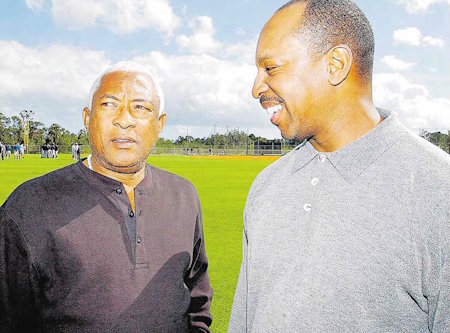 Sandy Alomar Sr. with Willie Randolph. The two were one-time Yankee teammates, and Randolph hired Alomar as his bench coach in 2005. Source: The Record, January 28, 2005.
Alomar spent parts of 15 seasons in the major leagues for 6 different teams. He had a career slash line of .245/.290/.288, and his 1,168 hits included 126 doubles, 19 triples and 13 home runs. He stole 227 bases, scored 558 times and drove in 282 runs. Alomar spent the bulk of his time on defense at second base, and he had a .977 career fielding percentage there. He also played 197 games at shortstop, 43 at third base, 14 at first base, 3 in right field and 5 in left field. He had a career OPS of .578, an OPS+ of 69 and, according to Baseball Reference, generated 10.5 Wins Above Replacement.
When Alomar first arrived in New York City in 1974, he told the Daily News that his wife, Maria, and children (daughter Sandia and sons Santos Jr. and Roberto) returned to Puerto Rico and visited him on weekends. Just as Alomar and his brothers had done, his children took to baseball at an early age. “The boys are crazy about baseball. Every year they live for the father-son game. They can play, too,” Alomar Sr. said. At the time, Sandy Jr. was 8 years old, and Roberto was 6. After he retired from the game, the Alomars returned to Puerto Rico, and Sandy Sr. coached and managed in the Winter League. His two sons both signed as amateur free agents with the San Diego Padres, made their way up the organizational ladder, and debuted in 1988. Alomar Sr. got to take part in the boys’ professional development, as he, too, signed with the Padres as a scout and minor-league coach. “I know I am their father, so naturally I am not going to say anything to hurt either of them, but to be honest, I consider both boys big league prospects,” he said in 1985, when all three Alomars were with the Class-A Charleston (SC) Rainbows. “I’m sure there are times when the others on the team think I’m favoring my sons, but truthfully, I don’t. They have to make it on their own. I think they can with the ability they have.” He also made sure to give credit to Maria, who cared for the children while their father was playing ball. “She watched them play every game,” Alomar Sr. said. “She is a great baseball fan. She would tell me what I was doing wrong, and she told the kids what they were doing wrong. I only put the name on them.”
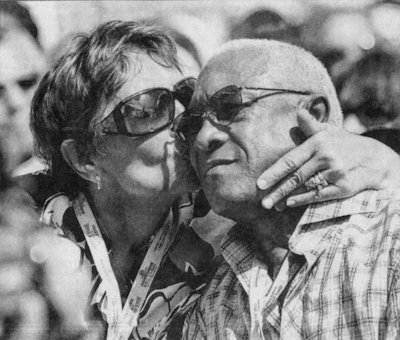 Maria and Sandy Alomar share a moment during son Roberto’s Hall of Fame induction speech in 2011. Source: The Daily Advertiser, July 25, 2011.
Both Sandy Jr. and Roberto went on to outstanding playing careers, with Roberto getting inducted into the Hall of Fame in 2011. Though they both debuted with the Padres, they found stardom elsewhere. Similarly, the elder Alomar returned to the majors as a Padres coach in 1986 and left the club in 1990 for other opportunities. He worked for the Chicago Cubs from 1991 to 2002, holding down a variety of roles that included a roving minor-league instructor, minor-league manager and big-league coach. He continued to manage in Puerto Rico during the winters, and his sons occasionally played for him. Alomar later coached for the Colorado Rockies in 2003 and 2004 and the New York Mets from 2005 to 2009. He initially was hired to be the bench coach for Willie Randolph, his former Yankee teammate. He also served as bench coach for Jerry Manual in 2009 and took over as manager on May 9 when Manual was serving a 1-game suspension. Alomar didn’t have to do too much, as the Mets offense piled on the Pittsburgh pitching staff to coast to a 10-1 win. The Mets shook up its coaching staff after the season and reassigned Alomar as manager of the Gulf Coast League Mets. The team finished 31-25 in 2010, but Alomar and pitching coach Hector Barrios were suspended for the final 2 games after an on-field argument. Alomar later spent several years as a consultant and special assistant for the Toronto Blue Jays.
Alomar’s influence was, most notably, shown in the careers of his two sons. However, his extensive career as a player and coach brought many players under his tutelage. Boston Red Sox manager Alex Cora, to name one, cited Alomar and Terry Francona as the two managers who influenced him the most. Cora played for him in winter ball and was taken aback when Alomar said, ‘The scoreboard is not for the fans. The scoreboard is for the players.’ “He’s like, ‘The scoreboard is going to dictate the way you’re going to play the game: tie game, up one, up two, the outs, the innings.’ That’s what he meant,” Cora said. “So I started watching that and started taking it into my game.”
Follow me on Instagram: @rip_mlb
Follow me on Facebook: ripbaseball
Follow me on Bluesky: @ripmlb
Follow me on Threads: @rip_mlb
Discover more from RIP Baseball
Subscribe to get the latest posts sent to your email.