
For nearly every person who visited her courtroom Wednesday to talk about dodging tear gas, being shot in the head with pepperballs while praying, and having to stare down the barrel of a gun, U.S. District Judge Sara Ellis had a similar question.
How did it affect them? Did they hesitate before protesting again? Did the experience “place a burden” on their faith?
Later, she interrupted a Justice Department lawyer who praised people for remaining courageous and steadfast in opposing the Trump administration’s deportation campaign despite those experiences.
“If they are making changes to what they do because they have been tear gassed, because they’ve been hit in the head with a pepperball — twice — because they’ve been staring down barrels of guns, then that is what matters,” Ellis said.
The judge made her comment hours ahead of a ruling she promised to hand down Thursday on whether to more permanently restrict the feds’ treatment of protesters and journalists in Chicago during the campaign known as “Operation Midway Blitz.”
An eight-hour hearing in her courtroom featured emotional testimony from witnesses who spoke of jarring encounters with armed federal agents, as well as sworn testimony by U.S. Border Patrol commander Gregory Bovino. And it revealed the ongoing disconnect over the level of danger faced here by federal law enforcement.
Decorum even broke down at one point, with Ellis being forced to take two opposing lawyers into a hallway amid a slew of objections that started when a federal agent was challenged to say whether he’d been out “looking for people with brown skin?”
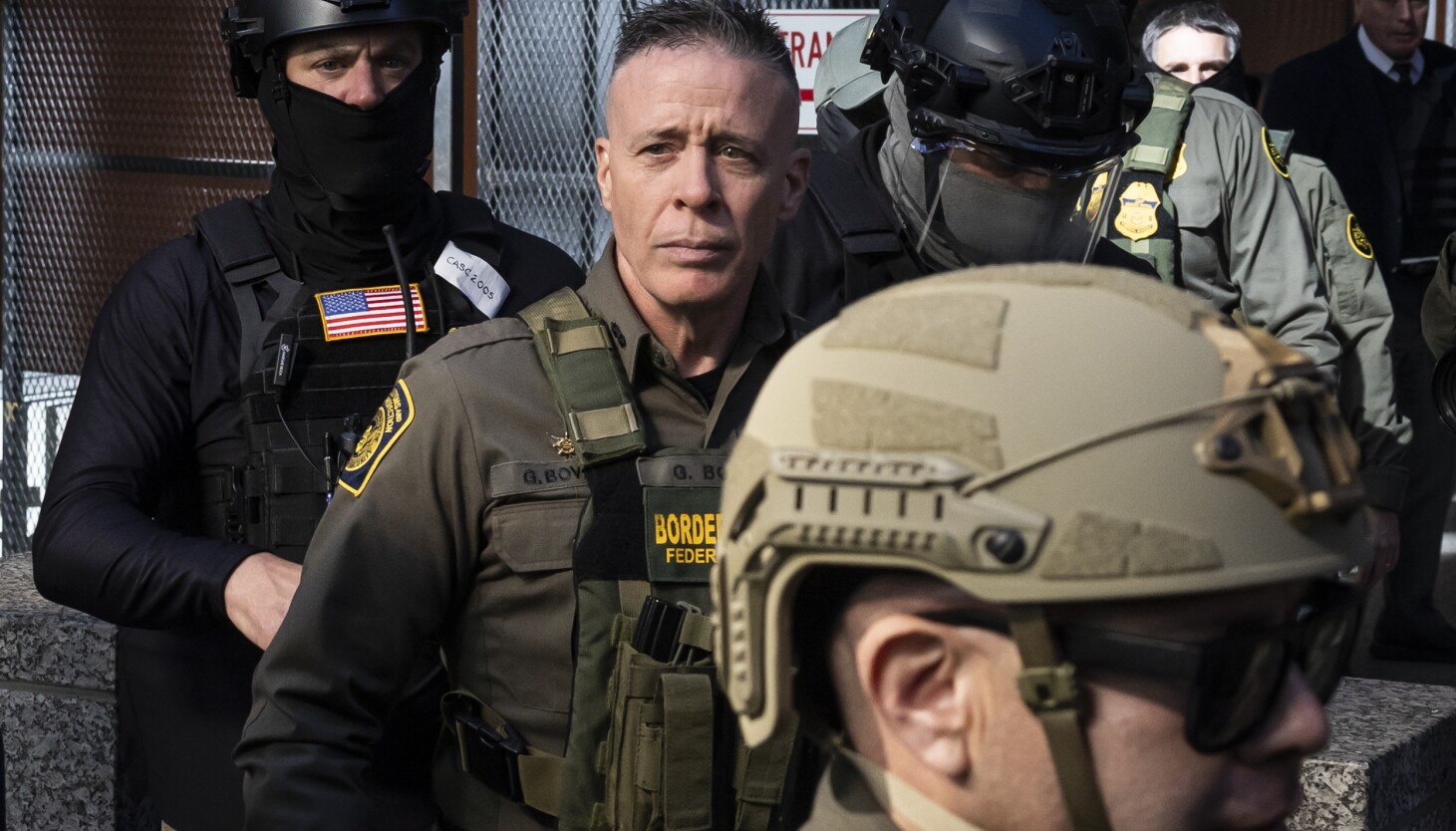
Bovino, in full uniform, testified on video that the use of force by federal agents in Chicago has been “more than exemplary.” He also testified he would have used more tear gas in Little Village last month if he’d had it. And he admitted that he threw it before he was purportedly hit in the head by a rock, contradicting earlier claims, lawyers said.

U.S. Border Patrol Commander-At-Large Gregory Bovino allegedly tosses tear gas into a crowd in Little Village.
Another U.S. Customs and Border Protection agent, Kristopher Hewson, downplayed the threat posed to people by tear gas. He denied that it’s a “serious” or “dangerous” weapon and said it “doesn’t harm people.”
Still, he later testified that agents properly arrested someone for kicking a tear gas can after it was thrown by agents because that’s “assaultive.”
Near the end of the day, lawyer Steven Art told Ellis the Trump administration defendants in the case “should be ashamed of themselves.”
“It’s a disgrace,” Art said of the way people in Chicago have been treated during Operation Midway Blitz. “And one of the great things about our Constitution is that, if that’s what we think, we can say it.”
Ellis previously forbade federal agents from using tear gas or other “riot control” weapons against people who pose no immediate threat and without two warnings during the immigration campaign. However, that order expires at 11 a.m. Thursday.
So Ellis says she will rule on a more permanent preliminary injunction at 10 a.m. Thursday. That ruling will almost certainly be appealed to the 7th U.S. Circuit Court of Appeals.
The appellate court last week found that Ellis infringed on the separation of powers by ordering Bovino to meet with her every weeknight over seven days to discuss agents’ actions in Chicago, and whether it complied with her orders.
Ellis presides over a lawsuit filed by media organizations such as the Chicago Headline Club, Block Club Chicago and the Chicago Newspaper Guild, which represents journalists at the Chicago Sun-Times.
It amounts to one of the most significant pieces of litigation at the Dirksen Federal Courthouse since the feds’ deportation campaign began. Judges there have also ruled against the Trump administration when it comes to National Guard deployment and conditions inside the U.S. Immigration and Customs Enforcement facility in Broadview.
On Wednesday, a judge issued a temporary restraining order in that case after hearing hours of testimony about unsanitary, “prison-like” conditions inside the facility. Meanwhile, Wednesday’s hearing in Ellis’ courtroom featured testimony about people’s aggressive encounters with federal agents around the city.
They included Leslie Cortez, an organizer for an environmental justice organization, who tried to film the arrest of a group of day laborers in early October. Eventually, she said an agent drew a weapon and pointed it at her. She said she could “see inside the barrel.”
Ellis asked how that has affected her.
“I get really nervous,” Cortez said. “Because it just feels like I’m not safe. And I question my safety when I go out … I just worry that something will happen to me.”
Ald. Julia Ramirez (12th) described an early October incident in Brighton Park that included angry protests. She said an “armored vehicle” that “looked very much like a tank” arrived with an agent “on top of that vehicle pointing their gun down at the community.”
Ellis asked if that’s caused a “chilling effect” on her willingness to protest. Ramirez, who is nine months pregnant, said she hasn’t participated in downtown protests because “I just feel like it’s too much of a risk for me.”
But some of the most compelling video played Wednesday came from the rooftop of the facility in Broadview on Sept. 19. The Rev. David Black could be seen with his arms outstretched as puffs of smoke erupted on the ground around him.
Black testified that he was praying and warning agents on the roof “of the spiritual consequences of their actions” when agents started firing pepperballs.
Black testified that he was hit seven times, including twice in the head. He also said he now carries a GPS tracker in case he’s confronted by immigration agents.
Justice Department lawyer Sarmad Khojasteh challenged Black on whether he’d stepped off the public sidewalk and over the property line. Ellis asked Black if it was fair to say his experience has “placed a burden” on his faith.
“Absolutely, yes,” Black told her.
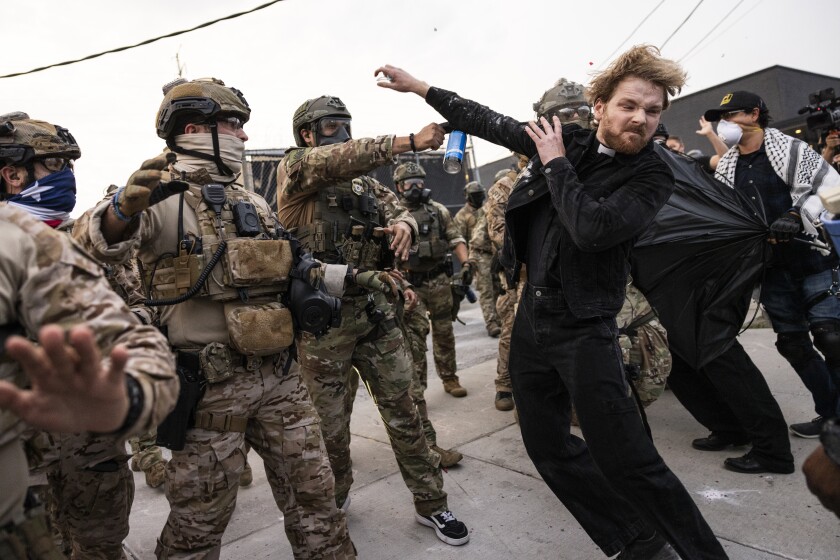
A federal agent sprays Rev. David Black, of the First Presbyterian Church of Chicago, as he and other protesters demonstrate outside the ICE facility in Broadview, Friday, Sept. 19, 2025.
The judge also heard from Jo-Elle Munchak of Edgewater, who video-recorded the detention of landscapers on Oct. 10. In the video, played in court, Munchak yells, “It’s almost like they’re stormtroopers or something! … Smile nice, boys, for the Hague!”
When she left the scene, she said agents followed in SUVs. She said they blocked her car, rushed her vehicle, and aimed a gun at her head.
She told Khojasteh the “stormtrooper” comment was a “Star Wars” reference. But when he asked if she believed agents were “akin to war criminals,” she said their methods are “cruel,” “draconian” and “step over the line.”
The most contentious moments came when plaintiff attorney Jonathan Loevy questioned Border Patrol agent Hewson. Loevy asked Hewson how the deportation campaign works in practice and whether “you’re looking for people with brown skin?”
“I have arrested many people of all skin colors,” Hewson insisted.
“When you are driving around looking for undocumented rapists and murderers, and you approach a brown-skinned guy walking his kids to school, do you … have an understanding that that might attract a crowd?” Loevy asked.
Hewson said he does not approach “people of brown skin walking their kids to school” and again insisted “I’ve approached all sorts of people.”
The exchange prompted a series of objections that led to Loevy and Justice Department lawyer Elizabeth Hedges being taken by Ellis out into a hallway. Later, Hedges had her own chance to question Hewson. He told her that “just putting your hands on somebody is not a use of force. Just grabbing on to them, and all that stuff, it’s just affecting arrest.”
Hewson also told the judge that he learned of Ellis’ original temporary restraining order, or TRO, “right when it was implemented” in October.
“Everything I have done, and my team has done, has abided by the TRO from the get-go,” he said.
Neither the reporter nor editors who worked on this story — including some represented by the Newspaper Guild — have been involved in the lawsuit described in this article.