
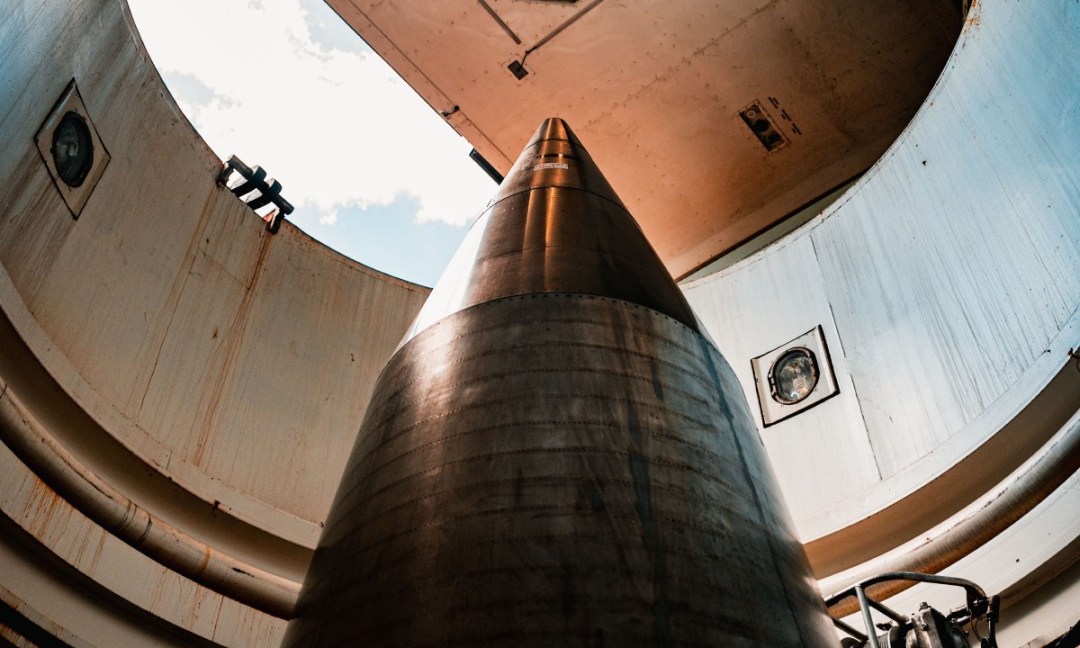
In Kathryn Bigelow’s new film, A House of Dynamite, a nuclear missile streaks toward Chicago. The president has minutes to decide whether to respond by launching America’s own nuclear weapons. It’s gripping cinema—and terrible nuclear strategy.
No threat looms larger over humanity than nuclear war. Educating the public and policymakers about this issue is therefore of vast importance, and movies and television shows can play a constructive role in this regard. The Day After was watched by over one hundred million Americans, including President Ronald Reagan, who cited the film as a motivating factor for signing the Intermediate-Range Nuclear Forces Treaty with the Soviet Union. WarGames highlighted the vulnerability of nuclear command and control to computer hacking, leading to real policy changes. Dr. Strangelove vividly illustrated the absurdity of nuclear conflict, and is considered by the American Film Institute as one of the best movies of all time. As a result, it has been referenced by both policymakers and advocacy groups to make the case against nuclear weapons.
Against this backdrop, A House of Dynamite held real promise. Indeed, there is much to commend it for. The film accurately portrays the unreliability of current-generation missile defense systems and, consequently, the vulnerability of the United States to nuclear attack. It also vividly highlights the human costs of nuclear war, as the central characters have loved ones who they desperately break the rules to try and save.
Unfortunately, it has a key flaw that holds it back from entering the pantheon of classic nuclear films. Like Bigelow’s previous military-oriented movies—Zero Dark Thirty and The Hurt Locker—A House of Dynamite is tension-filled and keeps viewers on the edge of their seat. In particular, it realistically depicts the intense time pressure policymakers would face in the case of a nuclear attack against the United States. It would take just fifteen to thirty minutes after a nuclear attack was launched for a missile to reach its target. This time pressure frames the key question of the movie—how the president should respond to an incoming nuclear attack against Chicago. But the film’s core dilemma is a false one and disregards basic facts about America’s nuclear arsenal. Most notably, it ignores that the United States could easily (even if incredibly painfully) absorb an incoming nuclear strike—especially a single missile attack against a city like Chicago—and still retain an ability to retaliate with its own nuclear weapons.
The Worst Choice a President Would Have to Make
In the film, after the United States government detects an incoming nuclear missile from an unknown country, identifies its target as Chicago, and fails to intercept it, the president must decide what to do next. “Your orders, Mr. President,” ask General Brady, who is in charge of the United States Strategic Command.
There are two primary options presented to the commander-in-chief. The first, advocated predominantly by key military officials, is to launch an all-out nuclear attack against America’s adversaries. The goal of such an attack would be damage limitation. As Lieutenant Commander Reeves—carrier of the nuclear football—advises the president, “We can hit their command centers, silos, and bombers while they’re still on the ground, eliminating their ability to take further action against us.” In other words, destroy the enemy’s nuclear weapons before they can launch more against the United States.
However, given the likelihood of nuclear retaliation, the deputy national security advisor, Jake Baerington, accurately frames this option as “suicide.” Instead, he proposes the United States “hold back” and not retaliate, even if that constitutes “surrender.” Lieutenant Commander Reeves counters by arguing, “If we do nothing, the bad guys see they can get away with it.” General Brady adds derisively, “We can all certainly say a prayer and rely on the goodwill of our adversaries to keep us safe.”
Whatever course he believes is optimal, the president is strongly pressured by General Brady to decide quickly given the imminent detonation over Chicago: “Mr. President . . . slowing down is one luxury we just don’t have.”
How Presidents Should Think About Time Pressure in Nuclear Scenarios
Both the time pressure placed on the president and the recommendation by key military officials to conduct an all-out nuclear counterstrike are nonsensical. There are two circumstances under which there would be significant time pressure to respond to an incoming nuclear attack on the continental United States. The first is when an enemy launches a large-scale nuclear assault that threatens to degrade America’s ability to retaliate with its own nuclear weapons. In such a scenario, there may be a real use-it-or-lose-it dynamic at play. The second is if an enemy attempts to decapitate the government (i.e., kill its top decision-makers), thereby undermining its nuclear command and control and threatening its ability to authorize retaliation.
Neither condition applies in the film. A single nuclear-armed missile striking Chicago would not inhibit Washington’s ability to retaliate since there are no publicly known nuclear weapons located in Chicago, and even if they were, the United States retains hundreds of nuclear weapons in other locations. Indeed, the film explicitly makes clear that nuclear-armed submarines, aircraft, and land bases located far from Chicago have been put on high alert to launch their weapons at a moment’s notice if a second stage of the attack materializes. The destruction of Chicago would also not threaten to decapitate the United States’ nuclear command and control, as neither the president nor key military personnel were located in Chicago and at risk of being killed.
Given these dynamics, combined with the fact that the United States did not even know who to retaliate against, the advice to launch an immediate and overwhelming counterstrike was not just unwise and arguably unrealistic—it was reckless. Doing so would almost certainly guarantee a significant nuclear response that would lead to much more devastation than the destruction of Chicago. Failure to do so would also not mean having to “say a prayer and rely on the goodwill of our adversaries to keep us safe.” Because Washington retains a second-strike capability—a key fact not discussed by the film at all despite being a basic and central concept of nuclear strategy—other countries would still risk mutually assured destruction if they were to launch a larger-scale, follow-on nuclear attack.
The film does raise the possibility of a cyberattack that could theoretically inhibit the United States’ ability to detect a second, larger nuclear attack and order retaliation. Cyber vulnerability in nuclear command-and-control systems—real or perceived—could rationally produce use-it-or-lose-it dynamics. But, if the decision-makers in the film thought logically about the situation, then they should have concluded that a massive follow-on attack was unlikely to materialize. It would not make sense for an adversary to start small and then go bigger, as the United States had already mobilized its nuclear forces and activated its emergency contingencies in response to the single missile launch against Chicago. This made a second attempt less likely to succeed in terms of destroying America’s nuclear weapons on the ground before they could be launched, or decapitating its leadership to prevent a retaliatory launch order from being given. If an adversary planned to completely obliterate America, it would have—or at least should have—started with a much larger attack.
While General Bradley and Lieutenant General Reeves’ argument thus makes little sense, and stereotypes the military as being unreasonably hawkish, the way the deputy national security advisor (and president) frame the alternative is also highly misleading. Holding back in the moment is neither “surrender” nor (in the president’s words) “let[ting] whoever did this get away with it.” The most logical decision would be to stay on high alert, absorb the nuclear attack against Chicago, ascertain who carried it out and for what reason, and then retaliate at a later time to punish the aggressor and deter or prevent future attacks from taking place. And if this was just the beginning of a larger-scale nuclear attack, as General Brady worried, the United States would still retain the option to respond with its own nuclear strikes at a later time.
Although we do not find out in the film what decision the president makes, the choice presented to him was a false one. A House of Dynamite delivers all the tension of nuclear war—just none of the understanding that might stop it. The illogic of the decision-making process in this case could be realistic given the intense time pressure and stakes of the scenario, which might fluster even the calmest and most sophisticated leaders. As the president notes, “This is insanity, okay?” However, if a real president and national security team is faced with the reality of choosing how to respond to a limited nuclear attack, then they should reject the film’s framing of the decision. Instead, they should realize that America’s second-strike capabilities mean slowing down is an option. Punishment can be imposed and deterrence restored at a later time. If America was to face its worst day in history, then it would be imperative to avoid compounding the pain by taking actions that would lead to Armageddon.
Joshua A. Schwartz is an assistant professor of international relations and emerging technology at the Carnegie Mellon Institute for Strategy & Technology. He has written widely on topics related to nuclear weapons and film, including in The Washington Post, Lawfare, and International Security. You can follow his work on X @JoshuaASchwartz or via his website.
The views expressed are those of the author and do not reflect the official position of the United States Military Academy, Department of the Army, or Department of Defense.
Image credit: Staff Sgt. Michael A. Richmond, US Air Force