
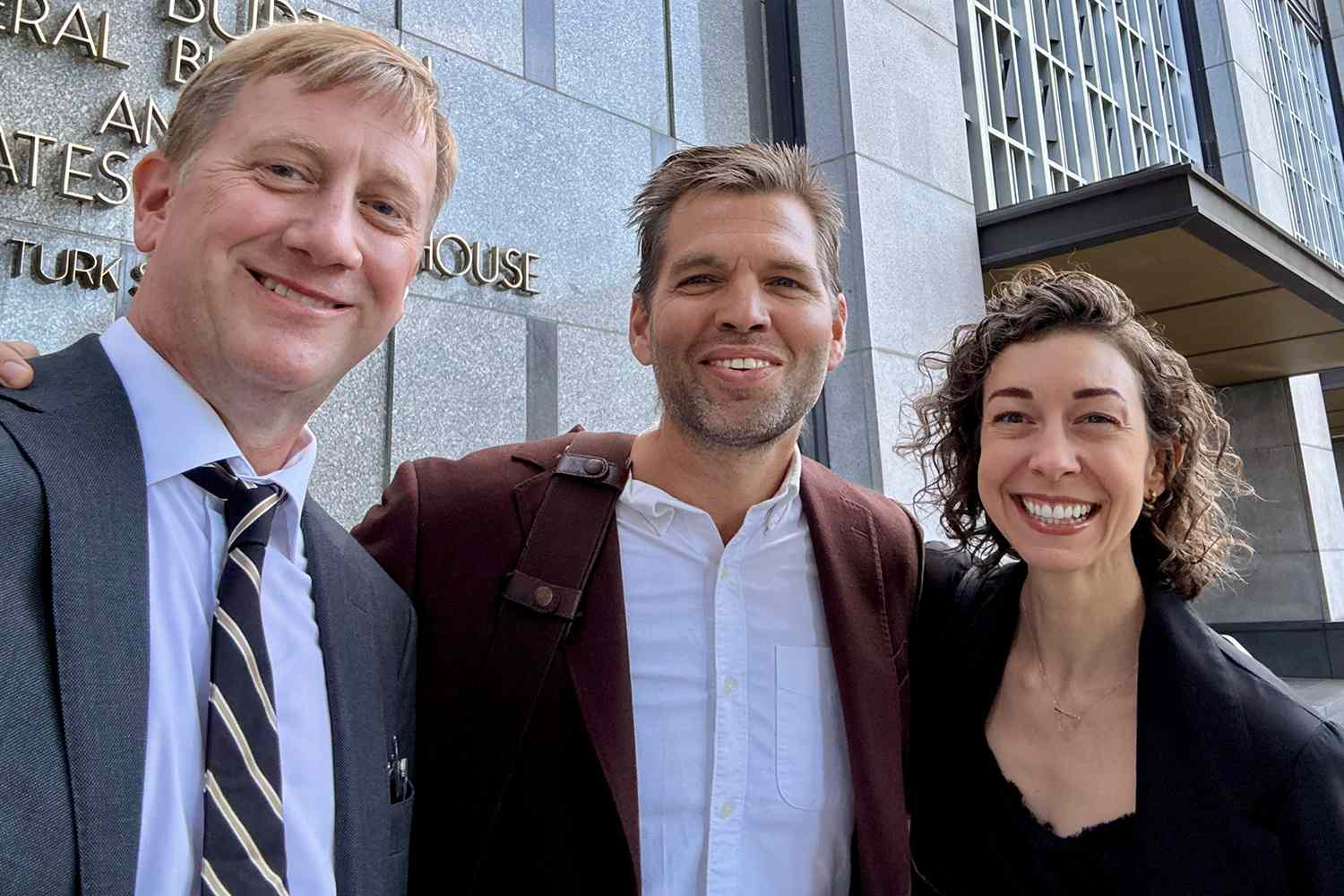
NEED TO KNOW
Authors Andrea Bartz, Kirk Wallace Johnson and Charles Graeber were three of many authors whose books were pirated to train artificial intelligenceThe writers became named plaintiffs in a historic class action lawsuit, which alleged that AI company Anthropic infringed on copyrights by illegally downloading booksFollowing the case’s $1.5 billion settlement in September, Bartz, Johnson and Graeber spoke with PEOPLE about what comes next
Author Andrea Bartz still remembers the moment she learned that her work had been pirated to train artificial intelligence.
It was August 2023. That month, The Atlantic published a series of articles about pirated books that were being used to fuel generative-AI systems created by Bloomberg, Meta and other companies. One story included a database that collected over 180,000 titles — from emerging authors to big names like Stephen King and Jane Austen — that had been downloaded by these companies without permission. The data set came to be known as “Books3.”
“I just remember typing in my name and my heart rate was picking up. Then when my books came up, I felt incredibly violated,” Bartz, a thriller writer known for novels like We Were Never Here, tells PEOPLE. “Every one of my books takes years of work, as well as so much vulnerability and emotions. To have that intellectual property taken from me without consent … just felt like a different kind of violation.”
Nonfiction writer Charles Graeber had two books recorded in the database, including his debut, The Good Nurse, which took him a decade to research and write.
“I felt very small,” he says. “I’m one person and this is a huge tech company that didn’t feel the need to even notify me that they wanted or were using several books.”
“I tried to figure out what one person could do besides complain,” he continues. “That’s when I started calling to see if there was a suit that we could join. It turns out there was.”
Charles Graeber.
Robert Krivicich
That need for action led Bartz, Graeber and nonfiction writer Kirk Wallace Johnson (The Feather Thief) to become named plaintiffs in a first-of-its-kind class action lawsuit. In Bartz vs. Anthropic, the trio alleged that AI company Anthropic infringed on copyrights by downloading books from pirate websites, including Pirate Library Mirror (PiLiMi) and Library Genesis (LibGen).
In September 2025, Anthropic agreed to a $1.5 billion settlement, in what’s now the biggest copyright recovery in history. The settlement covers 482,460 books and will pay around $3,000 per work. Copied and original files of their books will also be destroyed and unable to be used for future commercial and licensing purposes.
Bartz, Graeber and Wallace Johnson didn’t know each other prior to the lawsuit prepration. Fighting for authors’ rights, however, brought them closer, especially as they treaded into uncharted territory.
“We’re all so different, but to be able to stand together and say this one thing is wrong and serve as precedent — that was really important,” Graeber says.
Throughout the lawsuit — which included in-person courtroom dates in California and depositions with lawyers representing Anthropic — the authors gained a clearer understanding of how tech companies utilize AI. Books are an essential component in training the software, as it requires “unique, expressive, long-form content” to mimic the human voice, Graeber notes.
“It changed the way I think about the future,” he says. “For the AI companies, I would think that would change the way they would think about authors, because they require our work even as they threaten to make our jobs impossible.”
Kirk Wallace Johnson.
Marie-Josee Cantin Johnson
“There’s nothing to me that was more shocking — that the most valuable thing driving the largest economy in the world depends on books that we’re writing,” Johnson adds.
Bartz was struck by the boldness of the theft, noting that internal communications from Anthropic showed blatant awareness of the piracy.
“There’s really no excuse, which is a part of why we ended up with the largest copyright settlement in the history of copyright law in the U.S.,” she says. “This is sort of a first corrective step.”
Bartz vs. Anthropic didn’t fully end the practice of using books to train AI. In June 2025, Judge William Alsup ruled on summary judgement that books could still be used without permission if they were acquired legally, and were considered fair use. That doesn’t thrill the plaintiffs, though.
“We write books to engage human minds and to connect with readers and the rest of humanity,” Bartz says. “The implication that our work can just be fodder for an algorithm if a book of ours is legally purchased doesn’t sit right with any of us.”
The case does remain wide-reaching, though. It’s just one of several class action lawsuits brought forth by authors against tech companies like Open AI, following the publication of the “Books3” data set. Bartz says the settlement has helped remind other writers that they “are not powerless” in the face of artificial intelligence.
“We’re seeing a lot of gratitude, a lot of surprise because it feels like AI is this tsunami, this runaway train,” Bartz says. “Now is the time to set those guidelines and to set up those regulations.”
Andrea Bartz.
Savannah Lauren
Everyday people can also do their part in the fight against artificial intelligence. One way is being cognizant of how and when you’re using it, like through Google’s AI summary tool or bots like ChatGPT. But supporting creatives across all mediums is invaluable, the authors emphasize.
“If you want a world that has creators, where people can survive creating art, you have to support that actively,” Graeber says. “It’s possible, but if we rely on the people that are creating the technology to do that for us, it won’t happen. We’ve seen that already.”
It’s also crucial for affected authors in the Anthropic lawsuit to file their claims for the settlement, Johnson notes, even if there is no single lawsuit that will serve as a “cure-all” solution.
Never miss a story — sign up for PEOPLE’s free daily newsletter to stay up-to-date on the best of what PEOPLE has to offer, from celebrity news to compelling human interest stories.
“We hope that authors who might not have been aware that their work was so central to this massive economic force are now going to get the recovery that they’re entitled to,” he says.
The settlement is also a stark reminder that the fight against artificial intelligence is far from over. And Bartz, Graeber and Johnson’s own advocacy is still going strong.
“We’re all very focused on just talking to the public, to the author community and the publishing community about what the suit means,” Bartz says.
“The genie’s out of the bottle with AI. None of us are trying to put it back in,” Graeber says. “But creators should be treated as partners, as co-creators, an essential part of what comes next, as opposed to mined as free raw material and then thrown away.”
“It’s not just the right thing to do, it’s also the smart thing to do,” he continues. “We have an opportunity. We’re at a crossroads where we can create the future we want.”