
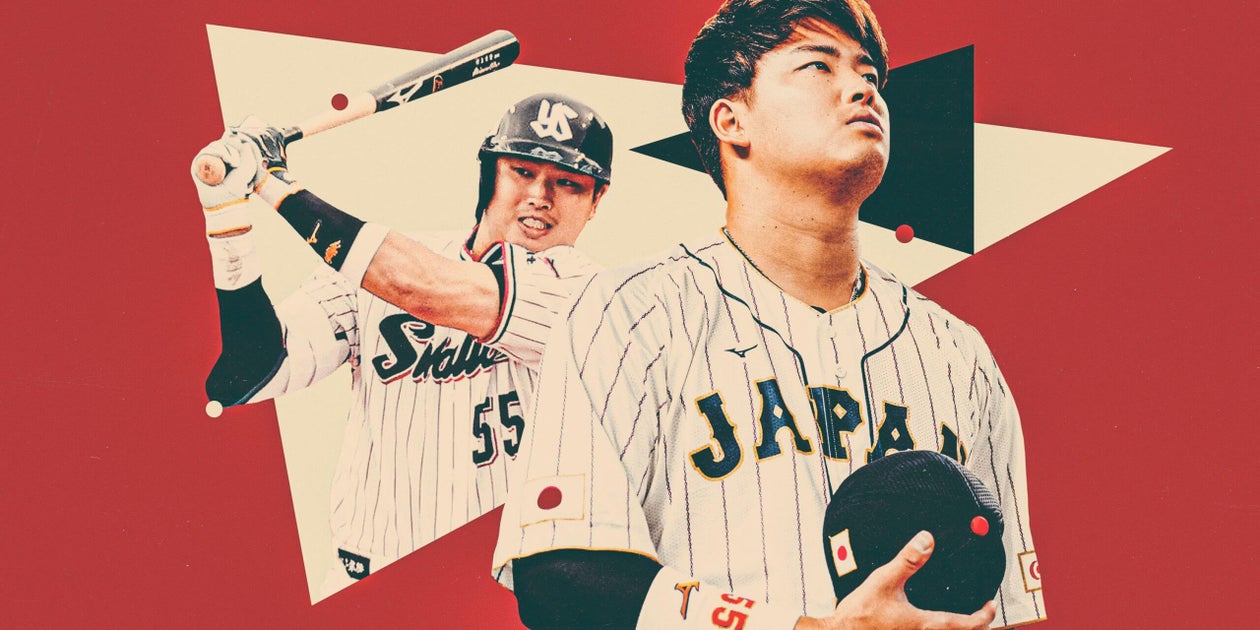
The biggest Japanese player expected to disrupt MLB’s free-agent market this winter has been called Murakami-sama.
After he hit 56 home runs for the Yakult Swallows in 2022, the hyperbole rose to declare his achievements could only be matched by a “kami-sawa.” By a god.
The outlook for Munetaka Murakami has since become surrounded with more questions about how his game will translate to Major League Baseball. But he is coming, and so is another offseason that should prove the pipeline from Nippon Professional Baseball and Korea’s KBO to MLB has never been stronger.
Two years ago, there was Yoshinobu Yamamoto breaking the market and signing a 12-year, $325 million deal with the Los Angeles Dodgers. Last year, there was Roki Sasaki — considered an international amateur because he was younger than 25 — signing for a $6.5 million bonus and going to … you guessed it, the Dodgers.
This season, there are a handful of intriguing players coming from Japan’s NPB with a chance to impact the narrative of the MLB offseason. Players over 25 enter the market via the posting system. Once they are officially posted by their NPB clubs, they are free to negotiate with MLB teams for 45 days. There are no restrictions on how much they can earn. Japanese clubs in turn get a “posting fee” based on the guaranteed value of the MLB contract a player signs.
For all the hype around Murakami, no one in this class profiles as quite the headliners Yamamoto and Sasaki were.
But there is still some star power, and there is still plenty of intrigue with more teams likely to factor into the race.
Plus, in recent years, players such as Shota Imanaga and Tomoyuki Sugano have surpassed the modest expectations placed on them ahead of their arrivals.
After conversations with several high-ranking MLB executives and Pacific-rim scouts, here is the industry’s read on this class of NPB and KBO players.
Munetaka Murakami, 1B/3B
If the name sounds familiar, think back to the 2023 World Baseball Classic. Murakami was a middle-of-the-order threat for Samurai Japan. The left-handed slugger hit a walk-off double to beat Mexico in the semifinal. He homered off Merrill Kelly in the championship game. He became a playable character with titanic power in the “MLB: The Show” video game.
At only 25 years old, Murakami is already a long-established star on Japanese soil. His 56 home runs in 2022 broke Sadaharu Oh’s longstanding NPB record. The question, though: Will his game come close to matching his reputation when he enters Major League Baseball?
His profile is one of big upside but also frightening red flags. No concern looms larger than Murakami’s propensity for swing-and-miss. NPB is a lower strikeout environment than MLB, yet Murakami’s strikeout rates have hovered close to 30 percent for each of the past three years. Some evaluators see holes in his elongated swing that could be further exploited by top-end velocity or breaking stuff. Per FanGraphs, Murakami’s contact rate against fastballs 93 mph or greater is only 63 percent since the 2022 season. In 2025, his contact rate against secondary pitches was only 51 percent.
Typically, a player’s strikeout rate going from NPB to MLB does not drastically shrink — if anything, it increases (Masataka Yoshida and Seiya Suzuki stand out as recent examples). That’s why evaluators suggest Murakami may sell out for even more power or need to make swing adjustments.
“That just kind of is who he is, so the strikeout percentage is going to be there,” a National League Pacific rim scout said. “It’s just going to be, ‘Can he get to enough home run damage to make it worth it?’ Is it going to be closer to Kyle Schwarber production or Joey Gallo production?”
No one doubts Murakami’s power. Multiple evaluators described it as a 70- or 80-grade, which is the highest on the industry’s scouting scale.
It’s the other parts of Murakami’s game that may require a refining period. Some evaluators suggested that Murakami might experience more success in 2027 and beyond — after an adjustment period in 2026. The same evaluators, however, were careful not to rule out his making an impact in 2026, either. It’s just that it’s difficult to project the size of the impact, especially because some scouts believed he tailored his approach for a certain competition level in NPB.
“The biggest key is, is he going to be able to walk enough?” the same NL scout said. “He’s going to have to make some mechanical adjustments to his swing just to be able to better handle velocity. He’s going to be able to make those adjustments, too. He evolves year after year. It’s just going to be about how quickly he is able to do it.”
The power is real enough to envision Murakami continuing to cross the 30-homer mark in MLB. The fact that he is only entering his prime years serves as a major plus. But the concern some clubs hold is whether Murakami, a left-handed batter, will hit left-handed pitching consistently in 2026. At worst, according to the perspective of high-ranking officials from a couple teams, Murakami immediately projects as a strong, power option against right-handers. As one high-ranking official surmised, it may be asking a lot of Murakami to come to the U.S., make mechanical adjustments and also improve against left-handed pitchers all in his first year.
Then there’s Murakami’s defense. Scouts generally rate him as a below-average defender. Another NL scout said the nicest way to put it is that Murakami is capable of picking the ball up at third base and making the throw to first base. That’s it. His arm is questionable and he lacks range. He is better suited for first base than third base, placing an even greater premium on his bat.
He is also coming off a string of injuries: A broken toe that ended his 2024 season, then an offseason elbow surgery, then an oblique injury and subsequent setback.
“I think he’d be an interesting fit for the Yankees, given their short porch there, but you got to play him somewhere,” another scout said. “I don’t think his offense is going to be able to make up for his defensive issues. I don’t think third is a realistic position in the big leagues. I think first is going to be a work in progress. I don’t see left field being realistic.”
Do not be surprised if Murakami’s sheer talent earns him a bigger deal than recent position players such as Yoshida (five years, $90 million) and Suzuki (five years, $85 million).
But whichever team signs him understands the risk here. Murakami’s MLB success could ultimately depend on the adjustments he does or does not make to his powerful swing.
Tatsuya Imai, RHP
If Murakami is the biggest NPB name who could enter the market, Imai might be the most intriguing. He is a right-handed pitcher who, with a plus arsenal at 27 years old, could command a large payday.
Imai offers a plus fastball that can sit 95-99 mph. He is also a divisive player among at least some scouts because of his secondary offerings. Some scouts say his slider is his most potent weapon while others are less certain. He also throws a cutter that can sometimes blend with the slider. Scouts are also torn on his splitter. Some refer to the splitter as a plus-pitch — but the offering, in the minds of at least one American League evaluator, is inconsistent.
“The splitter comes and goes a bit, but when it’s right, it’s a really, really good pitch,” an NL evaluator said. “And the splitter is always the difference-maker for guys who come over here.”
Because he is a young starting pitcher with multiple plus offerings — and a Boras Corp. client — he stands to make a lot of money. The Athletic currently projects him at 8 years, $190 million, noting the statistical similarities to Daisuke Matsuzaka’s last season in Japan. But there is also some risk in Imai’s profile. He compares to a right-handed Shota Imanaga or even Yusei Kikuchi more than he does a Yamamoto.
“I hesitate to put him on the level of someone like Yamamoto,” an assistant scouting director for a NL team said. “I think this is more of a No. 3 starter type.”
Imai commanded the ball better than ever last season, something that bodes in his favor. Also, scouts dig his deception. The 5-foot-11 Imai works from a lower slot angle, making him hard for batters to pick up. That is particularly important with the splitter because he is using more of a low-three-quarter slot. Thus, scouts believe hitters will need an adjustment period against Imai, which points to the strong possibility of initial success.
“He kind of looked bored at times when he dominated that competition, but then he’d dial it up when facing a hitter like Murakami, and you’d be like, ‘OK, yeah,’” said a scout who watched Imai in person multiple times. “So there might be another gear or two in there, which makes him really, really intriguing.”
There are parts of Imai’s game that need refinement. Multiple scouts expressed some concern about his relaxed demeanor, theorizing he may need to “throttle up” to be at his best. And all the usual caveats — using a different ball, performing in a different environment and possible arsenal changes — for a pitcher making the leap from NPB apply. But he could also easily be a capable mid-rotation starter for an MLB team.
Kazuma Okamoto, 1B/3B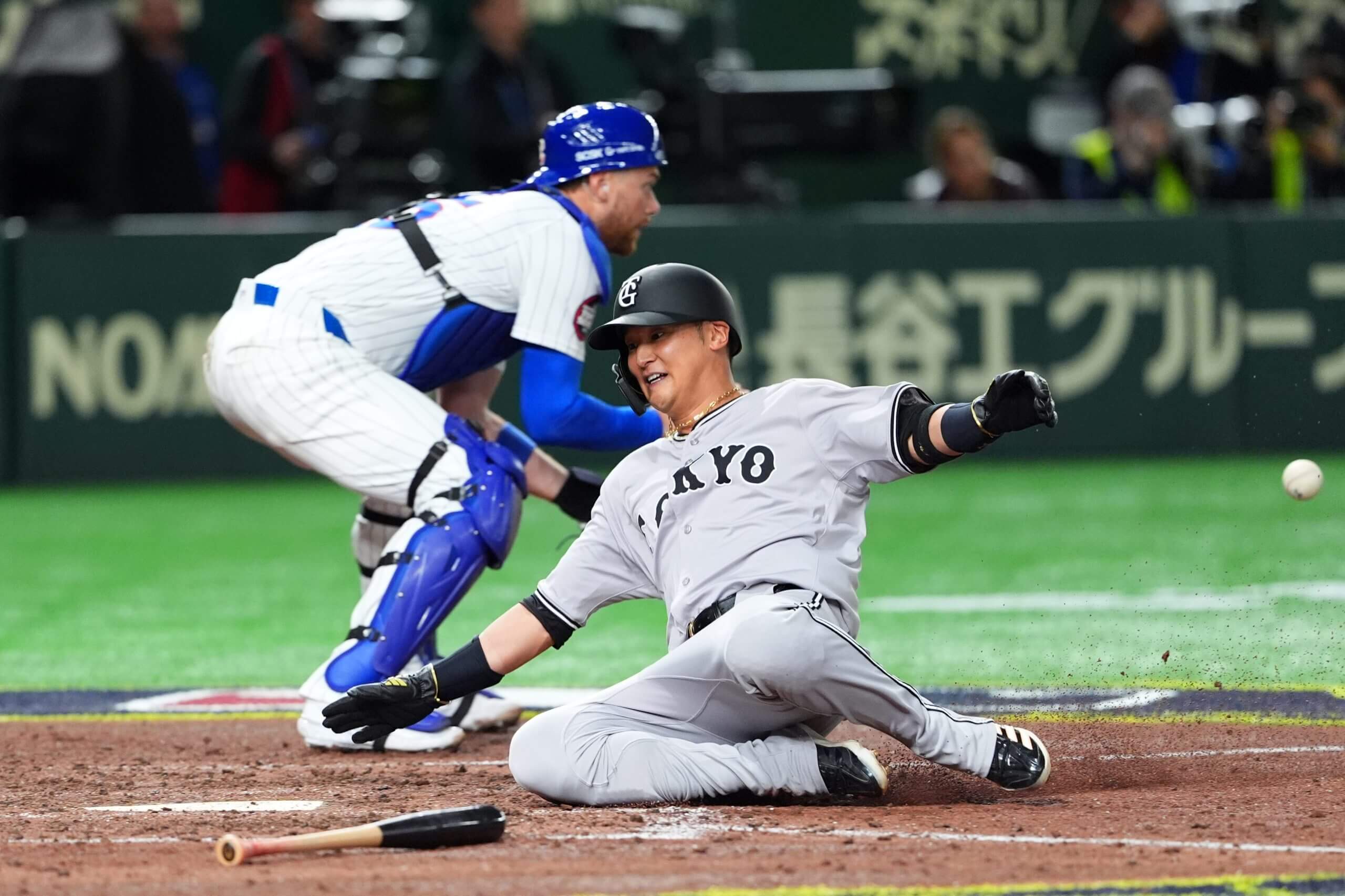
Kazuma Okamoto may not have Murakami’s power, but he might offer a more consistent bat. (Masterpress / Getty Images)
It’s possible Okamoto, a right-handed batter, ends up being a safer pick for MLB teams in terms of immediate results than Murakami — it’s just that at 29, he is four years older.
Like Murakami, Okamoto is a power-hitting corner type. He homered off Kyle Freeland to help Japan beat Team USA in the 2023 WBC. Unlike Murakami, Okamoto has better bat-to-ball skills, improved his performance against velocity (an 84 percent contact rate against 94 mph and above in 2025, per Fangraphs) and has a better chance to stick at third base, even if first base could still be his ultimate home.
“He is going to have the easier path to adjusting to major-league pitching just because he’s got simpler mechanics; he puts the ball in play more, it’s more of a basic swing and it’s more of a major-league-ready type of contact-swing,” another Pacific rim scout said.
Okamoto has six seasons or 30 or more home runs with the Yomiuri Giants, topping out at 41 in 2023. His raw power does not compare to Murakami and could result in lesser home-run totals in MLB. His 2025 numbers against velocity were also a great improvement from concerning previous performance, and there’s a small sample to account for. Okamoto missed a chunk of time with an elbow injury, the result of a collision, in 2025, but hit .322 for the season.
As an interesting comparison point, multiple evaluators suggested Okamoto resides somewhere in the middle between Murakami’s power approach and Yoshida’s contact-oriented style.
“Okamoto has power, but he is more of a pure hitter, compared to Murakami,” said an international scouting director for a NL team. “Okamoto has a chance to have a lot higher of a batting average than Murakami does, but Murakami, if they are both healthy, ends up with more home runs.”
Okamoto (another client of Scott Boras) is already approaching the tail end of his prime, something that will surely result in him getting a much smaller deal than Murakami. There’s still reason to believe he could become a solid everyday player, with some club officials pointing to a two- or three-year window where he is quite productive.
“I’m very curious who actually is in the market for both these guys and how they do,” said another NL scout. “Because if they have success, it kind of blazes another pathway. Prior to Seiya (Suzuki), there’s been a lot of guys who had success in Japan. They haven’t been able to transition that success, minus Ichiro and Hideki Matsui.”
Others to watch
RHP Cody Ponce: Outside of the three NPB stars, no player coming from overseas is gaining steam quite like Ponce. Born in California, he played for the Pirates in 2020-21 and could now be poised for an MLB return as a much improved pitcher. Ponce spent three seasons in Japan where he had decent-not-great results before dominating the KBO last season with a 1.89 ERA and striking out 252 batters.
Multiple scouts described Ponce’s stuff as “electric — when he’s right.” Since moving to the KBO, Ponce made mechanical adjustments. His fastball is up to 98 mph. He also throws a curveball, slider and changeup.
RHP Kona Takahashi: Set to enter his age-29 season, there is less buzz around Takahashi than there was when he dominated the NPB to the tune of 2.20 and 2.21 ERAs in 2022-23. His velocity has been inconsistent and there are fears his fastball is too hittable. He’s still capable of pitching in the major leagues, but his low strikeout rates suggest some risk.
3B Sung-Mun Song: A late-blooming KBO infielder, Song is a versatile defender who has greatly improved his plate production over the past two seasons. He is already 29 and considered a level below a KBO comp like Ha-Seong Kim. In other words, evaluators see him as more of a utility type than an everyday player.
1B/OF/C Kang Baek-ho: The 26-year-old is likely to make the move from Korea, but it is also possible he ends up re-signing in the KBO. The plan, however, is for him to start training in the U.S. at some point in November. A left-handed batter, Baek-ho owns a career .304 batting average and .877 OPS. Last year, he had an average exit velocity of 94 mph with a max exit velocity of 116 mph. He can play first base and the outfield — and can also be a club’s third catcher. As a free agent after the 2025 season, there is no posting fee attached to him.
LHP Foster Griffin: The former Kansas City Royal and Toronto Blue Jay is a candidate to return to North America after bolstering his arsenal posting a 1.62 ERA with the Yomiuri Giants in 2025.
LHP Anthony Kay: Another player returning to MLB, the former first-round pick is drawing interest after two seasons in Japan.
— The Athletic’s Dennis Lin contributed to this report