
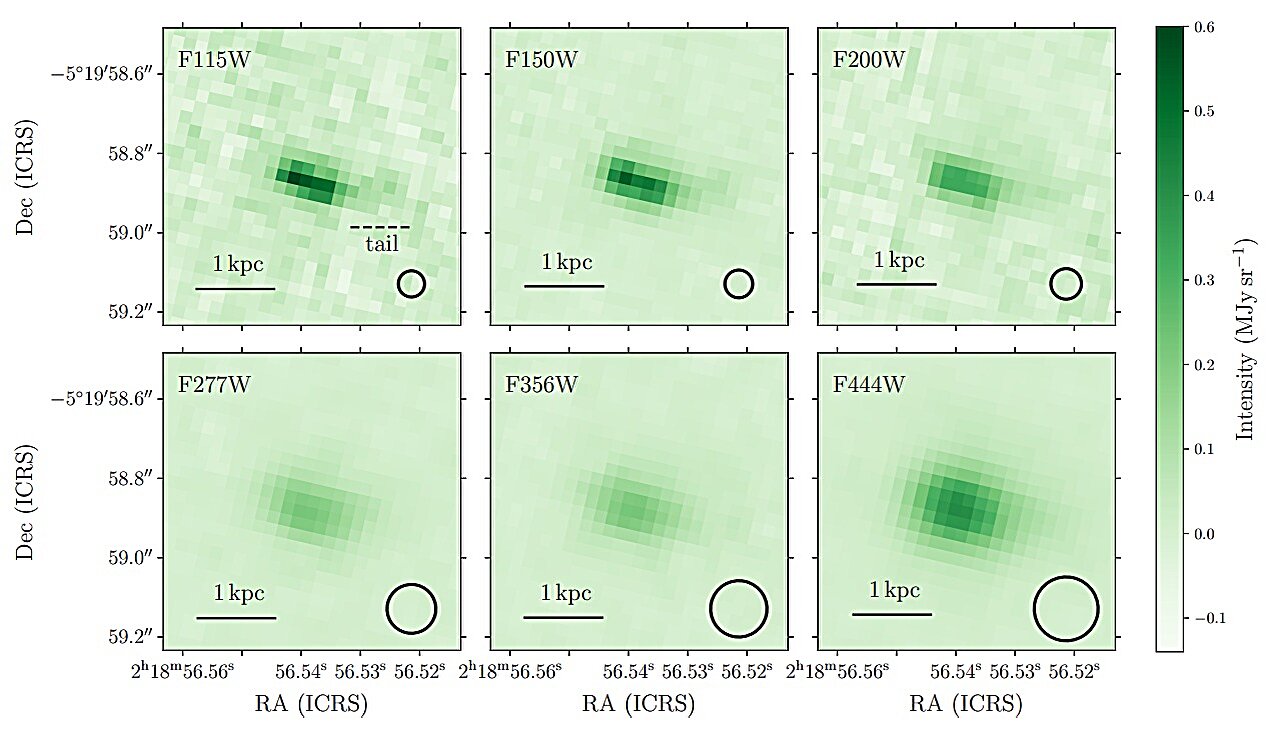
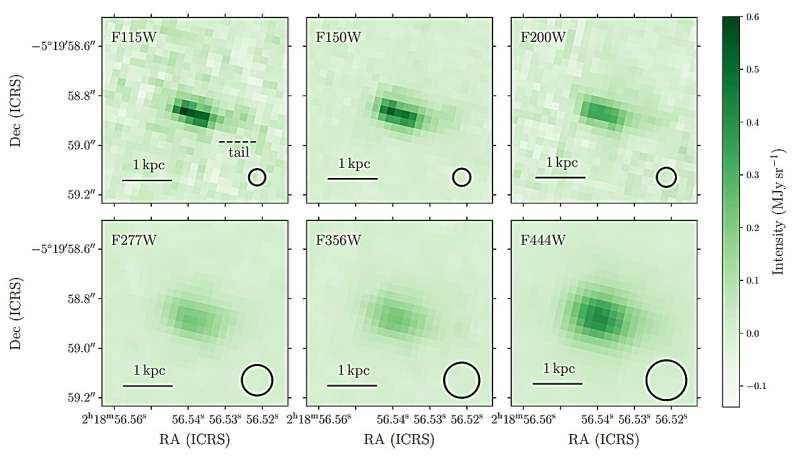
NIRCam images of SXDF-NB1006-2. Credit: arXiv (2025). DOI: 10.48550/arxiv.2510.25721
An international team of astronomers has employed the James Webb Space Telescope (JWST) to observe a distant galaxy designated SXDF-NB1006-2. As a result, they found that SXDF-NB1006-2 is a young starburst galaxy that experiences ionized gas outflows. The new findings were detailed in a paper published October 29 on the arXiv pre-print server.
Discovered in 2011 at a distance of some 12.9 billion light years away, SXDF-NB1006-2 is one of the most distant galaxies known. Previous observations of SXDF-NB1006-2 have suggested that it may be a young starburst galaxy with an extremely short star formation timescale of about 1–2 million years.
Recently, a group of astronomers led by Yi W. Ren, of the Waseda University in Tokyo, Japan, has taken a closer look at SXDF-NB1006-2 to get more insights into its nature. For this purpose, they utilized JWST’s Near Infrared Camera (NIRCam) and Near Infrared Spectrograph (NIRSpec).
“We present analysis of JWST NIRCam and NIRSpec observations of the galaxy SXDF-NB1006-2 at z = 7.212, as part of the Reionization and the ISM/Stellar Origins with JWST and ALMA (RIOJA) project,” the researchers write in the paper.
First of all, the observations found that the ultraviolet continuum of SXDF-NB1006-2 exhibits an elongated, clumpy morphology with a tail-like structure, suggesting an edge-on disk or a chain galaxy. The oxygen emission was found to also be clumpy with a tail-like structure extending toward the west. This indicates that SXDF-NB1006-2 may have experienced galaxy merger events in the past.
Furthermore, the observations detected a broad component of the oxygen emission line, with an extent of about 6,000 light years. This component suggests the presence of prominent ionized gas outflows.
The observations show that SXDF-NB1006-2 is dominated by young stellar populations and undergoing a bursty star-formation phase. The results point to an age of about two million years and indicate the presence of an intense radiation field.
According to the study, SXDF-NB1006-2 has a star-formation rate of approximately 38 solar masses per year and metallicity at a level of 0.2 solar metallicities. The gas mass of the galaxy was calculated to be approximately 19.3 billion solar masses and the gas depletion time was estimated to be about 144 million years.
Summing up the results, the authors of the paper conclude that SXDF-NB1006-2 may be quenched at a redshift of 6.5 or 5.0. This suggests that the investigated system may be one of the progenitors of observed massive quiescent galaxies at redshifts of approximately 4.0–5.0.
“The derived gas depletion time of a few hundred million years implies that our target could be one of the progenitors of massive quiescent galaxies at z ∼ 4−5 identified by recent JWST observations,” the astronomers explain.
Written for you by our author Tomasz Nowakowski, edited by Sadie Harley, and fact-checked and reviewed by Robert Egan—this article is the result of careful human work. We rely on readers like you to keep independent science journalism alive.
If this reporting matters to you,
please consider a donation (especially monthly).
You’ll get an ad-free account as a thank-you.
More information:
Ren et al, RIOJA. Young Starburst and Ionized Gas Outflows in a z = 7.212 Galaxy Uncovered by JWST NIRCam and NIRSpec Observations, arXiv (2025). DOI: 10.48550/arxiv.2510.25721
Journal information:
arXiv
© 2025 Science X Network
Citation:
SXDF-NB1006-2 is a young starburst galaxy experiencing ionized gas outflows, observations find (2025, November 6)
retrieved 7 November 2025
from https://phys.org/news/2025-11-sxdf-nb1006-young-starburst-galaxy.html
This document is subject to copyright. Apart from any fair dealing for the purpose of private study or research, no
part may be reproduced without the written permission. The content is provided for information purposes only.