
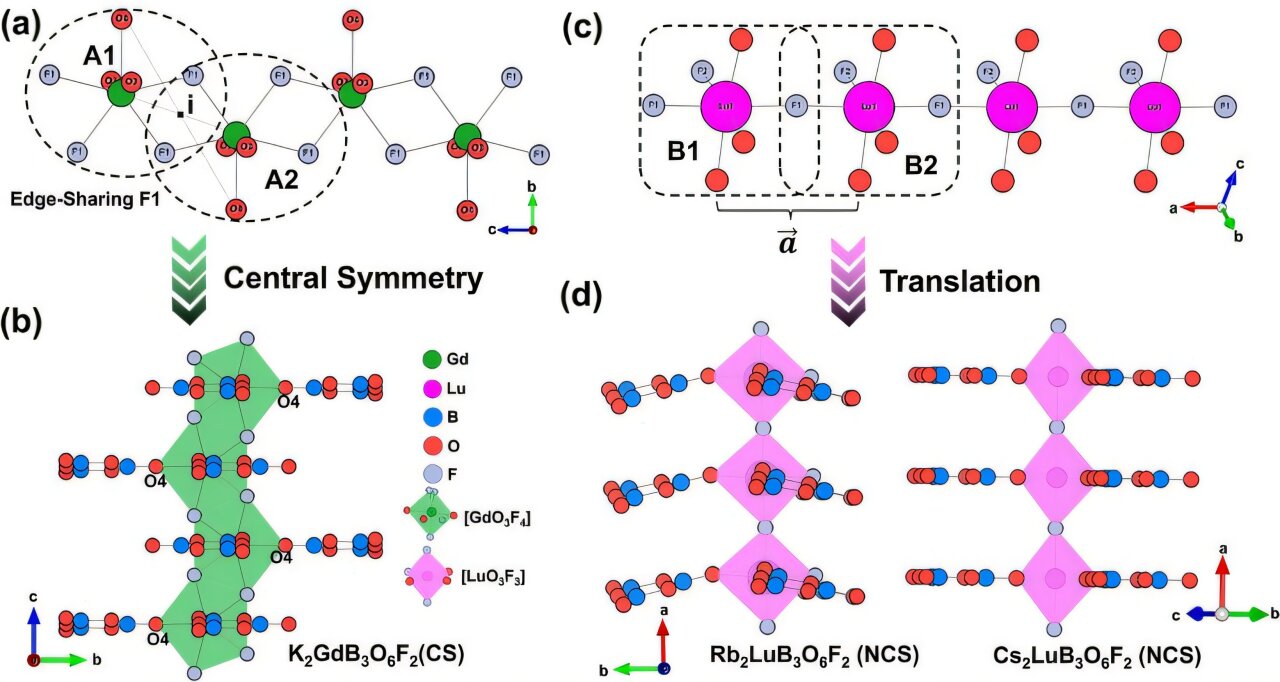
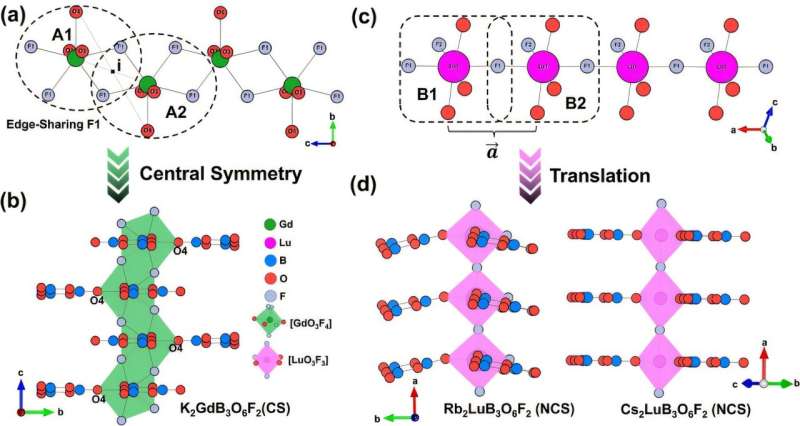
a) The central symmetry produced by the [GdO3F4] polyhedra; b) the [B3O6] groups connected by the same O atoms on the [GdO3F4] polyhedra are arranged in reverse directions; c) the translation operation between the [LuO3F3] polyhedra; d) the [B3O6] groups connected by the same O atoms on the [LuO3F3] polyhedra exhibit the same translation operation and orientation. Credit: Advanced Functional Materials (2025). DOI: 10.1002/adfm.202520516
Nonlinear optical (NLO) materials play a vital role in modern photonic technology, driving advancements in applications such as laser frequency conversion, ultrafast optical switching, and quantum information processing. Among NLO crystals, borate-based systems have long remained at the forefront of short-wavelength (<280 nm) NLO materials due to their structural adaptability, broad transparency window, and high laser damage threshold.
However, the development of next-generation NLO materials faces a critical challenge: achieving sufficient birefringence for short-wavelength phase matching while preserving a strong second-harmonic generation (SHG) effect.
Prior research has shown that synergistic interactions between various anions (e.g., O2-, F-, BO33-, BO3F4-) can unlock unprecedented optical functionalities. Meanwhile, the planar π-conjugated [B3O6] group exhibits high hyperpolarizability and significant polarizability anisotropy—key properties that enable efficient SHG and the sufficient birefringence required for short-wavelength phase matching.
Building on these insights, a research team from the Xinjiang Technical Institute of Physics and Chemistry of the Chinese Academy of Sciences (CAS) adopted a synergistic optimization strategy to successfully synthesize three novel rare-earth metal borate fluorides: K2GdB3O6F2, Rb2LuB3O6F2, and Cs2LuB3O6F2. Their findings were recently published in the journal Advanced Functional Materials.
All three compounds feature short cutoff edges below 200 nm. Notably, Cs2LuB3O6F2 demonstrates a large experimental frequency-doubling effect, measuring 1.5 times that of KH2PO4. For Rb2LuB3O6F2 and Cs2LuB3O6F2, the shortest Type-I phase-matching wavelengths are evaluated at 210 nm and 202 nm, respectively, indicating their potential to enable direct output of 213 nm coherent light via the fifth harmonic generation process of a Nd:YAG laser.
A key observation from the study is the structural evolution from centrosymmetric K2GdB3O6F2 to non-centrosymmetric Rb2LuB3O6F2 and Cs2LuB3O6F2. This transition reveals that the arrangement and orientation of [B3O6] groups are strongly influenced by the coordination of rare-earth metal polyhedra, which plays a decisive role in determining the overall structural symmetry of the materials.
More information:
Qianzhen Zhang et al, Unlocking Advanced UV NLO Crystals in Rare‐Earth Metal Borate Fluorides via [B3O6]‐Mediated Structural Modulation, Advanced Functional Materials (2025). DOI: 10.1002/adfm.202520516
Provided by
Chinese Academy of Sciences
Citation:
Three nonlinear optical materials achieve sub-200-nm cutoff edges for advanced photonics (2025, November 6)
retrieved 7 November 2025
from https://phys.org/news/2025-11-nonlinear-optical-materials-nm-cutoff.html
This document is subject to copyright. Apart from any fair dealing for the purpose of private study or research, no
part may be reproduced without the written permission. The content is provided for information purposes only.