
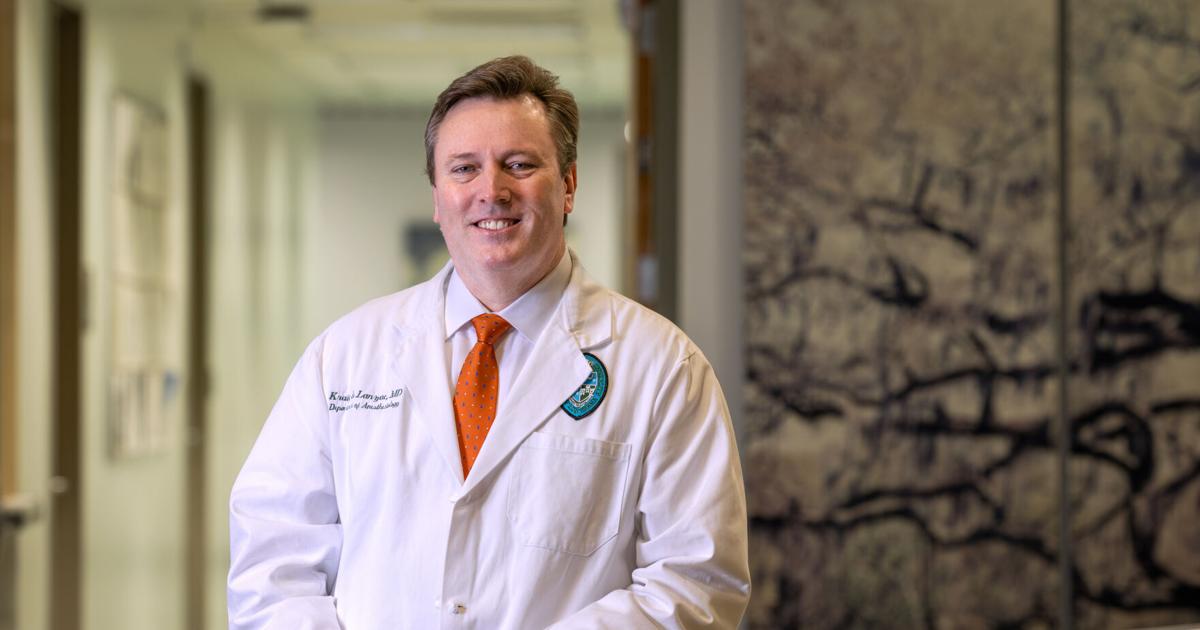
Dr. Kraig de Lanzac was elected first vice president of the American Society of Anesthesiologists, the nation’s largest organization of anesthesiologists, in October and will serve in this position for the year.
Outside of his role with the national organization, de Lanzac is director of clinical anesthesia at Tulane Lakeside Hospital and vice chair and associate professor of anesthesiology at Tulane University School of Medicine in New Orleans. Typically, de Lanzac can be found treating and administering medicine to patients in the operating room, but he goes wherever he is needed as an anesthesiology physician.
He studied medicine at the Louisiana State University School of Medicine in New Orleans, where he also completed his residency in anesthesiology in 1997. De Lanzac is a native New Orleanian and graduate of Brother Martin High School, where he still coordinates the alumni band as a trombone player. He is also a “Mardi Gras year-round kind of guy,” who rides in both Endymion and Bacchus every year.
As first vice president, de Lanzac will serve as a member of the national organization’s executive committee, which consists of the president, president-elect, first vice president and immediate past president.
De Lanzac was not born to a physician family, rather, from two parents who worked at the phone company their entire careers. Now, de Lanzac lives in Metairie with his wife, Rhen. They have two adult children: Mallory, a registered nurse, and Braden, a second-year medical student. De Lanzac and his father make it to nearly every Pelicans game.
What inspired you to become an anesthesiologist?
I was really inspired by my pediatrician who I was not only deathly afraid of, but also had deep respect for. I thought he was a genius. It seemed like he could solve any problem.
I thought I would be a pediatrician, like him. But the first year of medical school, they had us do a standardized personality test. It tells you what personality traits fit with what medical specialties. I was all excited to get the results back, but when I did get them back, it was anesthesiology. I was a little disappointed because, like many people, I didn’t really know what an anesthesiologist was or what they do.
I loved all of my rotations in medical school, but I was drawn to what I saw anesthesiologists do when I was in the hospital, the intensive care units, the operating rooms. They always looked calm and in control, even in bad situations. By the end of my third year of medical school, I knew I wanted to be an anesthesiologist.
How did you initially get involved as an anesthesiologist society member?
On my first day of residency, my chief resident handed me an application in white, yellow and pink triplicate. He said, “Fill this out. This is the membership for the American Society of Anesthesiologists. This is important.”
I filled it out on that day on July 2, 1993, and I’ve been a member ever since.
I got engaged when there were some questions about advocacy in Baton Rouge. I made my first drive out to Baton Rouge to see how that process worked — how bills were passed in health care. I saw that politicians needed more input from physicians.
That sparked a passion.
Now, as the first vice president, I want to change the way anesthesiologists are perceived. I want to help get the public to understand that we are physicians and understand what our role is. Anesthesiologists are play a critical role in their care, but we’re not always seen.
As first vice president, we deal with any issues that come up in the field of anesthesiology, whether it’s health care policy or dealing with private insurers or Medicare or drug shortages. Last year, as a result of natural disasters, we had to figure out how to advise national anesthesiologists on the shortage of IV fluids.
What are the problems facing the anesthesiology industry?
We’re training more and more anesthesiologists each year. The number of residency positions has almost doubled over the past 20 years. Even with that, we have more and more sites to cover. That means we have to increase our supply of anesthesiologists to keep up with the demand.
The other big issue that’s been career-long for me is protecting what I call anesthesiology-led care. We work very well with nurse anesthetists, but there have been pushes to remove anesthesiologists from the care team. Why wouldn’t you want both involved in care? We’re lucky in Louisiana that anesthesiology-led care teams is a state statute.
The final, biggest challenge is economic viability. Last year, one insurer wanted to limit the length of certain surgical procedures. If it went longer, the insurance company wouldn’t pay for the anesthesia services. We had to raise awareness and tell them that surgery, medicine and anesthesiology doesn’t work that way. We had the company rescind that policy.
What advice would you give a new graduate, or undergrad student, going out into the medical field today?
The simplest advice is to work hard and always put patients first. As you progress through medical school, and the training that comes out of it and the career that comes later, it’s not just an emotional, but also a physical challenge. I try to tell my son to prepare for that by surrounding himself with the right people, the right friends and family and finding ways to keep themselves happy and fulfilled.
I would tell them to not look at the training itself, but to look at what they want to be in their career. Some people will choose between a three-year or five-year program, thinking that’s all the time they will spend training, but it’s not. You’re dedicating yourself to a career in a certain specialty, maybe even 28 years in one area, like me. You want to make sure it’s what you want to do.
I always tell new graduates that it is a privilege to care for patients. They have to recognize that health care is a selfless job. You have to put the patient before you.
I absolutely love this work, and I do all of the society meetings and conferences outside of my day-to-day activities. I love the work I get to do with the American Society of Anesthesiologists. It feels like I’m leaving a legacy. I’m getting near the end of my career, but I want there to be somebody to take care of me when it’s my turn.