
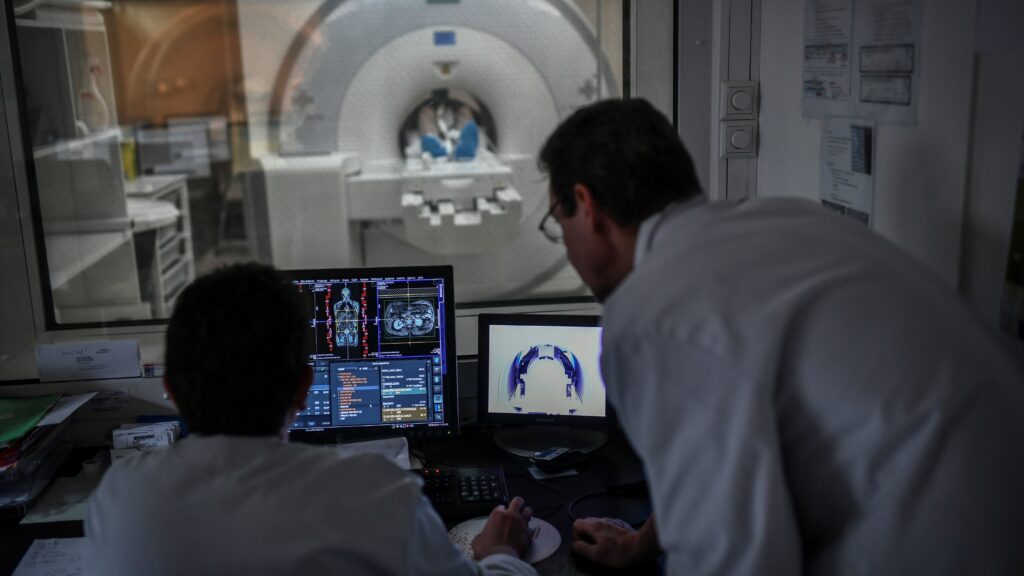
In October, President Trump revealed that he recently underwent an MRI and said that the results were “perfect.” He was not specific about what type of MRI he received, though later in the conversation with reporters, he brought up cognitive tests as well, suggesting he might have had an MRI of his brain.
Physicians cannot diagnose people they have not treated, but STAT asked a leading neurologist to consider the question: Why might a 79-year-old man need an MRI scan of his brain?
There are many reasons, each related to different types of brain disorders. Let’s begin by looking at the statistics.
Memory complaints are by far the most common reason that one would need a brain MRI. The Alzheimer’s Association 2025 Facts and Figures report notes that 13.2% of individuals ages 75-84 years have Alzheimer’s dementia, with the percentage increasing with age: The percentage jumps to 33.4% of people 85 and older. Dementia means that an individual’s cognition — their thinking and memory — has declined to the point that it interferes with day-to-day function.
Before one’s thinking and memory have declined to the point that they interfere with function, cognition may still be impaired, leading to daily tasks requiring more effort and taking longer to complete. This condition is called mild cognitive impairment, and it can be detected when people undergo cognitive testing, which is generally performed by a neuropsychologist. Its prevalence is 14.8% in those ages 75-79, and 25.2% in those aged 80-84. Adding the mild cognitive impairment prevalence (14.8%) to that of the dementia prevalence for 75- to 84-year-olds (13.2%), we have a prevalence of 28% for a 79-year-old to have either mild cognitive impairment or Alzheimer’s dementia. Thus, more than one-quarter of 79-year-olds have cognitive impairment, which would lead them to get a brain MRI as part of their workup. Alzheimer’s can be diagnosed with increased certainty if a blood, spinal fluid, or amyloid PET scan biomarker is positive.


STAT Plus: Trump keeps losing his train of thought. Cognitive experts have theories about why
Common symptoms of Alzheimer’s disease at the mild cognitive impairment stage include mild memory problems such as needing reminders, overly relying on GPS/phone apps to navigate even in familiar environments, misplacing and losing things more than before, word-finding difficulties, and trouble performing complicated tasks such as learning how to use a new software package, website, phone app, or board game.
Alzheimer’s disease is the cause of mild cognitive impairment and dementia approximately 60% of the time in people over the age of 75. But there are many other causes of dementia as well. Two disorders often mimic Alzheimer’s disease. Both have nice acronyms due to their long names. PART (primary age-related tauopathy) occurs in just about everyone who lives into their 80s or beyond. PART is believed to be one of the causes of “age-related” memory loss in individuals who do not have dementia, and so it is a large cause of mild cognitive impairment.
LATE (limbic-predominant age-related TDP-43 encephalopathy) is common cause of dementia and mild cognitive impairment in people over the age of 75. Although many people haven’t heard of LATE, in autopsy studies it is generally the third most common pathology observed in the brain, after Alzheimer’s disease and cerebrovascular disease.
Speaking of cerebrovascular disease — also known as strokes — these are incredibly common and become more common as individuals age, such that the risk of stroke roughly doubles every decade after age 55. So, an individual aged 79 has more than five times the risk of stroke as someone who is 55 years old. Risk factors for strokes in addition to age include heart disease, high blood pressure, diabetes, high cholesterol, obstructive sleep apnea, kidney disease, obesity, smoking, physical inactivity, unhealthy diet (particularly with ultra-processed foods), and excessive alcohol. Most 79-year-olds have at least some tiny “mini-strokes” that are observable on an MRI scan. If one has many of these mini-strokes, they can cause mild cognitive impairment or dementia. Strokes can be seen on an MRI scan, which is the imaging study of choice to make the diagnosis of cerebrovascular disease.
Symptoms of vascular mild cognitive impairment are similar to but not the same as those seen in Alzheimer’s disease, and include difficulty in or taking longer to do tasks, such as keeping information “in one’s head”; doing mental arithmetic like calculating the tip in a restaurant; following a route in one’s mind; figuring out how to use a software package, website, phone app, or board game; and finding words.
The last common cause of dementia is due to Lewy bodies. Lewy bodies, which are small clumps of protein inside brain cells that damage and then destroy them, are known for causing Parkinson’s disease, but they can cause mild cognitive impairment and dementia as well. When Parkinson’s disease starts first, we generally use the terms “Parkinson’s disease mild cognitive impairment” and “Parkinson’s disease dementia.” If the cognitive disorder starts first, we use the terms “mild cognitive impairment with Lewy bodies” and “dementia with Lewy bodies.” The core features of these disorders include cognitive impairment, signs of Parkinsonism, fluctuations in attention and alertness, acting out dreams while sleeping, and hallucinations (usually visual). Note that people don’t need to have all these symptoms to be diagnosed with a Lewy body disease. There are now spinal fluid and skin biopsy tests to diagnosis Lewy body diseases.

STAT Plus: The case against age limits for politicians
Finally, there are other reasons besides strokes and memory problems that a 79-year-old man might need an MRI scan. These include collections of fluid that can accumulate in between the brain and the skull, such as a subdural hematoma. Falls, especially if they include hitting one’s head, can cause subdural hematomas and other types of brain bleeding. Other reasons to get a brain MRI are persistent dizziness or trouble walking, either of which can lead to a fall.
An MRI is also needed if one has a seizure, which occurs in approximate a dozen people out of every thousand who are age 79. Sometimes a headache is bad enough or persistent enough or unusual enough that one should get an MRI scan to rule out a brain bleed or brain tumor. Lastly, if someone has hearing loss in one ear it could also be due to a brain tumor, so that’s another reason to get an MRI scan.
So, in summary, there are many reasons why a 79-year-old man might need to get an MRI scan. Some reasons are relatively benign, such as a headache or hearing loss, and others are more worrisome, such as signs of stroke or memory loss. Many would require ongoing monitoring.
Andrew Budson, M.D., is a professor of neurology at Boston University and the author of six books, including “Seven Steps to Managing Your Aging Memory” and “Why We Forget and How to Remember Better.”