
NEED TO KNOW
At age 41, Linda Doane was diagnosed with stage 4 non-Hodgkin’s lymphomaIn 2022, she was finally told she was in remission However, in 2025, she caught pneumonia and now tells PEOPLE it was a “miracle” she survived
Linda Doane says she was always “really healthy,” which made her shocking diagnosis at age 41 that much harder to grapple with.
The mother of five tells PEOPLE that she started “having trouble breathing and ended up in the hospital after seven lung taps and many weeks of testing.”
Ultimately, they determined she had stage 4 non-Hodgkin’s lymphoma.
“That was a journey that lasted over 10 years. I’ve had eight different IV chemos,” Doane, now 55, tells PEOPLE exclusively. “I’ve had three oral chemos. I have lost my hair three times. I’ve had methotrexate injected into my spinal fluid. When it spread to my brain, they found that out through a brain biopsy. Pokes, prods, procedures. I know hard things for sure.”
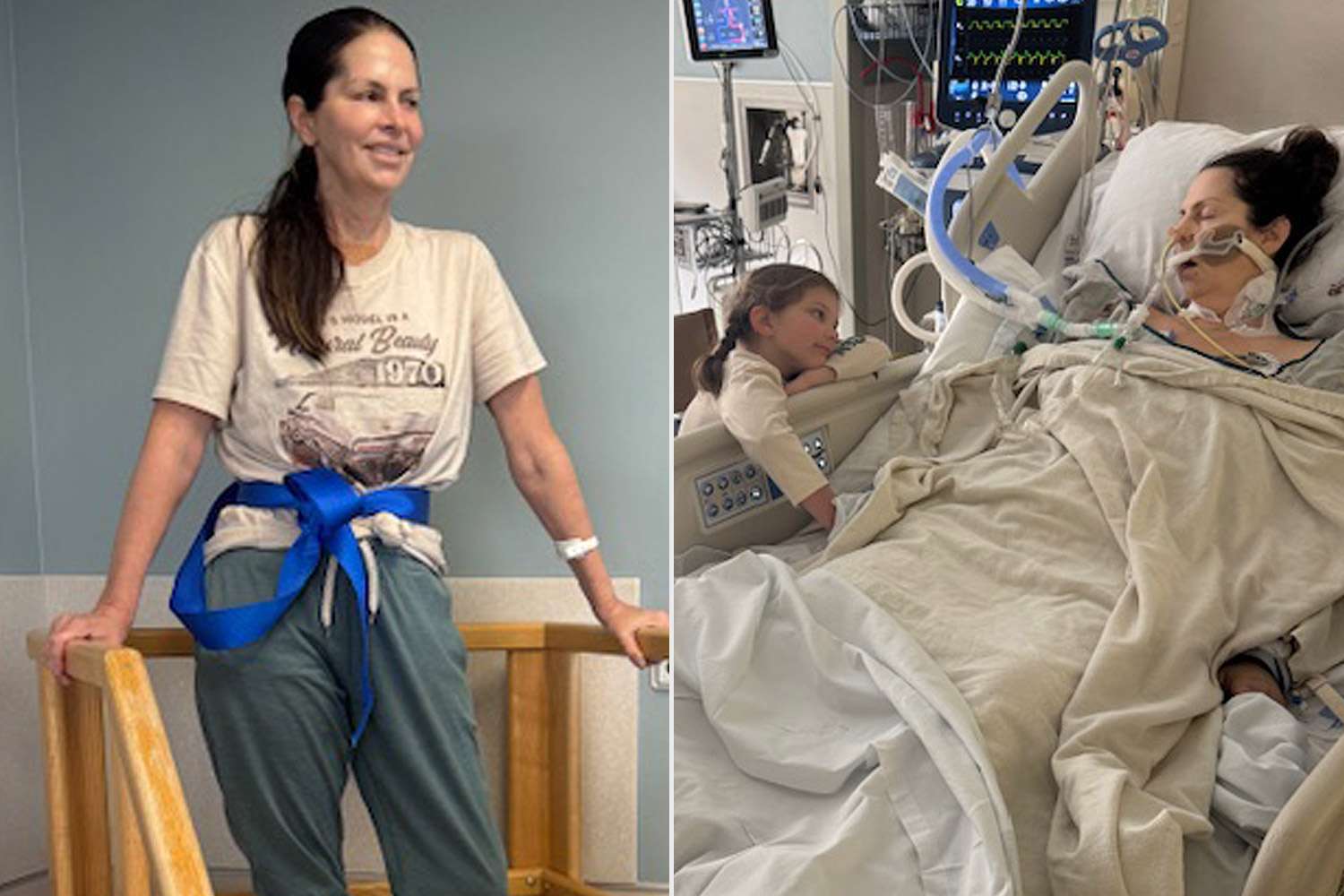
Linda Doane in the hospital.
Linda Doane
During her treatment, Doane focused on regular exercise and maintaining a routine. However, after losing her hair for the third time, she felt less comfortable leaving her house to work out at the gym. It was then that her sister and brother-in-law introduced her to their Tonal workout machine, which allowed for private but extensive workouts — and later helped save her life.
Doane received her second CAR T-cell therapy, a type of immunotherapy that uses a patient’s own T-cells, which breached her brain barrier in August 2021. From that very month until May 2025, she never missed a week of workouts, using it anywhere from two to four times a week. During that period, in 2022, Doane also received news that she was in remission.
However, May 2025 would prove to be a month of “unimaginable trauma” for Doane. It started as a slight cough and a general feeling of being under the weather. Being three years removed from her cancer journey, she thought she could rest and recover, but ended up in urgent care with a pneumonia diagnosis.
“I got ambulanced to the hospital, and within two days at the hospital, by day three, they called my family to come and say goodbye,” she says.
Linda Doane in the hospital.
Linda Doane
Her husband took pictures of all her vitals and machines. He then ran them through an AI software, which suggested doctors put her on ECMO (extracorporeal membrane oxygenation), a form of life support that temporarily takes over the functions of the heart and lungs if the body can’t do it on its own.
While the hospital Doane was at didn’t have one of the machines, their sister hospital did. However, doctors didn’t want to risk the 25-minute ambulance ride, believing she would die, so Doane took an eight-minute survival flight.
“They hooked me up rather quickly to ECMO. I was on ECMO for two weeks, and then I was on the ventilator,” Doane shares. “ECMO was a whole different level of challenging, with no preparation. It’s not like you get diagnosed with something and you talk about your options. You get put on ECMO when you’re already in a medically induced coma. Then, that decision’s out of your hands.”
“I woke up, tied to a bed and with a ventilator and everything, and it was by far the hardest thing I’ve ever dealt with in my entire life,” she adds.
Doane notes that “getting off of ECMO in the first place is a miracle.”
“You have a 50% chance [of survival]. Once I got off the ECMO and I was on the ventilator, I was tube-fed, tied down and didn’t get to move around for 42 days,” she shares. “My doctor said, once I started to digest what happened, she said, ‘Let me put it in perspective for you, out of over 1,100 beds in this hospital, you were the sickest person here.’ ”
After the ventilator, she was moved to a different breathing machine for three days, and then to physical therapy. When discussing continuing physical therapy at home, Doane’s physical therapist believed in her strength and ability to continue, as she had already done the “pre-work” after so many years of consistent exercise.
“I had never felt in better shape, really in my entire life,” she tells PEOPLE. “I thought I was preparing for a Mediterranean cruise, which I did not get to go on, but instead, what I was really preparing for was the hardest, most challenging, most traumatic thing that my body has ever been through.”
Linda Doane being loaded into a helicopter.
Linda Doane
When she finally returned home, most of her strength was gone, and her husband had to carry her inside. Still, she insisted on doing as much as she could, climbing up the stairs to their bedroom as she put her hands on the steps while her husband lifted her bottom half.
“My husband said, ‘I could carry you.’ I told him, ‘The more I do for myself, the faster I will recover,'” she recalls. “I was back to Tonal in two months.”
“I used the walker for two weeks. I had to have support on the toilet, to help me because I didn’t have my strength,” she shares. “The muscle mass and strength you lose when you’re tied down for over a month, you can’t even put it into words, the weakness that your body’s feeling. I ditched the walker in two weeks [and] the cane two weeks after that.”
After two months of recovery, Doane went back to the hospital and met the healthcare workers who helped save her life, bringing them a gift basket. They couldn’t believe her progress and that she was already walking, as half the patients put on ECMO don’t even survive.
“It is just incredible, to make that type of recovery and to go back and be able to talk to the people who helped you through it, it’s an amazing, incredible story,” Doane shares.
Linda Doane’s Tonal machine at her home.
Linda Doane
Now, nearly six months later, Doane says her care is now check-in scans and minimal visits. She also gets her bloodwork done every six months to ensure her cancer hasn’t returned.
“None of us know what we’re gonna deal with in life. We don’t know the challenges that we’re going to face,” she tells PEOPLE. “If there’s anything that we can do physically, spiritually or emotionally to prepare for that, then we should do it. Tonal prepared me to go into something very traumatic in optimal condition.”
Her advice, she continues, is for people to “take care” of themselves, so if something does happen, they’re ready.
“We don’t know what’s coming. Do the pre-work, and then whatever comes, we can face it,” she says. “Life is a blessing, and there’s just so much joy to be had every day. I hope people live that way. It’s a blessing. Being alive is a blessing.”