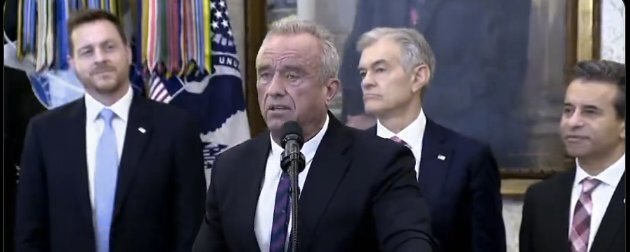
Robert F. Kennedy Jr. stood in the Oval Office on Thursday, flanked by pharmaceutical executives, celebrating a deal to expand access to weight-loss drugs. “This is a tool in the toolkit,” he declared, calling it “a momentous accomplishment.”
Rewind a few months. Same guy, different tune.
“They’re counting on selling it to Americans because we’re so stupid and so addicted to drugs,” Kennedy told Fox News viewers about Ozempic and its manufacturer Novo Nordisk. He claimed the drug wouldn’t “Make America Healthy Again” and insisted that spending money on “good food” instead could “solve the obesity and diabetes epidemic overnight.”
He also spread demonstrably false information, claiming Novo Nordisk doesn’t market Ozempic in Denmark and that Europe was investigating it for causing suicidal thoughts. Neither claim was true. Denmark uses so much Ozempic they had to restrict access for cost reasons, and European regulators concluded in April 2024 that there’s no evidence linking GLP-1 drugs to suicidal ideation.
What Changed?
Thursday’s announcement means injectable GLP-1s like Wegovy and Zepbound will be available through a Trump-branded website called TrumpRx for around $350 monthly (trending down to $245), with Medicare patients paying just $50. Oral versions, once FDA-approved, will start at $149. The deal also expands Medicare coverage to include these drugs for obesity—a first.
Kennedy projected Americans would collectively lose “125 million pounds” by next year. Dr. Mehmet Oz, standing beside him, claimed the plan would be “budget-neutral within two years.”
It’s worth noting what didn’t change: the drugs’ efficacy, safety profile, or the science behind them. Clinical trials still show 15-20% average body weight loss. The medications still work the same way they did when Kennedy was calling Americans “stupid” for wanting them.
The Pharma Partnership
The irony runs deeper. Kennedy built his political brand on attacking pharmaceutical companies. Now he’s celebrating deals with Eli Lilly and Novo Nordisk—companies that will see massive revenue increases from expanded Medicare and Medicaid coverage. Eli Lilly pledged $27 billion in U.S. manufacturing investments; Novo Nordisk committed $10 billion.
Both companies also received FDA vouchers to expedite drug approvals—a regulatory gift that could be worth hundreds of millions.
The Medical Community Responds
Doctors who treat obesity weren’t impressed by Kennedy’s earlier rhetoric. “It is wrong to assume that people with high body weight and BMI just sit around and eat low-quality food,” Dr. Jody Dushay told CNN. “Taking medication to treat obesity should not be demonized.”
Kennedy’s claim that diet and exercise alone could solve obesity “overnight” contradicts decades of research. “The challenge we have is that there have been multiple trials that have tried to see: Can we markedly improve people’s health and get substantial weight loss with diet and exercise?” said Dr. Daniel Drucker, a pioneer in GLP-1 research. “And the answer’s been no; people lose a little bit of weight.”
Nobody’s arguing against healthy food or exercise. The question is whether medications should be part of the toolkit—something Kennedy apparently now agrees with, despite months of saying the opposite.
The Politics of It All
There’s bipartisan support for making these drugs more affordable. The Biden administration also pushed for expanded coverage in its final days. But Trump’s deal comes with branding—literally. TrumpRx. The website. The photo op. The pharmaceutical executives standing behind the president like props.
And then there’s the spectacle itself. During Thursday’s announcement, a pharmaceutical executive collapsed in the Oval Office. Dr. Oz rushed to help. Trump stood frozen behind his desk, visibly annoyed that his press conference had been interrupted. Kennedy bolted from the room.
What This Actually Means
The deal isn’t terrible policy. Making expensive medications more affordable helps people who need them. Expanding Medicare coverage addresses a real gap. The prices, while still high, represent genuine reductions from current retail costs.
But it’s not the revolution being advertised. Novo Nordisk and Eli Lilly already offered direct-to-consumer pricing of $499 and $349-$499 monthly, respectively. The new prices are lower, but not dramatically so. And only about 10% of Medicare enrollees will qualify under the new coverage rules.
The real winners? The pharmaceutical companies Kennedy spent months attacking. They get expanded government coverage, regulatory fast-tracking, and a health secretary who’s suddenly singing their praises.
The Bigger Picture
Kennedy’s reversal on Ozempic matters because it reveals how policy actually gets made in this administration. Ideology bends to political convenience. Yesterday’s corporate villains become today’s partners. The science doesn’t change, but the messaging does—completely.
“He acts like he knows what he’s talking about when he doesn’t,” Dr. Michael Osterholm told CNN, “and he says things with a definition that makes people convinced he has the data to support his statement.”
That’s the pattern. Confident assertions. Shifting positions. No acknowledgment of the contradiction.
Americans struggling with obesity deserve access to effective treatments. They also deserve honesty about what those treatments can and can’t do, and consistency from the people making health policy decisions.
What they got instead was a health secretary who called them “stupid” for wanting these drugs, then took credit for making them more available—all while standing next to executives from companies he’d spent months demonizing.
The drugs work the same either way. But the whiplash is real.
Share this article on Bluesky, Facebook, and X/Twitter.