
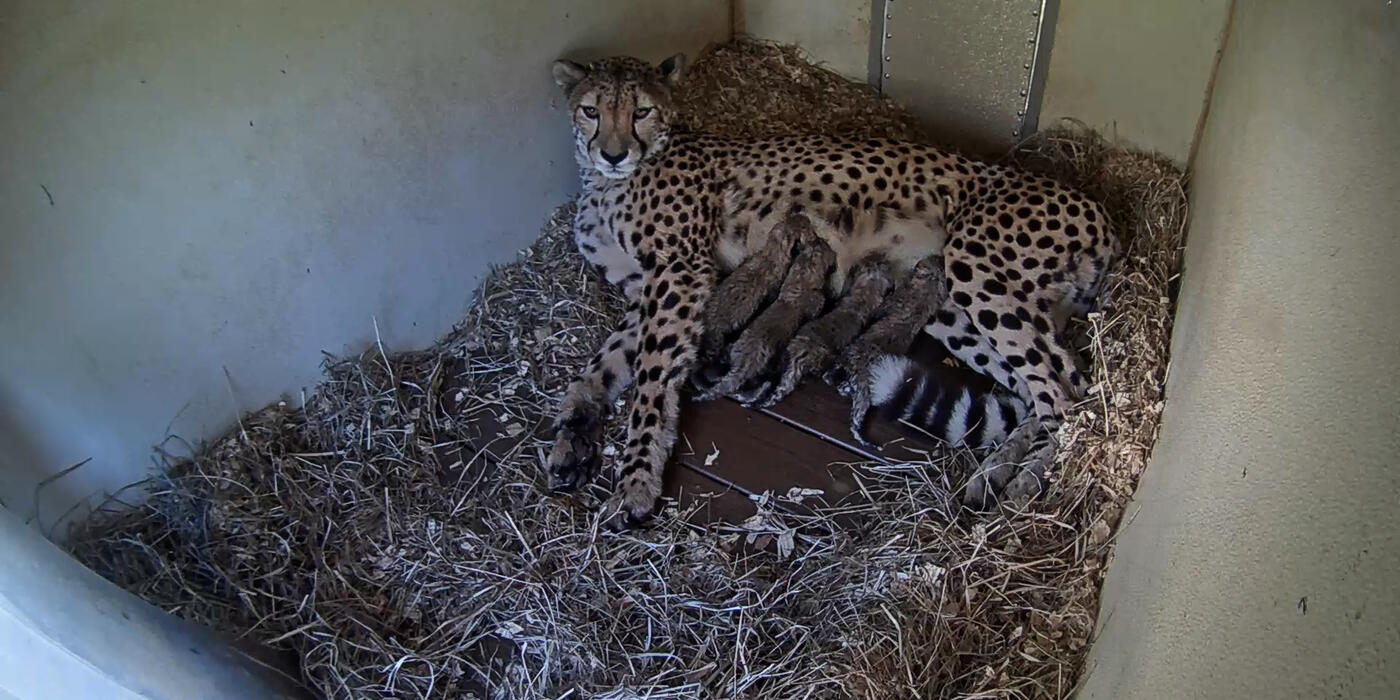
Carnivore keepers at the Smithsonian’s National Zoo and Conservation Biology Institute (NZCBI) in Front Royal, Virginia, are celebrating a litter of four cheetah cubs born to 5-year-old adult female Amabala Oct. 17 and 18. Viewers can enjoy watching the cubs grow via the Cheetah Cub Cam, a live camera feed available on the Zoo’s website. Note that Amabala may move her cubs out of the den and around her habitat, so they may be out of view at times.
To allow first-time mom Amabala to bond with and care for her cubs, staff are remaining hands-off but are watching the cam in case they need to step in. The cubs appear to be strong, active, vocal and eating well. The litter was sired by Flash, an 8-year-old male who has three surviving cubs from a previous litter. Male cheetahs do not play any role in raising their young.
The births mark two special milestones: Amabala’s litter is the 20th litter born at the Front Royal campus and the fifth litter to be broadcast through the Cheetah Cub Cam. Amabala herself was born on camera in 2020.
“Cheetahs can be challenging to breed, in part because female reproductive cycles can be sporadic and their behavior is often very difficult to interpret,” said Adrienne Crosier, a carnivore biologist at NZCBI who leads the cheetah Species Survival Plan (SSP). “It’s taken our team of keepers, veterinary staff and biologists thousands of man-hours to produce 20 litters. For that 20th litter to be Amabala’s is an exciting, full-circle moment for us.”
NZCBI is part of the Cheetah Breeding Center Coalition—a group of 10 cheetah breeding centers across the United States that aim to create and maintain a sustainable North American cheetah population under human care through the Cheetah SSP. In coordination with the Association of Zoos and Aquariums’ population management center, scientists and animal care staff determine which animals to breed by considering their genetic makeup, health and temperament, among other factors. As Flash is a genetically valuable individual within the North American population, these cubs will likely play an important role in the future breeding program.
Cheetahs live in small, isolated populations mostly in sub-Saharan Africa. Many of their strongholds are in eastern and southern African parks. Due to human conflict, poaching and habitat and prey-base loss, there are only an estimated 7,000 to 7,500 cheetahs left in the wild. The International Union for Conservation of Nature considers cheetahs vulnerable to extinction.
# # #
Photo caption 1: Four healthy cubs were born Oct. 17 and 18 to parents Amabala and Flash.
Photo credit 1: Smithsonian’s National Zoo and Conservation Biology Institute.
Photo caption 2: Amabala was part of the first cheetah litter to be showcased on the Cheetah Cub Cam.
Photo credit 2: Brooke McDonough, Smithsonian’s National Zoo and Conservation Biology Institute.