
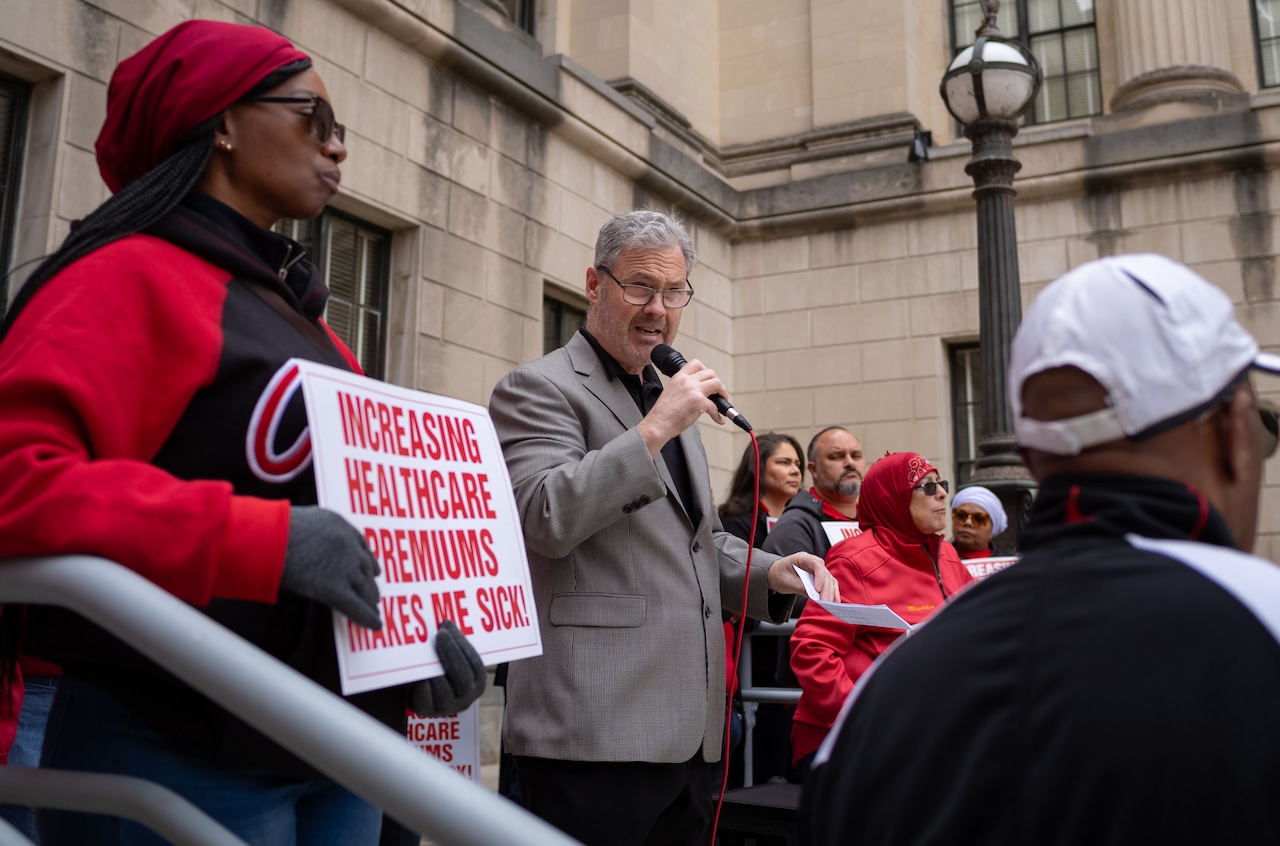
The State Health Benefits Program that insures nearly 150,000 county and municipal employees in New Jersey is broke and headed for collapse next year, unless members agree to pay thousands of dollars more for their coverage, Gov. Phil Murphy announced Thursday.
The Democratic governor proposed spending $260 million in state funds to rescue the program by paying off its debt and creating a reserve fund to pay unforeseen excessive claims. But workers would have to pay much more in premiums and out-of-pocket costs. They will also see their choice of plans reduced from 50 to six, according to the governor’s office.
Premiums have risen 59% over the last three years, causing dozens of the largest counties and municipalities to flee for cheaper insurance options. That’s left behind a weaker, sicker pool of members and a program that is headed for disaster, state officials have said.
Murphy outlined the proposal in a speech at the New Jersey League of Municipalities’ annual conference in Atlantic City, which is heavily attended by members of the state Legislature, labor leaders and local government officials.
A majority of the 40-member state Senate and 80-member state Assembly would have to approve a bill containing his proposed changes — and fast. Murphy leaves office after eight years on Jan. 20, when Gov.-elect Mikie Sherrill becomes New Jersey’s chief executive and inherits this problem.
“Unless we take sweeping action — now — to shore up this program, there are tens of thousands of New Jerseyans whose access to health care will be in serious jeopardy. And next June’s rate increases will be astronomical. We cannot allow that to happen,” Murphy said in his speech.
“Our administration is willing to provide a quarter-billion dollars in the short-term to keep the State Health Benefits Program for Local Government solvent in exchange for smart, structural reforms that will stabilize the program in the long-term,” Murphy said, according to a copy of his prepared remarks. “Of course, achieving this goal will require hard decisions. But that is what good government is all about: making reasonable reforms to advance the public good.”
The proposal will likely alarm many of the 146,000 state and local government workers who are accustomed to having the state pay for 98% of insurance costs while shouldering modest co-pays and premiums. Generous health benefits have long been the incentive for people to take government jobs that tend to pay less than opportunities in the private sector.
At least one labor leaders briefed on Murphy’s proposal before the speech rejected it, calling it “a joke.”
“Any legislator that would listen to Gov. Murphy when it comes to health care should have their head examined,” said Steve Tully, executive director for the American Federation of State, County and Municipal Employees New Jersey.
“This is not a reform, it’s an insurance executive dream, something they are trying to ram down our throats,” added Tully, whose union represents 20,000 local, state and higher education workers.
Labor leaders have repeatedly asked the state to adopt strategies to hold down the rising costs of health care, such as reimbursing hospitals and doctors based on what Medicare pays to cover people 65 and older and disabled, Tully said. This proposal, aside from the $260 million bailout, doesn’t measure up.
“Asking people to pay more without addressing the root cause of the problem is ridiculous,” he said.
State officials and health policy experts say it’s time state taxpayers are spared the cost of these generous benefits that are out of step with the higher premiums and deductibles in the private sector.
Workers would see their copays triple in some cases—from $10 to $30 for a doctor’s visit, and from $75 to $300 for emergency room care, according to a description of a new Preferred Provider Organization or PPO plan.
Pricier deductibles would also apply under the new PPO plan. Members now pay no deductible for in-network care and a $250 deductible for a family’s out-of-network coverage, according to the State Treasury Department. But workers and their families would face a $2,500 deductible for in-network care and a $5,000 deductible for out-of-network care.
Members would also be offered a high-deductible plan, and a tiered-network plan which traditionally saves money by limiting which doctors or hospitals are covered. The state would cover 78% of costs in the high-deductible plan and 88% in the PPO plan, officials said.
The state would also save money by reducing the number health plan choices to just three each from Aetna and Horizon, according to the proposal.
The state’s contribution would help stabilize the roughly $2.27 billion insurance program by paying $260 million — a $180 million loan to settle past claims and $80 million to place in reserve should expenses soar unexpectedly. The investment would reduce premiums sometime in 2026, according to the proposal.
The proposal also would create new rules for how the program is governed. A seven-member commission that for the first time includes municipal employers would oversee the operation, replacing a 12-member panel that frequently deadlocked when voting on changes that could have protected the program from financial ruin. Towns and counties that enroll in the program would have to remain for a minimum of five years, to help combat the exodus that occurred after premiums soared in the last several years.
State Senate President Nicholas Scutari, D-Union, said Murphy’s proposal offers “an opportunity for compromise” based on what his members in the Senate and those in the Assembly are already considering.
They all agree that any bill must reduce the number of plans, control how often municipal and county governments are allowed to leave the program and “break the stalemate between management and labor,” Scutari said in a statement.
Assembly Speaker Craig Coughlin, D-Middlesex, declined to comment on the specifics of Murphy’s ideas. “We welcome discussions about how to lower costs for taxpayers and municipalities while providing quality, affordable health insurance to public workers and look forward to finding common ground,” Coughlin said in a statement.
Separately, the state employee portion of the State Health Benefits Program is also in financial trouble. In September, labor leaders agreed to accept $75 million in premium and copay increases that will take effect next year.
Health care analysts say premiums have skyrocketed because hospitals and medical professionals are charging more and people are using their benefits for expensive drugs, like the GLP-1 injections for weight loss. Local government employees now pay a $16-a-month for these drugs and would see their share rise to $45 a month, according to the proposal. Consumers pay a minimum of $349 a month without insurance.
About 95% of local government employees are enrolled in “platinum-level” plans, Treasury officials said.
The annual cost of public worker coverage in New Jersey was $22,000 in 2023, according to a consultant’s report that called for broad changes to the plan to save it. That’s 60% more than average cost of private and public sector plans nationally.
If you purchase a product or register for an account through a link on our site, we may receive compensation. By using this site, you consent to our User Agreement and agree that your clicks, interactions, and personal information may be collected, recorded, and/or stored by us and social media and other third-party partners in accordance with our Privacy Policy.