
SPOILER ALERT: This article contains major spoilers for plot points, cameos and the ending of “Wicked: For Good” now playing in theaters, as well as minor spoilers for the “Wicked” stage show.
“Wicked” makeup designer Frances Hannon had her work cut out for her.
After successfully finding the perfect verdant hue to turn Cynthia Erivo green, she had to continue each character’s arc for the film’s conclusion, “Wicked: For Good.”
“For Good” doesn’t just continue the story of Elphaba (Cynthia Erivo) and Glinda’s (Ariana Grande) friendship; it also gives the backstory of Dorothy’s companions: The Tin Man, The Cowardly Lion and The Scarecrow.
Fiyero (Jonathan Bailey), who is in a love triangle with Elphaba and Glinda, becomes the Scarecrow, while Boq (Ethan Slater), a Munchkin, transforms into the Tin Man. All the transformations were done practically.
Here, Hannon breaks down how Slater and Bailey transformed into their respective characters.
Boq’s Transformation

In “Wicked,” Boq becomes smitten with Glinda the moment he lays eyes on her on their first day at Shiz University. But Glinda has her eyes set on Prince Fiyero, so she convinces Boq to court Nessarose instead. Nessa believes Boq truly cares for her.
In “Wicked: For Good,” Nessa becomes the Governor of Munchkinland after her father dies. When Boq tries to leave, she uses her power to oppress the Munchkins, forcing Boq to stay with her. When Elphaba learns of this, she visits her sister to try to help. However, things go wrong, and Nessa casts a spell from the Grimmerie, hoping to have Boq’s heart. Things end with Elphaba regaining control and stepping in.
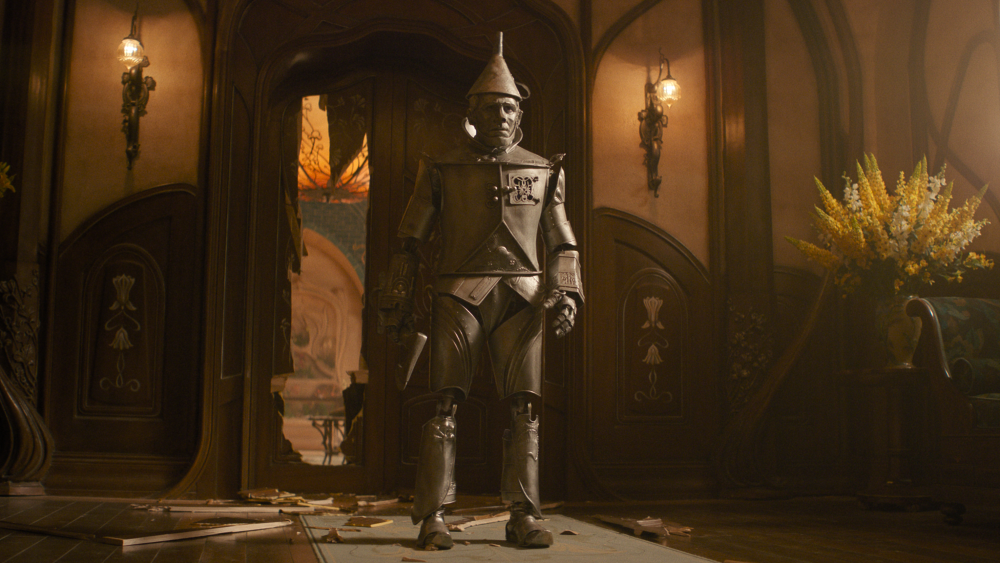
During the scene, Boq begins to feel his heart shrink, and metal starts attaching itself to him. Elphaba leaves, telling Nessa that he is asleep. After she leaves, he awakens and smashes through the door with an axe. Boq is now the Tin Man with no heart, and his transformation is complete.
In pulling it off, Hannon explains that Jon M. Chu and Marc Platt were very specific about what they wanted. It also required a collaboration with production designer Nathan Crowley, costume designer Paul Tazewell and prosthetic makeup designer Mark Coulier. “The main thing was to make sure that whatever we did never removed the character from being so accessible and allowing all that emotion to come through,” Hannon says. “Even though he’s covered in prosthetics, and they were all practical, you still saw Boq underneath it all.”
Aside from keeping his emotions intact, the details of what made him the Tin Man were just as important.
Coulier began by making a plaster cast of Slater’s face. A few weeks later, Slater saw the Tin Man design on a Styrofoam head. He recalls thinking, “It doesn’t really look like me; it looks like the Tin Man.” Coulier assured him that the pieces would stretch to contour to his face.
In total, Slater says 11 pieces were applied to his face, including cheekbone prosthetics that changed his cheek line and additional pieces to alter his jawline.
The application process took four hours. “I would go sit in the prosthetics chair with the team, and they would start applying glue to my eyebrows to tack them down,” Slater explains. “They started layering on these pieces of silicone, piece by piece. It needed to be meticulous and precise.”
Slater’s eyelids and lips were painted silver, and he wore dentures. “I had contacts to make my eyes gray-silver,” he adds.
The actor recalls seeing himself in the mirror for the first time: “I couldn’t believe what I was seeing. It looked like me, but it didn’t look like me. The thing that really blew my mind was it didn’t look anything like it did on the Styrofoam head because it had completely morphed to my face. I could lift an eyebrow, and the eyebrow would lift, and you could see my dimples come through.”
The Tin Man’s body was developed using metal pieces from Nessa’s office. Hannon says, “The little square where his heart would be was part of the fireplace. On the tray were sugar bowls and milk jugs, and the handles of the jug were his ears. On his fingers were salt and pepper pots, thimbles, and bits from the fireplace.” She adds, “The little rivets around the edges were very delicate and hand-picked and chosen by Jon.”
Hannon worked with Coulier to find the balance of keeping Slater’s performance visible through the design. “You want him to still have a human quality, so you don’t give him a bulbous nose from the teapot or anything silly. You stay within all the parameters that leave the human that brings the Tin Man to the performance.” When designing him, they wanted to nod to the previous film without copying what had come before. “We started by looking at the silvers. The arms had to match the face. Mark [Coulier] painted the pieces in advance. It matched the other pieces on his body, but it didn’t look different from the other parts.”
By the time of “March of the Witch Hunters,” there was a slight progression in his makeup.
The tin was now starting to show details of rust after he had been out in the rain.
As for Slater’s hair, it needed to be scraped and flattened before a bald cap could be put on. Boq was given extension pieces to make his hair “architectural and big.” Slater says the bald cap was as tight as possible. “It took about 30 minutes to do because there’s a lot of hair there. I feel like I have a lot of hair now, but this was three times as much.”
Hannon adds, “The little funnel went on at the last minute.” In total, “It took roughly four hours. The suit was left to last because once he was in that suit, he was pretty much standing all the time.”
In addition to the practical makeup, VFX was used. Chu gave credit to the VFX team for their work, saying, “There were mechanical joints on the Tin Man body that were done by VFX and some seams cleaned up.”
Fiyero’s Transformation
Universal
Fiyero’s transformation is foreshadowed. The lyrics of “Dancing Through Life” hint at what his future holds, and costume designer Paul Tazewell weaves the easter egg into his Emerald City guard costume.
During “No Good Deed,” Elphaba casts a spell to protect Fiyero from torture after he’s been captured by the Wizard’s guards. The spell turns him into a Scarecrow, which allows him to live.
Hannon says they definitely took a nod to the film in creating the Scarecrow.
She explains, “We didn’t go for that big baggy look over the head with the big rope around his neck. What Paul Tazewell did was brilliant. He went for the straw coming out of the areas of the seams and everything in his uniform.” She adds, “Mark had made a burlap collar so that where the buttons on the shirt were all busting open.”
Hannon made the Scarecrow’s wig and eyebrows from grass and straw.
“I used blonde in Fiyero’s hair as a very strong point to carry through that change. The blonde in his own hair in film one and the opening of film two, then develops into the straw quality from the field.”
The wig was made from heads of wheat and sewn in, but with very little hair in it,” She adds, “Then you had that cute little cap that Paul designed from bark on the top.”
Additionally, Hannon points to a subtle detail in Jonathan’s eyes. Fiyero comes from Winkie Country, which is very much in the blue palette. Hannon says, “He had blue contact lenses. When he goes to Scarecrow, we went back to Jonathan’s own color eyes, which are really deep, dark brown, to bring back the earthy quality.”