

A recent survey shows that the U.S. stock market will be boosted by corporate earnings this quarter, enough to offset tariff risks. Nearly two-thirds of respondents believe that U.S. stock returns will outperform U.S. Treasury bonds, with the Technology Industry receiving the highest expectations. The profit growth of the Mag7 is expected to reach nearly 15%.
A recent survey shows that although tariffs cast a shadow over business prospects, the U.S. stock market will be boosted by corporate earnings this quarter, with strong earnings performance enough to overshadow the risks posed by trade policies.
According to the latest Bloomberg Markets Pulse survey, nearly two-thirds of respondents believe that adjusted returns from Stocks will outperform U.S. Treasuries as the earnings season fully unfolds in the coming weeks. This survey, conducted from July 10 to 17 among 102 market participants, indicates that the positive outlook for the stock market continues to be supported by the Technology Industry, with respondents expecting this sector to perform the strongest during the upcoming earnings season.
 The U.S. stock market’s second-quarter earnings season has just begun, but the earnings expectations for the S&P 500 Index have already exceeded analysts’ initial forecasts. Before the earnings season commenced, Wall Street predicted earnings growth of only 2.8%, the slowest increase since mid-2023. However, as the Bank reports solid performances, the overall earnings growth estimate has been slightly raised to over 3%.
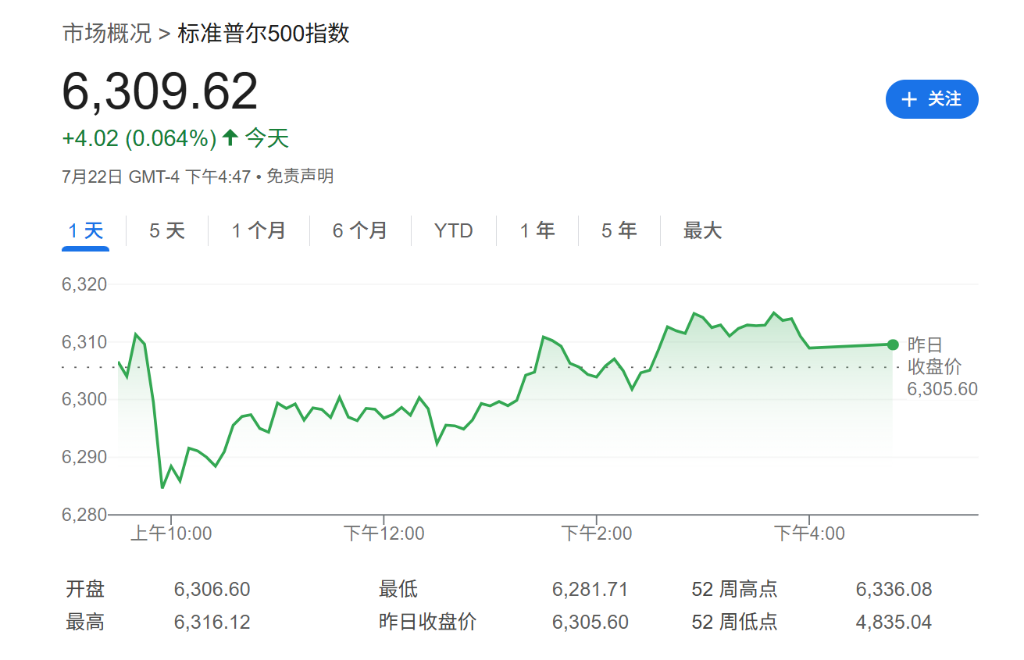
As of the time of writing, the S&P 500 has slightly increased to 6,309 points.
 Technology giants are likely to continue leading the rise in U.S. stock market earnings.
The core of this earnings season’s outlook is the growing performance gap between technology giants and other companies. Data shows that driven by strong demand for artificial intelligence, profits for the Magnificent Seven (Mag7) are expected to grow by nearly 15%. In sharp contrast, the profit growth for the remaining 493 companies in the S&P 500 Index is expected to be ‘almost zero.’
Max Gokhman, Deputy Chief Investment Officer at Franklin Templeton Investment Solutions, stated in an interview:
“When many companies previously lowered or even suspended their earnings guidance, setting very low expectations, once the Earnings Reports are released and exceed expectations, it will make the U.S. market appear attractive again.”
He added:
“As the Earnings Reports of Technology companies begin to be announced, it will again prove that they remain a force that cannot be ignored in the market.”
Despite the bullish outlook for profits, tariff risks remain the primary focus for investors. Survey respondents overwhelmingly identified tariffs as the biggest risk to corporate profit outlooks for the remainder of the year, believing that non-essential consumer goods companies are the most vulnerable under tariff pressure on profit margins.
The impact of tariffs has already begun to show in some companies’ Earnings Reports. General Motors reported on Tuesday that its profits were hit by $1.1 billion due to tariffs. Meanwhile, since the implementation of new tariffs, inflation data has only shown signs of a portion of companies passing on costs to consumers, suggesting that many companies may be absorbing part of the impact themselves.
Few have really positioned themselves for tariffs.
It is worth noting that there is a clear divide between investors’ perception of risk and their actual investment behavior. Gokhman pointed out:
Interestingly, while people generally believe that tariffs are the biggest risk, very few have actually made adjustments in their portfolios for this.
Part of this disconnect is due to different companies exploring various ways to mitigate the impact of tariffs. According to Morgan Stanley, companies are addressing this by diversifying their supply chains, leveraging pricing power, and renegotiating with suppliers. Analysts, including Michael Wilson, wrote in a report on Monday:
“We have not heard widespread serious concerns about the impacts of tariff-related costs on profit margins from companies in the Index.”
They acknowledge that the situation may change in the third quarter, but “so far, most of the impact has mainly been reflected in the consumer goods sector.”
This sentiment is also reflected in investors’ positions. Surveys show that slightly more than half of the respondents stated they would keep their Stocks exposure unchanged over the next month. This indicates that investors’ confidence in the U.S. stock market is overshadowing any concerns triggered by trade uncertainties.