
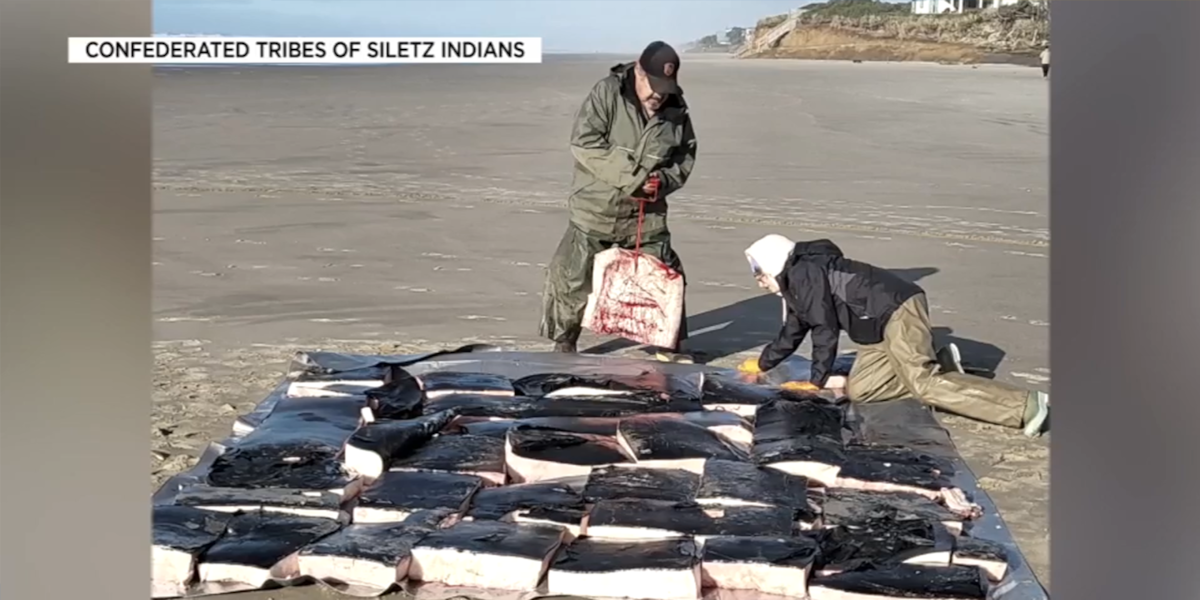
YACHATS Ore. (KPTV) – The Confederated Tribes of Siletz Indians harvested parts of a humpback whale that beached in Yachats last week, marking the first whale salvage for the tribe in generations.
The 26-foot humpback whale, estimated to be one to two years old, beached alive while tangled in crab lines. After days of attempting to return the whale to the ocean, NOAA Fisheries determined the most humane option was euthanasia.
“This magnificent creature had given its life for this opportunity,” said Lisa Norton of the Confederated Tribes of Siletz Indians.
Oregon State University researchers and veterinarians administered sedatives as Siletz tribe members offered prayers. The tribe returned the following day to harvest the whale alongside OSU’s necropsy work.
“We wanted to be really respectful of the journey this whale had had and the impact it had on the community,” Norton said.
SEE ALSO:
A 250-pound pet pig is on its way to a better home thanks to Portland Fire & Rescue and its Community Health Outreach Program, called “CHAT.”
The tribe was already gathered on the coast for their Restoration Holiday Powwow, and incorporated prayers for the whale into the practice. The prayers continued when tribe members gathered in person with the whale as it died.
The next day, Oregon State Police, which contacts the tribe when an animal has been illegally hunted or harvested, reached out with an unexpected request: the harvest of the humpback.
They quickly secured the necessary permits and got to work. The collaborative effort saw OSU researchers collecting scientific data while the tribe’s experienced hunters worked to salvage usable parts.
“We’re doing this with you,” she said. “Where are you at with your necropsy? With your information gathering? What are your next steps?”
The harvest represents a return to historical practices for the tribe.
“It is a rekindling of some of our historical subsistence practices,” Norton said. “We’re salvaging the whale for cultural purposes, but it’s not like we come with a handbook.”
Working against the rising tide and setting sun, the team carefully disposed of chemically affected parts and harvested blubber, bones and baleen.
TruNorth Construction used equipment to help get the whale off-site so tribe members could continue their work over the next week. Now, the blubber has been frozen and bones buried while the tribe determines appropriate and safe uses with OSU guidance.
The harvested materials could be used for regalia, soap or furniture.
“We didn’t want visions of a horror movie. We wanted to be respectful,” Norton said.
Norton called the experience significant for the tribe, and an honor for the volunteers on the beach.
“I almost don’t have words for it because it was such a momentous event,” she said.
NOAA is continuing to study samples collected from the whale, and the Oregon Department of Fish and Wildlife is investigating factors that led to the whale becoming tangled in crab lines.
Copyright 2025 KPTV-KPDX. All rights reserved.