
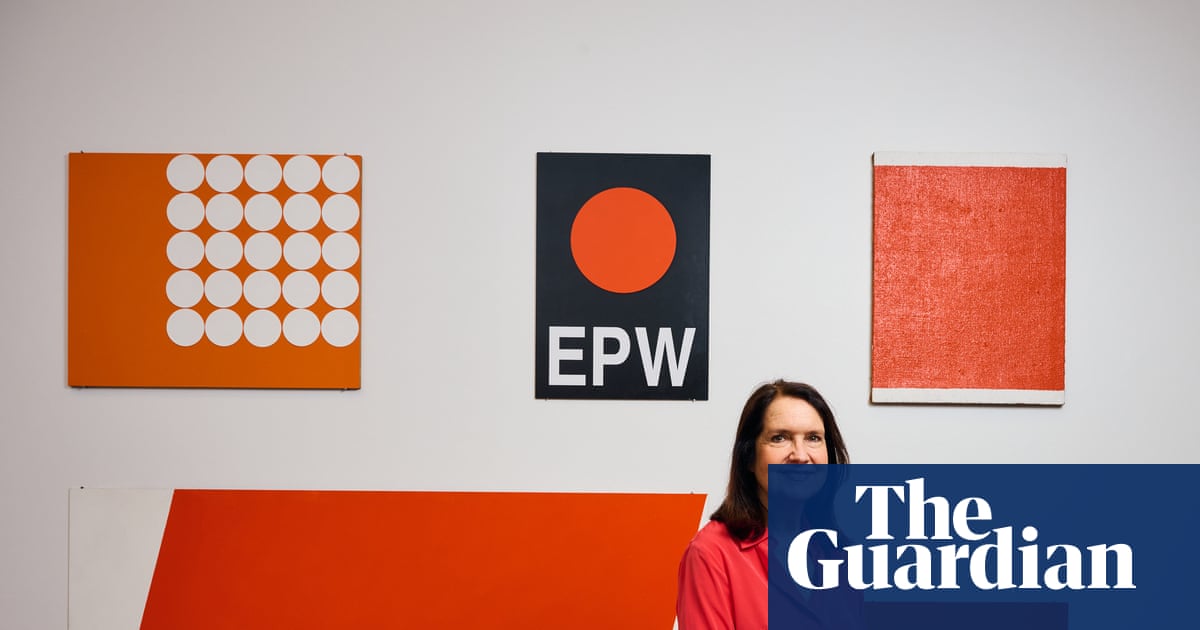
John Nixon, the late Australian avant-garde artist, would sometimes save the shells from his boiled eggs and sprinkle them across blank paint, creating his own starry night. Other times he’d set himself rules, such as painting only in orange for five years. It was 1996 and he was becoming a father, so he wanted a streamlined practice – plus, what other artist was associated with orange?
These anecdotes – just two among many – reflect not only Nixon’s lifelong frugality, idiosyncrasies and strategies, but his steadfast blending of art into everyday life for more than 50 years. His hardline minimalism never feels stifling or overwrought, but rigorous and playful, critical yet fortuitous.
“Through his life and work he wanted to challenge orthodoxy in everything he did,” says Sue Cramer, Nixon’s wife and the co-curator of his first major exhibition since his death in 2020 at the age of 70.
Song of the Earth at Heide Museum of Modern Art opens with a room dedicated to Nixon’s experimental painting workshop. Photograph: Eugene Hyland/The Guardian
Cramer has undertaken the “professional and personal” endeavour of sifting through Nixon’s thousands (possibly tens of thousands) of art works, encompassing painting, prints, text, music, film, performance, photography and more. As Nixon once joked to an artist friend Marco Fusinato: “I made too much.”
For a staunch minimalist known for his paintings of imposing crosses and forthright monochromes – and who courted a rather serious reputation in his youth in the 1970s – the exhibition title, Song of the Earth 1968-2020, privileges Nixon’s gentleness as much as his rigour. His love of both nature and music, Cramer says, “runs throughout his work as a joyous celebration of art and living as an artist”.
Nixon ‘found a precedent for the reinvention of what art could be’, Cramer says. Photograph: Eugene Hyland/The Guardian
Song of the Earth at Heide Museum of Modern Art opens with a kaleidoscopic, yet orderly room dedicated to Nixon’s experimental painting workshop (EPW). Started in the 1970s, EPW became an enduring banner for his abstract paintings, born from conceptualism, minimalism and Russian constructivism – all methods of questioning art itself.
Across playful lines of colour and form, there’s the aforementioned orange paintings from the 1990s, starring materials such as sawdust and onion bags (the strict colour rule didn’t last); his shimmering silver series; his rare curvy paintings with an organic, planetary edge; and his iconic crosses and monochromes from various decades, with some having objects such as dinner plates or a violin stuck to their surface.
Nixon kept his practice frugal – focused on ‘making something out of nothing’. Photograph: Eugene Hyland/The Guardian
Painting on everything from cardboard to masonite, Nixon’s use of found objects and cheap materials started out of financial necessity – but he always kept his practice frugal. “It was his sense of making something out of nothing,” Cramer says. “You don’t go to the art store, you find something in the leftovers.”
Did Nixon know, when he began creating in the 1960s, that he was starting a lifelong project of variations in colour and form, and that the sheer volume of his work would become its own statement?” Cramer doesn’t miss a beat: “Yes, I think he did.”
Sue Cramer: ‘He was interested in the idea of construction, the worker and building. He saw what he did as an artist as work.’ Photograph: Eugene Hyland/The Guardian
Also in the show is Nixon’s 1982 installation at the influential international exhibition Documenta 7: a multipart work with cloth banners, type-written texts and paintings on newspaper that could be all packed neatly into a suitcase, avoiding freight fees.
Poignantly, Nixon’s first and last works are placed about 40 metres apart, facing one another.
skip past newsletter promotion
Sign up to Saved for Later
Catch up on the fun stuff with Guardian Australia’s culture and lifestyle rundown of pop culture, trends and tips
Privacy Notice: Newsletters may contain information about charities, online ads, and content funded by outside parties. If you do not have an account, we will create a guest account for you on theguardian.com to send you this newsletter. You can complete full registration at any time. For more information about how we use your data see our Privacy Policy. We use Google reCaptcha to protect our website and the Google Privacy Policy and Terms of Service apply.
after newsletter promotion
His final work, made in 2020 when he knew he was dying, are two pieces featuring squares within squares; they’re almost a metaphor for eyes.
Nixon’s first and last works are both on display at Heide.
The first is a 1968 small black monochrome, painted when he was 19 years old and studying at Preston Institute of Technology. He had been influenced by a recent display of Ad Reinhardt’s black monochromes at the National Gallery of Victoria and a Marcel Duchamp exhibition at the National Gallery of Australia.
“He was sensing there was a different art you could make that wasn’t hand-to-eye technique,” Cramer says. In the 1960s and 70s Australian conceptual artists were interrogating ideals of realism and expressionism, with Nixon forming independent art spaces and an enviable community of like-minded artists including Jenny Watson, Peter Tyndall, Tony Clarke and Imants Tillers. Nixon engaged sincerely (never ironically) with modernist art histories, writing manifestos for his vision of experimental art in Australia.
Across the exhibition there’s a persistent theme of labour and making: hessian potato bags and pumpkin seeds cover canvases; art works hang off an old agricultural wheelbarrow; paintings hold tools like hammers and saws. “He was interested in the idea of construction, the worker and building,” Cramer says. “He saw what he did as an artist as work.”
Nixon was influenced by Russian Constructivism and preoccupied the idea that with art should integrate with life. Photograph: Eugene Hyland/The Guardian
This links to Nixon’s abiding influence from Russian Constructivism, an early 20th-century art movement privileging abstract forms and industrial materials for a social purpose. What made a young man in 1970s Melbourne operate like a Russian avant-garde, out of time and place?
“He found a precedent for the reinvention of what art could be,” Cramer says. “That meant that he, in his own time where art was being reinvented, could borrow from that precedent and take it into the future. He also responded to the poetry of it, to its ambition, to the idea that art should integrate with life.”