
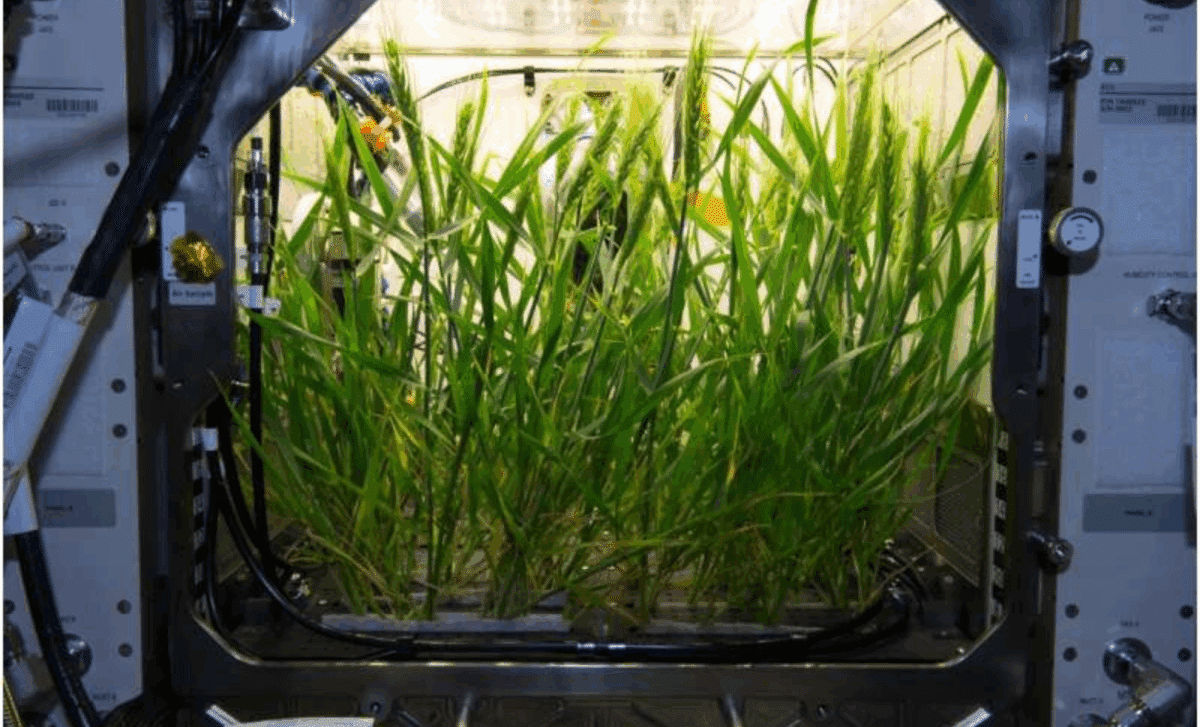
Imagine harvesting fresh vegetables and strawberries while gazing at the Moon’s barren surface or Mars’ red landscape. This futuristic scenario is becoming increasingly possible, thanks to groundbreaking research led by the University of Melbourne in collaboration with NASA. Published in New Phytologist, their work is paving the way for growing plants in space, a critical development for sustaining long-duration missions and enabling human life on other planets.
The Crucial Role of Plants in Space Exploration
Plants are more than just a source of food—they could be the key to humanity’s survival in space. As we venture to the Moon and Mars, our reliance on plants extends far beyond basic nutrition. A team of over 40 scientists, part of the Australian Research Council Centre of Excellence in Plants for Space (P4S), is developing a comprehensive framework for plant science in space missions. Published in New Phytologist, the study introduces the “Bioregenerative Life Support System (BLSS) Readiness Level” framework, which aims to optimize how plants can recycle vital resources like air, water, and nutrients in extraterrestrial habitats.
This is vital for long-term space missions where astronauts’ health, food supply, and even mental well-being depend on a closed-loop system. Plants help purify the air, provide oxygen, and reduce waste, all while offering fresh, nutritious food. This research is not just about feeding astronauts; it’s about ensuring that every aspect of their environment is self-sustaining.
Challenges of Growing Plants Beyond Earth
Growing plants in space isn’t as simple as packing seeds and adding water. The unique challenges posed by microgravity and the lack of a stable environment make it difficult for plants to grow as they do on Earth. The absence of gravity disrupts fluid dynamics, making it harder for water and nutrients to reach plant roots, while the lack of natural convection affects air circulation and heat transfer. These factors significantly hinder plant growth and survival.
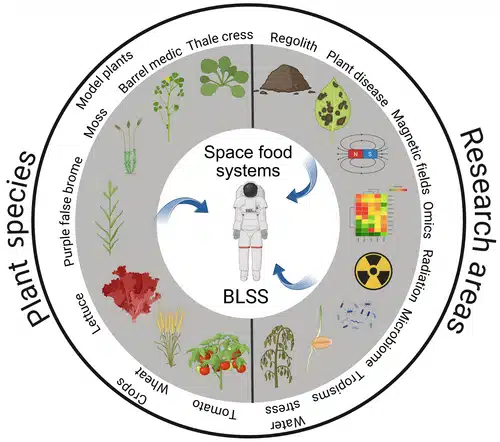 Representative model plant and crop species studied in space, and research topics discussed at the Liverpool workshop. Translating fundamental and applied plant research into tangible products that can be integrated into sustainable space food systems and a fully operational Bioregenerative Life Support System (BLSS) should be a priority moving forward. This figure was created in BioRender (Gilliham, M. (2025)
To address these issues, scientists are focusing on gravitropism—the way plants respond to gravity in different environments. Understanding how plants adapt to microgravity could lead to breakthroughs in optimizing crop cultivation in space. This ongoing research is vital for future space missions, such as NASA’s Artemis program, which aims to send humans back to the Moon by 2030.
Upcoming Lunar Experiments: A Historic Milestone
In 2027, plants will grow on the Moon for the very first time, marking a historic achievement in space exploration. NASA’s Artemis III mission will conduct the Lunar Effect on Agricultural Flora (LEAF) experiment, where three fast-growing plant species will be grown in a controlled climate chamber on the lunar surface. After a week, 500 grams of plant samples will be returned to Earth for analysis, with studies focusing on gene expression, the effects of lower gravity, and how higher cosmic radiation impacts plant growth.
This experiment will be a crucial step toward understanding how plants respond to the harsh conditions of space. It will also provide valuable data that could support future missions to Mars and other celestial bodies. Researchers in Australia and beyond will closely examine these samples, with some studies focusing on how plant growth is altered by space’s extreme conditions.
Leveraging Technology for Space Farming: AI and Omics
The future of space farming is rapidly advancing, thanks to cutting-edge technologies like artificial intelligence (AI) and omics. Researchers are developing ‘digital twins’—virtual models of plants—to optimize plant growth in space. These models simulate various environmental conditions, allowing scientists to predict how plants will respond to different factors like water availability, temperature, and radiation exposure.
AI also plays a pivotal role in improving food quality and astronaut meal satisfaction. By tracking sensory feedback from astronauts, scientists are working to ensure that space-grown crops remain appealing and nutritious, reducing the risk of menu fatigue. These high-tech solutions are expected to revolutionize space farming, ensuring that astronauts on long-term missions will have access to a wide variety of fresh, healthy food.