
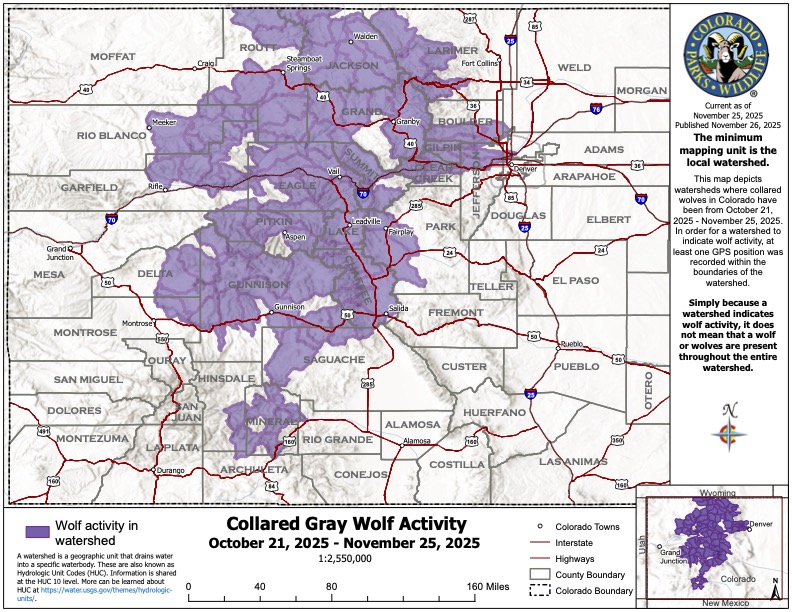
Colorado’s collared gray wolves remained heavily active in the state’s central and northern mountain region this past month after venturing further west and south toward the Utah and New Mexico borders a month prior.
The latest wolf map published by Colorado Parks and Wildlife on Wednesday shows wolves moving away from some of the southwest portions of the state between Oct. 21 and Nov. 25.
The month before that, wolves were recorded pushing deeper into Mesa, Montrose, San Miguel, San Juan, Hindsdale, Archuleta and Rio Grande counties. The latest map shows the animals largely retreating from those counties, with activity remaining consistent across central and northern mountain areas, including Pitkin, Eagle, Summit, Grand, Jackson and Routt counties.
Wolves also pushed further east of the Continental Divide into the foothills and near the Denver metro area, with activity recorded in watersheds in Gilpin, Clear Creek, Boulder, Jefferson, Adams and Denver counties.
If a watershed is highlighted on the map, it means that at least one GPS point from one wolf was recorded in that watershed during the 30 days. GPS points are recorded every 4 hours.
Parks and Wildlife noted in its latest wolf map that the animals continue to explore watersheds near tribal lands in Colorado. The agency has a memorandum of understanding with the Southern Ute Indian Tribe and is working to finalize a similar one with the Ute Mountain Ute Tribe, which addresses the potential effects of wolf restoration on the Tribe’s reservation and the Brunot Treaty Area in Southwestern Colorado.
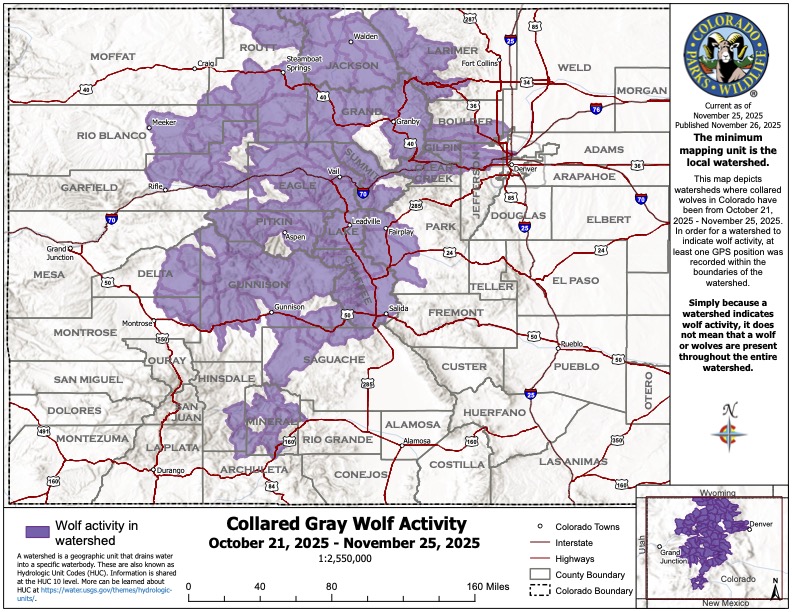 Colorado Parks and Wildlife’s latest map shows the activity of reintroduced collard gray wolves between Oct. 21 and Nov. 25. If a watershed is highlighted on the map, it means that at least one GPS point from one wolf was recorded in that watershed during the 30 days. GPS points are recorded around every four hours. Colorado Parks and Wildlife/Courtesy image
The agency also noted that another collared wolf was confirmed dead on Oct. 30 after it received a mortality alert from its collar. The wolf was a female and one of 15 that were brought from British Columbia and released on Colorado’s Western Slope at the start of this year, six of which have now died.
To date, Colorado has released 25 wolves since December 2023. Those wolves have formed four packs, with at least 10 pups born.
There have been 11 confirmed wolf deaths, with one of those being a one-year-old pup that was killed by Parks and Wildlife in late May after being connected to multiple livestock attacks in just over a week in Pitkin County, which met the agency’s definition of “chronic depredation.”
Another chronically depredating wolf was shot in August, but the body was never found, and officials could not confirm if the animal was dead.
Parks and Wildlife has been planning a third wolf release this winter, but is facing obstacles.
The federal government last month told Colorado that it can no longer import wolves from Canada, and that any new relocations must be from U.S. Rocky Mountain states. Less than two weeks ago, Washington state denied Parks and Wildlife’s request for up to 15 gray wolves, citing a lack of public support and wolves’ endangered status in the state.