
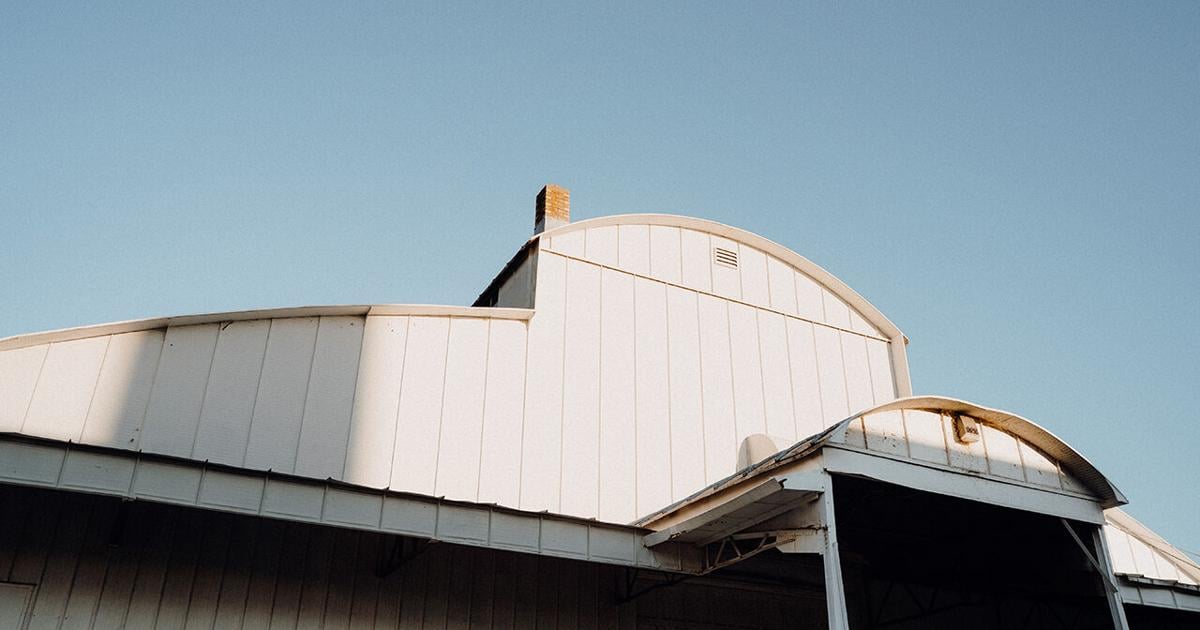
If you’re not paying close attention while traveling along East Main Street near the intersection of South Paterson Street, you might think you’re passing by a heating supply warehouse in the gritty industrial corridor of Madison’s manufacturing heyday. But look more closely, beyond the greenhouse-like pitched roof: That corrugated steel building with faded but still visible “Kleenaire Corp.” lettering is now a popular event space that hosts more than 100 weddings a year.
The Tinsmith, which opened in 2020, is an ambitious reuse of a “Trachte building.” Brothers George and Arthur Trachte (pronounced TROCK-tee), tinsmiths by trade, opened a sheet metal shop on King Street in 1901. By the 1920s, Trachte garages, gas stations, shops and diners were appearing — adjacent to anything from rusty, dusty factories to fancy Frank Riley-designed homes.
Unlike Quonset huts — prefab buildings with a half-cylinder design that became popular during World War II — Trachte buildings feature curved roofs with straight sides.
The preengineered structures have been phased out by Trachte Building Systems, a self-storage construction company now located in Sun Prairie. Today, some of those early Trachtes are decrepit, patched and peeling. Others have been brightly painted and reconfigured into studios and shops.
Tinsmith owner and venue director Jessica Wartenweiler first noticed the long-vacant Kleenaire building during her frequent visits to a nearby eatery and coffee shop on East Washington Avenue.
“I’ve always had a fascination with older buildings, and reimagining what they can be,” Wartenweiler says. When she learned the former warehouse was for sale, she and a business partner decided to give the building at 828 E. Main St. a new purpose.

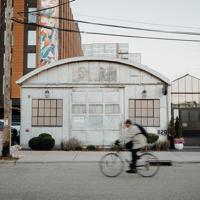
Jessica Wartenweiler, owner and venue director of the event venue The Tinsmith, has transformed the Trachte building at 828 E. Main St. while preserving many of the structure’s unique features.
Photo by Nick Garcia
“We thought about a boutique hotel, but realized that would require dividing the space — which would take away this big, open expanse that the Trachte Brothers are known for,” Wartenweiler says. “We wanted to keep as much of the character as possible.”
Wartenweiler decided a wedding venue would best leverage the building’s attributes, including its barreled roof, metal siding and proximity to dining, lodging and entertainment in the Capitol East District.
Other Trachte transformations in Madison have been smaller in scale, but no less inspired. One was converted into a woodworking shop on Wilson Street — it has a Little Free Library out front in its own Trachte-esque image. Just off North Fair Oaks Avenue, the Madison Public Library’s Bubbler program created an artist-in-residence studio in an early Trachte that once served as the Blooming Grove Town Hall.
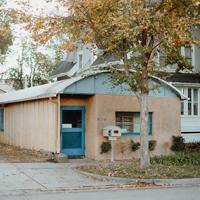
Photo by Nick Garcia
Although a few Trachte buildings are located within historic districts, none are designated as landmarks. “We’ve never done an architectural survey on Trachtes,” says Heather Bailey, preservation planner for the city of Madison. But The Tinsmith is “a great example of someone being creative with one of these structures.”
The factory on Dickinson Street that Trachte vacated in 1985 is a mega-Trachte of sorts, resembling the company’s tiny garages but occupying most of a city block. “I keep the former factory site on my radar,” Bailey says. “I think that it would be a great adaptive reuse opportunity.”
Bill Graf is a freelance writer for Madison Magazine.
COPYRIGHT 2025 BY MADISON MAGAZINE. ALL RIGHTS RESERVED. THIS MATERIAL MAY NOT BE PUBLISHED, BROADCAST, REWRITTEN OR REDISTRIBUTED.