
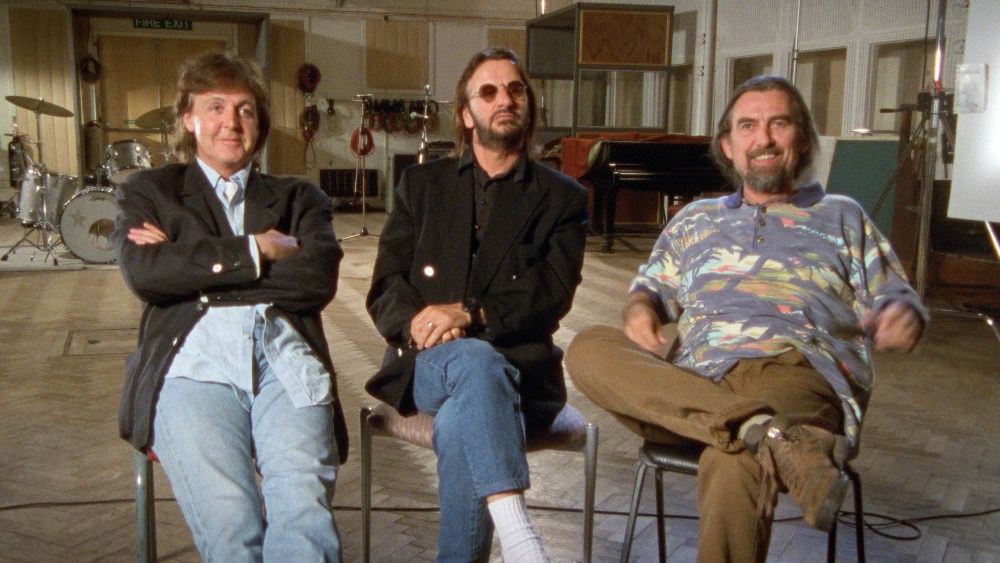
The newly refurbished version of “The Beatles Anthology” has been rolling out on Disney+ over a period of days this week, with a newly commissioned Episode 9 premiering on the service Friday night. It gives the epic 1995 docuseries more than just a new edit and a fresh set of paint: it gives it an all-new finale that feels sweeter than the way the original project faded out with the gradual breakup of the most popular band of all time. And fans aren’t likely to mind the extra hour’s worth of either added context or additional sentiment.
With the new episode about to premiere, its director, Oliver Murray, told Variety about his intentions for this fresh finale. He’s the same man whom Apple Corps drafted to a short movie about the “final Beatles single,” “Now and Then,” when that was unveiled two years ago. Even though he was not yet a teenager when the original “Beatles Anthology” first aired in prime time 30 years ago, Murray was considered the right candidate to draw together footage that was shot at the time with Paul McCartney, George Harrison and Ringo Starr. The three ex-Beatles became active Beatles once again at that point in drafting old John Lennon home demos to expand upon for “Free as a Bird” and “Real Love,” songs that were added to the “Anthology” albums also being released in ’95. And they even attempted, briefly, “Now and Then,” although it took till 2023 for that third number to come to fruition, but it at least gets foreshadowed in the new Ep9.
The British filmmaker says he gave himself the mission to humanize the three musicians as they reassessed their legacy in the ’90s, while also recognizing that their story is “modern, 20th century folklore (that) doesn’t age, in the same way that something like ‘The Lord of the Rings’ doesn’t age.” (The following interview has been edited for length and clarity.)
The Apple people were clearly pleased with your work on the “Now and Then” film, to assign you this… assuming that it indeed came after you’d finished that, and you weren’t working on them simultaneously.
I was in L.A. doing press for the “Now and Then” short film with Jonathan Clyde [the director of production for Apple Corps], and the last day of us being there, I was asked to come and see him in an office in Santa Monica, and he said, “We’re doing the ‘Anthology’ — redoing it, re-releasing it — and it would be great if there was an extra episode. Would you take time over Christmas to have a think about what that might look like? Look at the materials, talk to the film archivist and photo archivist at Apple and watch material and come back with a treatment.” So in-between my Christmas dinners and trips to see family, I was scribbling all sorts of ideas, with a loose brief that it would be great if we could keep going through the ‘90s sessions we used for “Now and Then.” In making that, we’d only scratched the surface of the “Free as a Bird” and “Real Love” material, so I knew that we would be able to get that in. But I really wanted to kind of go above and beyond and use episode 9 as an opportunity to work untethered from the chronology of 1-8.
We had 1-8 sorted, and I knew what that looks like .because they’re doing a faithful reconstruction of it. So the gift of 9 was that then we get to go back with a more contemporary sensibility and discuss how the band felt. How it felt to be a Beatle was the north star of episode 9.
I also liked the idea of making the “Anthology” feel a bit more cyclical. The themes of the brotherhood and the way that the band find each other in episode 1 is reflected in how they sort of rebuild their friendship in episode 9. So it comes full circle. Rather than episode 8 being the finishing point, where they break up, it was an opportunity to lift the kind of heavy fog of what was going on at the very end in 1970 and finish it in a much more positive light.
It’s interesting that your episode, episode 9, ends in the mid-‘90s, with the footage of making “Free as a Bird” and “Real Love” and the promotional interviews for the original “Anthology.” There are no contemporary interviews or references to what came after, and it stops in time there just as surely as the original series stopped in 1970. It almost feels as if your episode could have been cut together as a final episode 9 in 1995, if there’d been time or willingness to consider that.
Yeah. Every time I shut the door in the edit suite, I sort of imagined myself saying, “Right, OK, it’s 1995.” And I could have gone and spoken to Ringo or Paul. But I didn’t really like the idea of Ringo in 2025 talking about an interview that he gave in 1995 about something that happened in 1965. It was all too nebulous to do that. Given that the “Anthology” is sort of this artifact that you have to put white gloves on to mess with, I wanted to take the gloves off and make something that had more modern rhythms or feel. But I still wanted it to feel that it was tethered to something that was ultimately made 30 years ago … I wanted to approach it thematically, where we could go anywhere we liked, when we’re talking about memory or brotherhood or that kind of tumbler jar existence they lived in. But I also did want to stick to that old mantra of “arrive late, leave early” in the story.
Obviously I didn’t know it was gonna play out like this, but to do “Now and Then” first was kind of interesting. Because you could almost put “Now and Then,” the short film, on the end as episode 9.5m in a way, because it all tethers together. I really loved getting Paul in there in episode 9 saying, “You know, ‘Now and Then’ maybe hasn’t gone away [as a possibility to complete someday]. It’s the Beatles — you never know.” You actually also see George say, “I think we should leave it, and we’ll come back to it,” and knowing what happens to George, that’s a very sad moment.

Paul McCartney being interviewed for “The Beatles Anthology”
Apple Corps Ltd.
But yeah, it was important to me that the pool of material we were working from had a time and a place. It was made in 2025, but the world that we’re absorbed in is from anywhere between ‘91 and ‘95.
I was excited by as well by the fact that they’re interviewed in Studio Two [at Abbey Road]. everyone wants to see new Beatles stuff. Unseen stuff is always the holy grail. I couldn’t believe that there was the interview of the three of them at Studio Two that was unseen. Because it’s great from 1 to 8 to see them talking individually, where it was then montaged together, curated by a team of producers. But in 9, you see the three of them talk about the things that they want to talk about together — also having seen each other’s interviews by then, which is kind of cool, because they start to understand that each of them saw the story differently.
Ringo Starr at Studio 2 at Abbey Road Studios for “The Beatles Anthology”
Apple Corps Ltd.
And Ringo says as much. He says, “Look, this isn’t my ‘Anthology.’ It’s our ‘Anthology.’” He’s just saying that it’s all of our stories and even the individual Beatles themselves can’t get their arms around their own legacy. It’s this big, sprawling, modern folklore, almost, that morphs and adapts. And another reason to stick to material no newer than ‘95 was because their story does adapt. It’s almost like the Beatles are bigger than ever. It’s been kind of lifted out of the vinyl records and tape cassettes into pixels and streams, and it’s in the feed, if you like. It’s morphing again. It’s not just nostalgia. It seems to be able to evolve into a very sort of immediate and resonant music for young people.
Some of this material was seen on the extras that were on the extras on the 2003 DVD boxed set. Some of us either never watched those extras or have forgotten them. But in this episode 9, when I saw that charming moment where the three guys were singing and “Thinking of Linking,” one of the first original songs the Beatles ever started dreaming up, I searched and realized that had first appeared to the hardcore fans among the DVD extras. But even the stuff that has previously been issued in some fashion was never edited together to really tell a linear story people would sit down and watch, so there’s been a need for that, for decades. For those of us who aren’t hardcore enough to keep track of these things, is most of the material you used for this episode stuff that’s already been out there as extras, or did you actually dig up stuff that hadn’t been seen in any form?
I think it’s about 50/50. So, 50% unseen. But I think it cannot be understated how much work has gone into the restoration, and the work that Park Road Post [Peter Jackson’s company] have done. Yeah, sure, there’s a whole load of DVD rips and that kind of thing, which is fine. But the fact that this thing has been scrubbed up the way it has makes all the difference. And I got to go back to the rushes of that kind of stuff. So for the 50% of the stuff [that has been seen in some form], we’re seeing familiar material in a different context. And your example, “Thinking of Linking,” that has been properly put up. You know, it deserves to be on a premium streamer like Disney because of all the work that’s gone into properly finishing off that material. It’s not ideal when this stuff sort of gets leaked onto YouTube, because yeah, people have seen some of it, but they were seeing a proxy version of what it should be.
When the three of them are there in the ‘90s singing quasi-Beatles versions of “Blue Moon of Kentucky” or “Ain’t She Sweet,” those are wonderful moments that kind of hark back to the more casual moments of the “Let It Be”/”Get Back” sessions where they were messing around with oldies, except here, 25 years later, it’s more relaxed. We don’t have to be looking for clues as to what kind of a mood they’re really in.
On the one hand, I wanted to make sure there was plenty of stuff in there for the lifelong Beatle fans that want things they haven’t seen or heard. But I also wanted to think about a younger audience coming to this. Because 9 sits outside of the chronology. So if you wanted to go straight to 9 as a kind of intro to the Beatles, there’s an element of it that I think serves that purpose. And the stories about the haircuts and the boots, and an overview of just how great they were live and how inventive they were in the studio… I was trying to make sure it was accessible for someone that’s coming to the Beatles’ story for the first time, but yp also have loads and loads of nice bits with all sorts of meaningful story depths. The trick was not to land in the middle, where it didn’t really do either of those things.
Also, the north star of the piece being about how they felt being a Beatle means that sometimes that they have those great moments of pride in what they did. And there’s also a lot of melancholy in it. Because I think being a Beatle, especially beyond the operational years, was probably, it’s fair to say, something that especially George kind of fell in and out of love with — you know, constantly being branded with a badge you can’t take off, which is “George Harrison: Beatle.” So that all plays into it, all the different colors of their personalities and the way that they wore that their Beatle tag.
George Harrison being interviewed for “The Beatles Anthology”
Apple Corps Ltd.
We think of Paul and Ringo as the happiest or most enthusiastic Beatles, historically. John’s no longer around at that point this is being filmed, so in his absence, we think of George as the most skeptical one. Watching it, I think we’re kind of looking at George and thinking, “Are you really happy to be here? Have you reconciled yourself with this?” And it seems like it’s the George we know and love who’s kind of taking almost an outsider view of things at times, but he does happy to be there and a willing participant. So that kind of reconciliation feels good to watch, I think, especially for people who’ve watched “Get Back” or “Let It Be” and aren’t sure how to think about the Beatles’ latter days. Ultimately, it’s just funny that 50-plus years later, we’re still thinking about these relational dynamics between these guys, and how each one related to the other three.
It’s amazing to me as well that even though there’s such a long amount of time — a couple of decades — where they really didn’t spend time together at all, that when they get back into a room, when they go to Abbey Road and the three of them sit there, those dynamics that we identify from the interviews are alive and well and have just been lying dormant for two decades. Because when they’re back sitting there, Paul is still the one racing ahead, full of ideas, full of exuberance to create. And then I think George, through those ‘90s sessions, is kind of occupying a Lennon-esque position as well, or at least filling some of that void, energy-wise. And Ringo sits there and says very little, and then he suddenly comes out with the absolute cherry on the cake they’re making, which is either funny or particularly poignant. And those dynamics clearly were kind of forged in the hours and hours that they spent together through teenage years and into the Beatles.
Ringo Starr, Paul McCartney and George Harrison relax on the grounds of George’s house at Friar Park filming material for “The Beatles Anthology,” as seen in the new episode 9.
Apple Corps Ltd.
That’s why I think it’s this kind of full circle moment, that music brought them together when they were kids and music brought them back together in the ‘90s. When you see them sitting there on the grass at George’s estate just playing a tune, it kind of makes me think that that’s such a lovely way to end the definitive Beatles story — much more in keeping, I think, with their legacy than for it to just sort of slowly drift away in 1970.
We’re 30 years out from that footage now — which, it’s hard to fathom, is further out than “Anthology” was out from 1970 in 1995. For those of us of a certain age, it’s sort of a time warp. Because in ‘95, we thought of the Beatles as being really old and far along. But they look really comparatively youthful in this footage, even as we also register that they are middle-aged men.
Yeah, I agree. Well, I mean, it resonates for me. I was 10 when the “Anthology” came out the first time around. I remember watching it because my family had just moved house and it was just a sea of boxes everywhere, and they got the TV and made a makeshift TV stand out of boxes. And it was one of those moments where my parents just said, “Right, this is what we’re watching,” and in those days, there was no TV anywhere else; that was the house TV, and it went on for everyone to watch. And I was just as skeptical as you imagine a 10-year-old would be to watch whatever your parents want to watch. But then this story of these young working-class kids who were your classic, almost cliched kids with a dream that went on to conquer the world… it grabbed me, in a timeless way. Because certainly in Britain, and I think probably all over the world, it’s modern, 20th century folklore. It doesn’t age in the same way that something like “The Lord of the Rings” doesn’t age. The techniques it was made with may age, but I think it’s got the same sort of lasting quality.
Oliver Murray, director of the new episode 9 of “The Beatles Anthology”
Chris Lopez
So I wanted to try and humanize them as much as possible, because that’s what I think that I was most drawn to about the sessions that they record in Paul’s studio for “Free as a Bird” and “Real Love.” I think they feel youthful because they’re doing something that they were doing together as teenagers. So they’re having a lot of fun and kind of almost reverting back to 20 years ago. They don’t seem like men in their fifties, curmudgeons regurgitating old stories. It’s a whole new chapter for something that they left behind when they were still in their twenties. It blows my mind that George says he was 24 when he made “Sgt. Pepper.” At that age I was probably trying to impress a girl by making a bong from a potato or something stupid like that.
It now exists like a cultural language that’s passed down from one generation to the next. And for those of us that weren’t there first time round, it doesn’t get old, like good literature or something doesn’t age. It’s kind of Shakespearean in its longevity.