

A team of astronomers has captured an extraordinary gamma-ray flare from the distant blazar TXS 2013+370, revealing new clues about jet dynamics in active galactic nuclei.
The event, observed in February 2021, offered a rare opportunity for multi-frequency VLBI polarimetric observations at unprecedented angular resolution.
This campaign spanned frequencies of 22, 43, and 86 GHz—marking the first time this object was studied with such precision across multiple bands. Details of the findings were posted November 19 on the arXiv preprint, providing new insight into the magnetic field structure and variability mechanisms in blazars.
Chasing A Blazar’s Flare: First Multi-Frequency Polarimetric VLBI Study Of TXS 2013+370
A dramatic gamma-ray outburst from the blazar TXS 2013+370 gave scientists a rare window into the workings of one of the universe’s most energetic phenomena. The team behind the study used Very Long Baseline Interferometry (VLBI) to observe the source simultaneously at 22, 43, and 86 GHz during the flare, achieving angular resolutions down to ~0.1 milliarcseconds. This multi-frequency approach allowed for the most detailed analysis ever made of this specific blazar.
“In this work, we conducted polarimetric VLBI observations of TXS 2013+370 at 22, 43, and 86 GHz during an exceptional GeV outburst on February 11, 2021, achieving angular resolutions down to ∼0.1 mas. This represents the first multi-frequency polarimetric VLBI study of this source,” the researchers write.
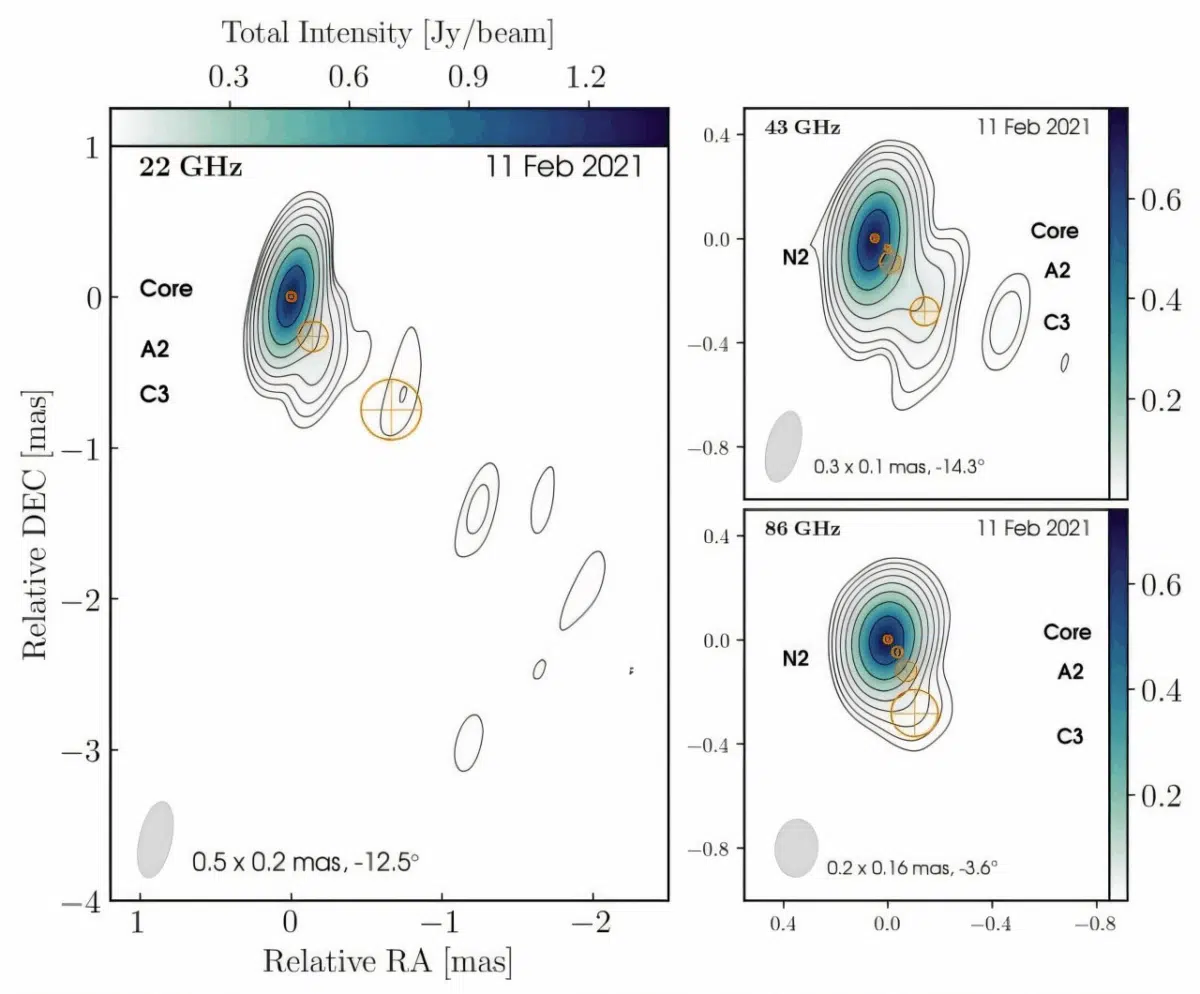 Total intensity images of TXS 2013+370 from February 11, 2021. Left: 22 GHz; top-right: 43 GHz; bottom-right: 86 GHz. Credit: arXiv (2025). DOI: 10.48550/arxiv.2511.15601
Blazars, known for their highly variable and energetic emissions, often serve as natural laboratories for studying relativistic jets. What made this particular flare unique is not only its timing and intensity but also the exceptional coordination of multi-band VLBI instruments to observe it. The flare itself reached GeV energy levels, detected by space-based gamma-ray telescopes, prompting ground-based radio arrays to spring into action.
Posted November 19 on the arXiv preprint, the paper outlines how researchers meticulously measured polarization structures and mapped out jet components on micro-arcsecond scales. Such measurements are vital for understanding the magnetic field configurations that control jet collimation and particle acceleration. Notably, the team observed structural changes in the core and inner jet that suggest a dynamic reordering of the magnetic field during the outburst.
Jet Anatomy Revealed: What Polarization Maps Tell Us
By comparing data across three observing frequencies, the team reconstructed a spectral and polarimetric profile of the blazar’s jet that revealed complex magnetic field orientations, fractional polarization levels, and evolution in the core region. The inner jet showed signs of rotation in the electric vector position angle (EVPA), hinting at turbulence or shock propagation within the jet flow.
One of the standout results was the significant shift in polarization angles between frequencies, indicating Faraday rotation—a phenomenon caused by magnetized plasma along the line of sight. These shifts helped the researchers estimate magnetic field strengths and infer the physical conditions of the jet’s base.
The multi-frequency nature of the data set also provided a rare opportunity to study core shift effects, where the radio core’s position changes with frequency due to synchrotron self-absorption. The data confirmed a shift consistent with a highly magnetized, optically thick jet base.
Crucially, the researchers linked the timing of the flare to changes in both total intensity and polarization—supporting the theory that magnetic reconnection events or shocks may be responsible for the sudden release of energy. This level of detail is uncommon, especially for a northern sky source like TXS 2013+370, which is rarely targeted in VLBI campaigns.