
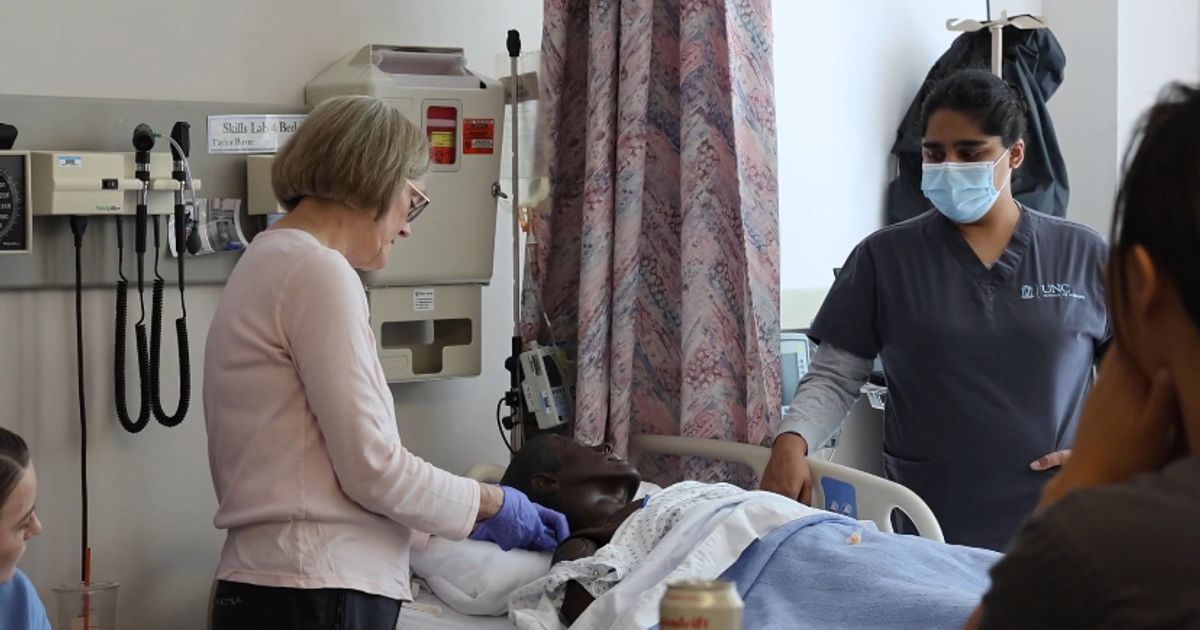
A patient was in pain, frustrated because she
felt like no one was listening to her.
Emily Barksdale, a nursing student at
UNC-Chapel Hill at the time, walked in and asked the patient to describe her
pain, and to help her and the other providers understand her frustration.
The patient turned and looked Barksdale
straight in the eye before exclaiming, “WHAT? Are you trying to psychoanalyze
me, bitch?”
But it wasn’t real.
It was a simulation, Barksdale said,
recreating workplace violence that nurses can encounter in the field.
Simulations have been implemented in nursing programs across North Carolina — and
nationwide — to provide nurses with hands-on training in how to deal with
everything from running codes to handling potentially violent patients.
In January, the School of Nursing at
UNC-Chapel Hill, along with UNC Medical Center and UNC Health Rex, ran its
first sessions of a new program for nursing students and health care staff to
better address workplace violence.
It’s one thing to learn about workplace
violence prevention and de-escalation practices in the classroom, said Valerie
Howard, dean of the UNC School of Nursing. But you can’t really solidify those
skills until you experience a situation that forces you to put that knowledge
to the test. “It’s almost like using theater to teach nurses,” Howard said.
Though workplace violence prevention and
de-escalation are already taught and practiced in many nursing schools across
the country, including UNC-CH, there is a dire need for this kind of immersive,
hands-on training. A 2023 survey from National Nurses United shows
that 8 in 10 nurses have experienced at least one type of workplace violence
within the past year, and 6 in 10 RNs reported either considering or actually
leaving their job— or the profession itself— due to workplace violence.
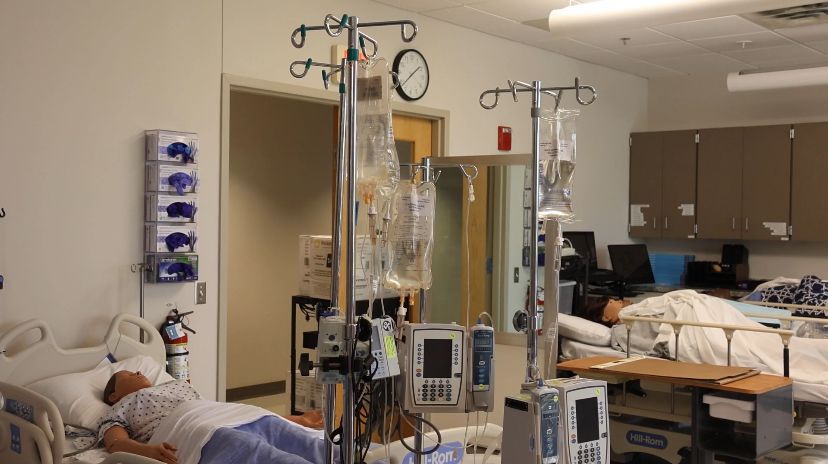 The nursing simulation
lab in ITS Manning at UNC-Chapel Hill, Wednesday, Oct. 22, 2025. Photo by
Jinrui Liu.
The prevalence of workplace violence is why
schools like East Carolina University and UNC-CH have been enhancing their
nursing programs, and it’s why UNC-CH rolled out this grant-funded program
utilizing the “tag team” approach in the spring.
“We know that one out of every four nurses
will experience some sort of workplace violence during their career. That could
be physical, mental, emotional abuse,” Howard said. “It could be harassment,
bullying. It’s not always just the physical violence that we think of.”
Though the grant’s funding for the program
ended in July and administrators have been reviewing the results, Howard said
she’d like to continue the program after receiving overwhelmingly positive
feedback from students. She believes more training like this has the potential
to improve retention and decrease burnout of nurses everywhere.
 Undergraduate nursing students at ECU conducting
intake assessments as part of a class. Students then consulted with psychiatric
mental health nurse practitioner students via telehealth when the patient was
acting erratically and potentially violently. Photo courtesy of ECU.
A culture change from acceptance to de-escalation
For years, workplace violence was just
considered part of the job, said Bonnie Meadows, president of the North
Carolina Nurses Association and a nurse with more than 20 years of experience.
“Back in the day, when I first started, it
was, ‘Oh well, it comes with the territory, it goes with the job,’” Meadows
said. “And honestly, our wording towards that, it probably has just recently
changed.”
And violence didn’t always come from the
patient, Meadows said.
“I love working with doctors all day long. I
love working with surgeons, all the things. But we used to make it okay when
they would just get upset and throw instruments and do all of these things,”
Meadows said. “You would talk about it, but you wouldn’t really talk about it.”
Howard recalled a similar culture when she
worked as a nurse in the emergency room roughly three decades ago.
“We really didn’t talk about the violence that
occurred in the workplace. It was a part of your job as a nurse, and you just
had to deal with it,” Howard said. “And you might have had an abusive patient
or a co-worker or something happen, you just moved on from that, and no one
really addressed it. No one took it seriously.”
Fast-forward to the spring of 2024, when
Howard and members of nursing leadership from UNC Medical Center and UNC Health
Rex—all part of a partnership known as the Tar Heel Academic Practice
Partnership— came together at a retreat and expressed their desire to work on
something that could make an impact on nursing practice and the profession.
That’s when the topic of workplace violence
came up, Howard said.
After the TAPP retreat, the nonprofit
organization AARP issued a call for grant proposals for the AARP Health Equity
and Nursing Innovation Fund, Howard said. TAPP and the NC
Future of Nursing Action Coalition, an initiative to improve health
care through nursing in the state, submitted a proposal and, in July 2024, were
one of 12 recipients awarded the grant nationwide. They received $25,000, an
amount matched by UNC Health’s Robert A. Ingram Institute for Equitable
Healthcare Access, and they put those funds toward developing the
simulation training program, according to a press release.
After roughly six months of developing,
testing, and having the scenarios reviewed by the Coalition and other experts,
three workplace violence scenarios were created, Howard said.
The first scenario dealt with a verbally
abusive, confrontational parent of a child patient who was being involuntarily
committed; the second—the one Barksdale participated in— dealt with a patient
experiencing severe pain, and the situation escalated because the patient felt
like health care providers weren’t listening; the third dealt with a co-worker
trying to bully the nurse into doing something that didn’t align with policy,
Howard said.
The training was voluntary, and multiple
sessions were run throughout the spring semester for nursing students, Howard
said. The number of participants per group varied, but Barksdale said her group
had roughly 25 people total.
“We thought that we could do this maybe three
times and get our 150. That was our goal, to get 150 participants,” Howard
said. “As it turns out, nurses have very busy schedules.”
Realistic, safe training
While some simulations use mannequins — models
that replicate human anatomy — this training only utilizes human actors.
“When people think of simulation, they think
about what’s happening downstairs in our sim lab, right, the beds, the mannequin
laying there,” Howard said. “We hired actors to come in and to portray these
instances of workplace violence with nurses, and we had an audience sitting
there. We did this in a classroom, very low budget, low cost, but very
realistic.”
The simulation training received
overwhelmingly positive feedback from nursing students, Howard said.
“All but a few of the participants, and when I
say a few, I’m talking one or two, agreed that the training was extremely
valuable: the pre-briefing that we did, the actual scenario, and then the
debriefing, and they felt like this could translate into practice,” Howard
said. “The results were very positive.”
Even if a student isn’t actively participating
in a scenario, the interactive nature of the training — referred to as the “tag
team” approach — requires them to remain engaged, Howard said. While half of the
room can be tagged into the scenario by the director or another student at any
moment to help, the other half of the room writes suggestions for the actors on
note cards and gives them to the director. If the suggestion aligns with
learning objectives, it will be incorporated into the scenario. The length of
the scenarios varied, with some as short as five minutes, others as long as 20
minutes.
“You really do have to pay attention,” Howard
said. “You immerse yourself in that situation. Everyone’s there to learn,
that’s what we believe in simulation.”
East Carolina University’s College of Nursing
uses a variation on the tag team method in their simulations, said Benjamin
Abel, a spokesman for the college, and describes the overall training as
“multifaceted in every encounter, asking students to complete their medical
tasks with a consideration of the psychosocial dynamics of each experience.”
ECU has also received positive feedback for
its simulation training program, which incorporates instances of workplace
violence, said Bimbola Akintade, dean of the ECU College of Nursing.
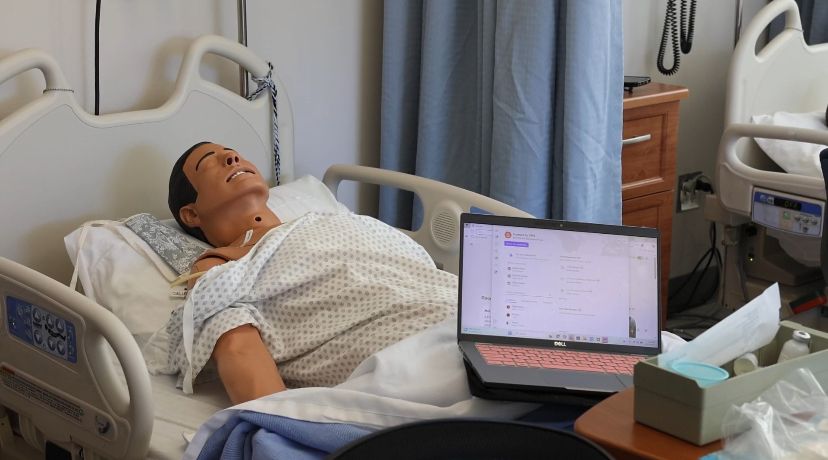 A mannequin being used for
a hands-on skills session for nursing students in ITS Manning at UNC-Chapel
Hill, Wednesday, Oct. 22, 2025. Photo by Jinrui Liu
“Technology has come a long way. Our mannequins
can sweat, they can blink, they have pulses,” Akintade said. “The technology is
realistic, but then the way the case studies are presented and how it flows,
students very quickly get into it. Students enjoy it. We get really positive
feedback from simulated experiences with our students.”
Sydney Rogers, an ECU alumna who graduated in
May, praised the training for providing opportunities to learn in a safe
environment.
“Yeah, they’re really good. I like
simulations,” Rogers said. “They give you an idea of what you could do better,
and you don’t have the fear of messing up with an actual patient. Instead,
you’re with an actor, you’re with some sort of dummy, and you can mess up
there, than actually messing up in the real field. So they’re really helpful.”
Even so, Akintade said there is still room for
improvement.
“We are currently revising our curriculum. All
schools and colleges of nursing across the country are doing that to
incorporate competency based education,” Akintade said. “So it’s already
included, but there are opportunities to further expand on that.”
Though many positive learning experiences can
be gained from workplace violence training, and participants are never in any
real physical danger, Howard said it’s important to note the mental and
emotional toll it can take on students.
“This can induce trauma, because when you are
even just portraying the role of a nurse, and you have an actor who is playing
the role of someone else yelling at you, there was some throwing of things,
loud voices, this is what nurses and clinicians deal with sadly in the clinical
setting,” Howard said. “We had to make sure that we were supporting all the
learners, because this can be definitely triggering.”
The emotional toll was evident on some
students’ faces even after just a couple of scenarios, Howard said, which is
why time was built in to decompress after the second scenario in addition to
the debriefs. On-call chaplains were made available to students as well. Having
those emotional well-being resources in place to support students is crucial
for this kind of training, Howard said.
“If a training was invoking these strong
feelings and emotions, you can only imagine what happens in the clinical
setting, in the real life setting, when these things happen,” Howard said.
An earlier introduction can help nursing students know what to expect
The grant funding for UNC-CH’s simulation
training program ended in July, Howard said. As they have reviewed the results
of the training, Howard said she would love to continue it in the future,
incorporating more scenarios and rolling it out to the entire state, offering
it to nurses and even other kinds of health care workers. Right now, the
program’s future looks bright.
“I just presented to all the chief nursing
officers of UNC Health, and they are very interested in sustaining this program
and replicating it and rolling it out even to more hospitals, to more health
care workers,” Howard said.
If given the green light, Howard said they
have everything they need to continue the program, including a facilitator’s
manual created using some of the grant funding to provide directions on how to
implement this program in the future. The program would supplement the
de-escalation training that is already a part of UNC-CH’s curriculum.
Akintade said he would like to see more
discussion of workplace violence earlier in nursing students’ education.
“I think there’s more room, and maybe not
waiting until it’s about time for them to graduate,” Akintade said. “Maybe we
can introduce that earlier, which gives them the opportunity to advocate even
in clinical, ever before they experience this as nurses.”
North Carolina is expected to face one of the
worst nursing shortages in the nation, with current projections showing a 22%
shortage in 2037, according to a 2024 report from the Bureau of Health
Workforce. Better equipping nurses to handle workplace violence with training
like this could help remedy that, and have a lasting positive impact on the
profession, Howard said.
“Workplace violence is impacting retention and
turnover,” Howard said. “So if we can address this and get a handle on it,
there’s a good chance that we might be able to have more resilient nurses,
decrease burnout, increase retention, decrease turnover on the units.”
The training is already making a positive
impact on students’ learning. Barksdale, who graduated from the nursing school
in May, said simulations are
a great way to prepare students for interacting with people in real-world
situations.
“If I’m going to be in a job where I’m up on
my feet interacting with people, what better way to learn just anything,
workplace violence related or not?” Barksdale said. “What better way to learn
things than to be up on my feet and interacting with human beings?”