
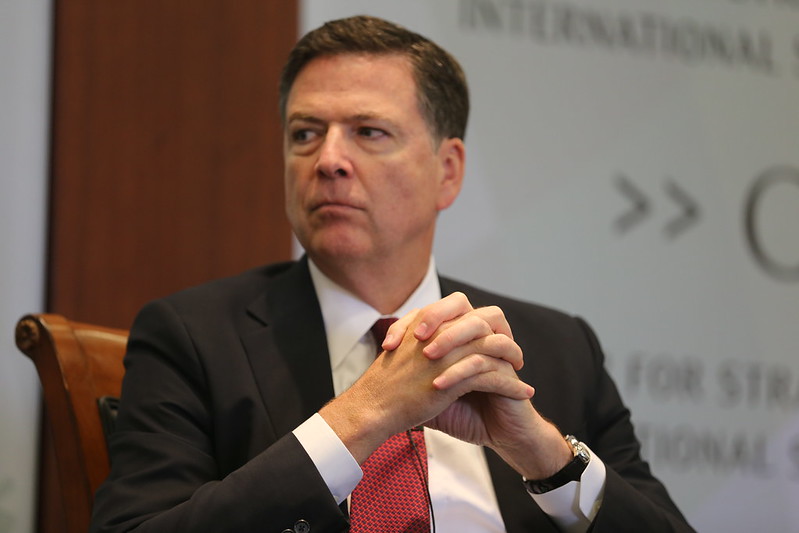
Let’s start with a critically important myth. When it comes to today’s Department of Justice (DOJ), the lawsuits they bring have absolutely nothing to do with the United States. These days, the official U.S. is Donald Trump and Donald Trump alone. Why? Because he and DOGE have fired and marginalized just about anyone at the DOJ with independence and loyalty to the Constitution, not to the man or to MAGA.
United States v. James Comey is the perfect example. I cannot think of anyone, with the possible exception of Hillary Clinton and a rabid MAGA minority, who would choose to waste valuable time and money going after a distinguished former FBI director rather than serial killers, school shooters, and multi-million- and multi-billion-dollar scam artists—like maybe health insurance executives who make many millions a year raising premiums and denying claims.
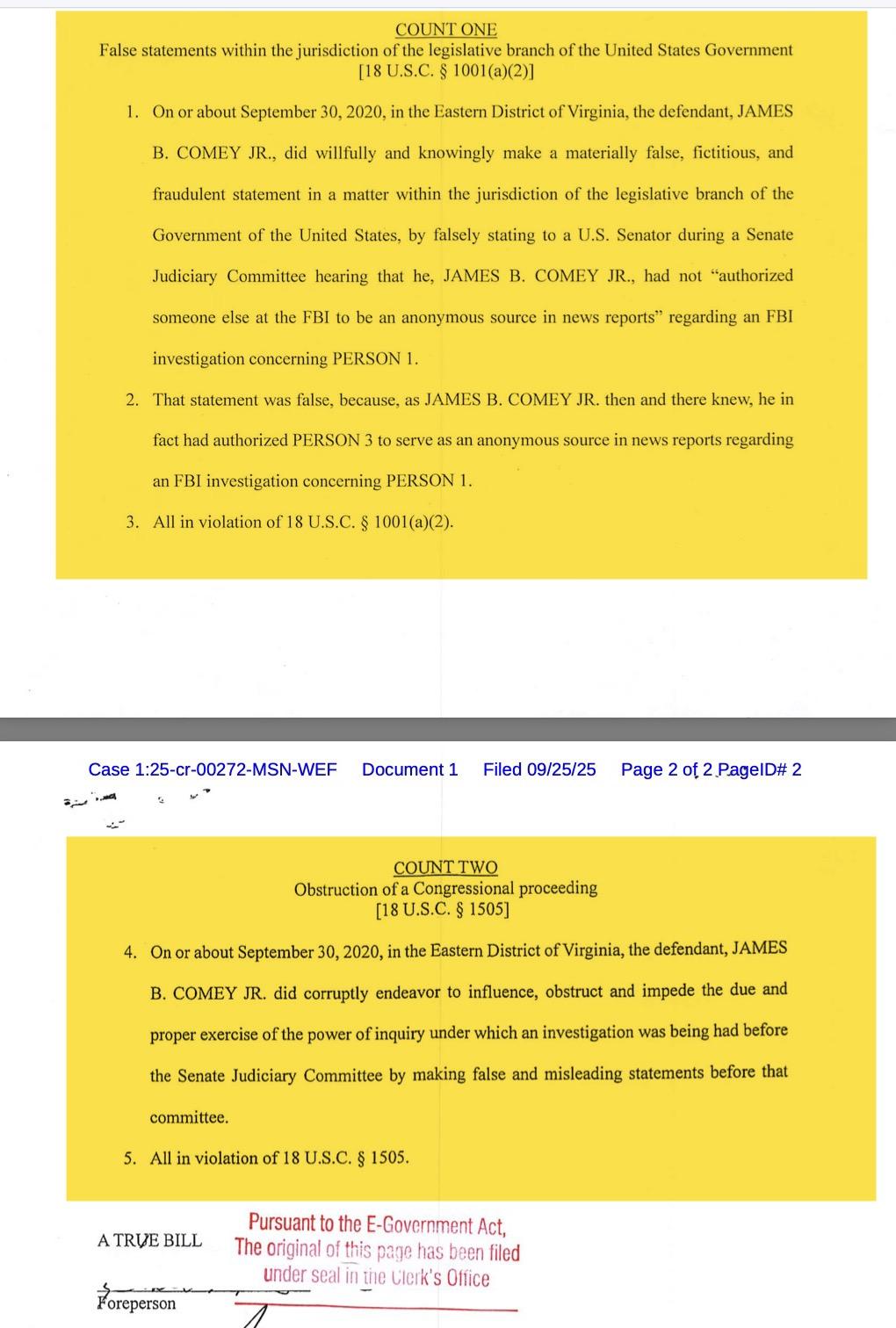 United States of America v. James B. Comey Jr., Sept. 25, 2025. Used under Fair Use provisions of U.S. Copyright Law. Highlighting added.
In last week’s column, I wrote about the compulsive tendency of the power-obsessed autocrat to distrust and zealously persecute anyone who might threaten his reign.
But sometimes the tyrant just picks the wrong fight, overestimates his own intelligence, and underestimates his opponent. Sometimes, the tyrant goes after the wrong man, the wrong woman, the wrong country. It is particularly interesting that at the very same time that Donald Trump has decided to go after Jim Comey with a vengeance, he has also once again opted to weigh in on the side of his sociopathic friend and invader Vladimir Putin, trying with the help of his morally compromised son-in-law Jared Kushner and his so-called negotiator Steve Witkoff to pressure and humiliate Volodymyr Zelenskyy and force the Ukrainians to accept a Russian-shaped surrender. See The New York Times’ “Leaked Transcript of Witkoff Call Shows U.S. Deference to Russia.” Of course, whatever these so-called dealmakers are hoping for, no matter what Putin says in public, at the end of the day, he will only be happy with an abject and defeated Ukraine. And I do not imagine that will get Donald Trump his dreamed-for Nobel Peace Prize. And despite the mounting pressure from fellow authoritarians like Xi Jinping, Viktor Orbán and Kim Jung Un, the proud Ukrainians will continue to fight, either with our help or without it, for their liberty
Had Donald Trump and his collaborators any sense of irony, a smidgeon of humility, or an ability to see clearly without the haze of their own over-sized ambitions, they might learn something from what is really happening today in Ukraine. But, sadly, there is little reason for optimism on that score. Maybe someone brave enough or suicidal enough in what is left of Trump’s intelligence community might clue him in to what Ukraine’s new generation of drones and flamingo missiles are now doing to Moscow’s oil and gas infrastructure. Perhaps they might open Trump’s eyes to the devastating losses inflicted on Putin’s conscripts. Yes, it took a while, but Ukraine has now brought their war home to Moscow. Finally, Russians must acknowledge and accept many of the consequences of Putin’s folly. Their economy is teetering. They must accept that with every passing day, Russia is running out of the funds to pay its army. And despite his impressive ability to inhabit a world of his own wishing, I suspect in the months to come Trump will learn that he should have picked Ukraine.
Here at home, we can celebrate, for the moment at least, that Donald Trump has been stymied in his nonsensical attempts to punish two of his prime enemies, Jim Comey and Letitia James. On November 24, 2025, U.S. District Judge Cameron Currie ruled that both the indictment of Jim Comey and the indictment of Letitia James are dismissed without prejudice:
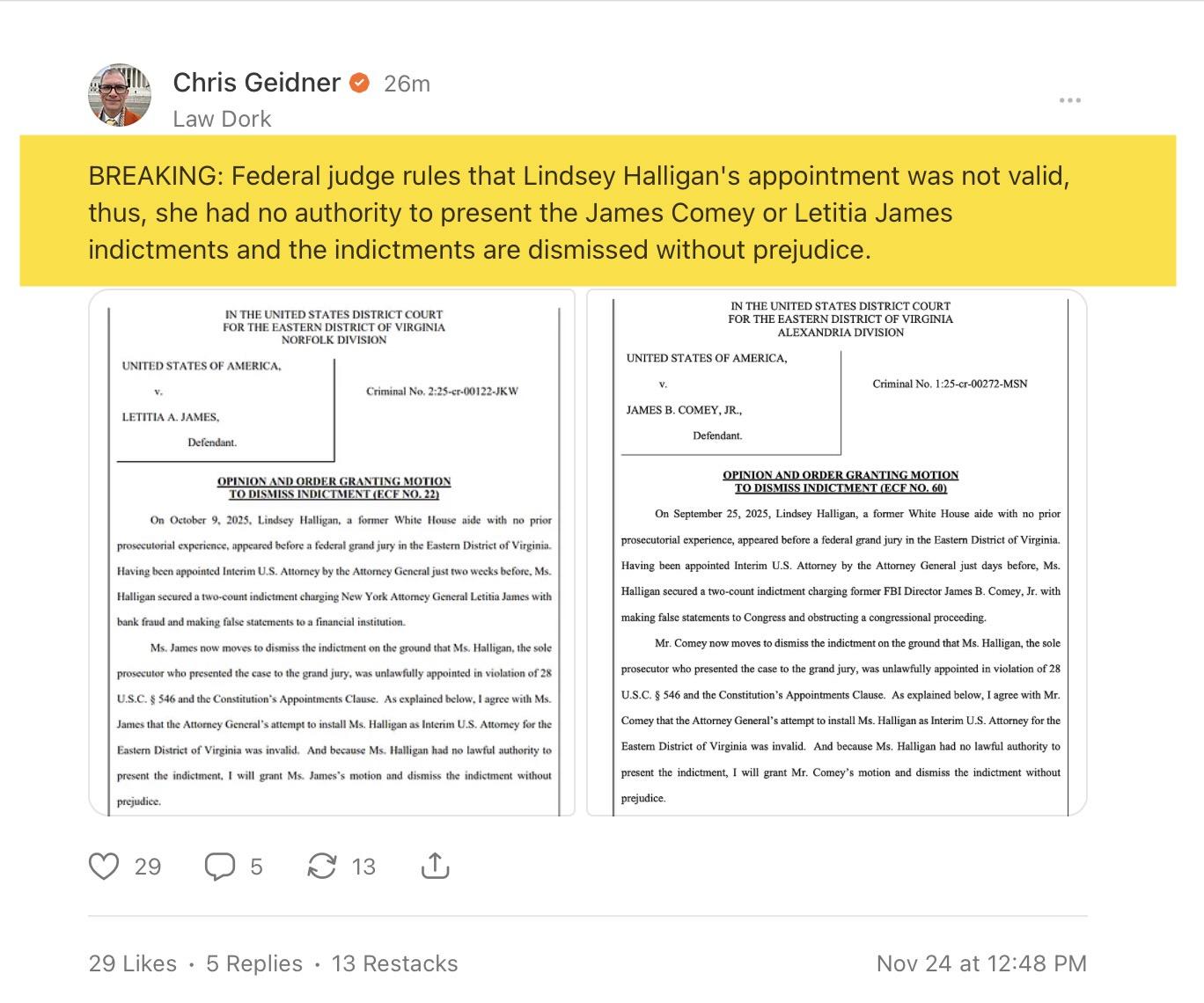 Chris Geidner, Nov. 24, 2025, Lawdork. Used under Fair Use provisions of U.S. Copyright Law. Highlighting added.
But there is much to be learned from the story of Donald Trump v. James Comey—about vengeance and intransigence and about the determination to fight back. Let’s start with why and how James Comey made it to the top of the enemies list.
It has probably been a while since you have heard “Russia, Russia, Russia!” And forgive me, but if we are really going to understand what is going on with the government’s case against Comey, we are going to have to relive and rediscover some recent history. I do not know if you are familiar with Jethro Gibbs of NCIS fame, but over the many years he excelled at fighting crime, he developed some handy rules. His Rule 39 is particularly relevant here: “There is no such thing as coincidences.” The more I thought about it, there is no coincidence when it comes to going after Jim Comey, the incredibly complicated relationship between Vladimir Putin and Donald Trump. Add to this Trump’s betrayal of Ukraine and Putin’s election interference on his behalf. Just history reemerging to remind us of who Donald Trump really is and how indebted and deeply compromised he is when it comes to the Russians.
It did not take long for Donald Trump to figure out that Jim Comey was one of those guys who was just trouble with a capital “T.” Comey was, after all, a straight shooter, and having worked from 1987 to 1993 as deputy chief of the Criminal Division for the Department of Justice’s Southern District of New York (SDNY), he successfully prosecuted members of New York City’s organized crime families. Of course, to actually build his buildings in the city, Trump had to rely upon the gang-controlled unions in the building trades to get anything done. If truth be told, I suspect he realized early on that he had more in common with the connected families whom Comey had taken down than with Comey himself.
As U.S. attorney in the Eastern District of Virginia, Comey went after wrongdoers regardless of political party. In 1996, he was a deputy special counsel investigating Whitewater for the Senate. He prosecuted those involved in the truck bombing of U.S. Air Force personnel housed at Khobar Towers in Saudi Arabia. Comey then returned to the SDNY until he joined the Bush administration as deputy attorney general.
Ironically, as Wikipedia reveals, unlike Donald Trump who continues to illegally blast to smithereens the Venezuelan fishing boats he is convinced are carrying drugs, Comey actually helped to cripple the money-laundering scheme behind a real cartel operation with 1993’s “Operation Project Meltdown.”
Then, famously, both Assistant Attorney General Comey and FBI Director Robert Mueller threatened to resign if the Bush administration continued its illegal program of secretly spying on U.S. citizens. While Attorney General John Ashcroft was in the hospital, he had designated Comey to make decisions. But in an end-around of Comey, the Bush administration sent White House Counsel Alberto Gonzalez and Chief of Staff Andrew Card to pressure Ashcroft to agree to continue the program. Luckily, Ashcroft’s wife called Comey, and he and Mueller confronted Card and Gonzalez at the hospital and adamantly refused to go along with their plan.
Later, President Barack Obama appointed Comey to head the FBI. Which brings us to the still very controversial decision Comey made to go public with the FBI’s continuing investigation of Hillary Clinton’s private internet server and her possession of government emails. Comey, to the undying dislike of Democrats, chose transparency over concern that his acknowledgment might influence the 2016 presidential campaign.
Everything about his past life made crystal clear that Comey would be guided by his own, perhaps exceedingly stubborn, determination to do what he thought was right, despite public or private pressure. All of which made the coming calamitous collision with the extremely transactional and highly amoral 45th president of the United States, Donald John Trump, almost inevitable.
Now, Comey probably suspected he was about to sign on for a world of hurt on January 6, 2017, when he drew the short straw. That short straw was the decision of his fellow members of the Obama-era intelligence community to pick him to brief Donald Trump about the recent findings of the intelligence community assessment (ICA), “Assessing Russian Activities and Intentions in Recent U.S. Elections“:
 2017 Intelligence Community, “Assessing Russian Activities and Intentions in Recent U.S. Elections.” Used under Fair Use provisions of U.S. Copyright Law. Highlighting added.
Unfortunately for Comey, they had also been given the Steele Dossier. Remember, the ICA made it clear that after considerable analysis, the intelligence community believed there was no question that the Russians had intervened in a variety of ways in our presidential election:
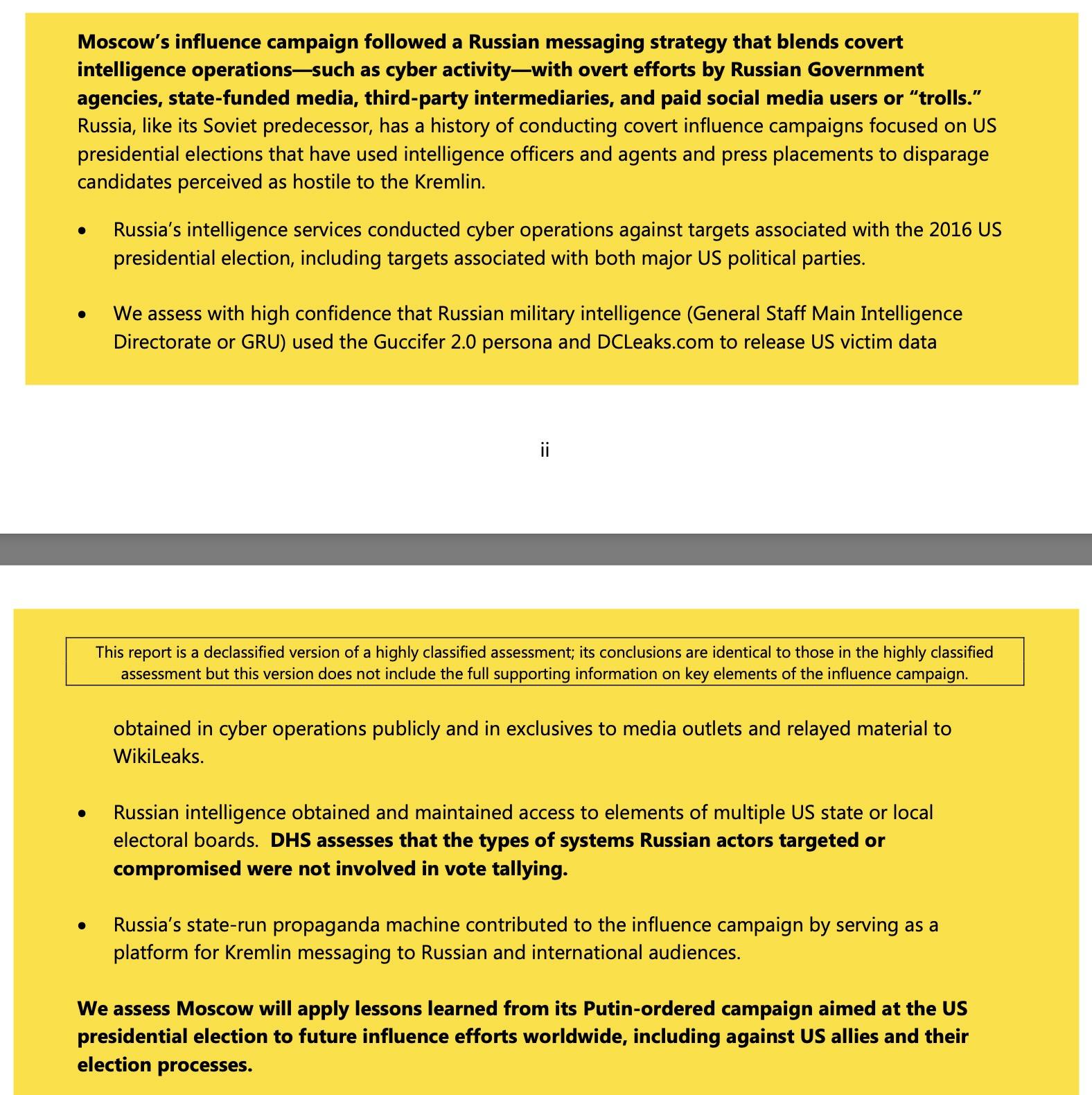 2017 Intelligence Community, “Assessing Russian Activities and Intentions in Recent U.S. Elections.” Used under Fair Use provisions of U.S. Copyright Law. Highlighting added.
As Comey wrote in his book, “A Higher Loyalty,” despite his worry, he knew he had a responsibility to warn Donald Trump:
The material included some wild stuff. Among that stuff were unconfirmed allegations that the president-elect had been engaged in unusual sexual activities with prostitutes in Russia while on a trip to Moscow in 2013, activities that at one point involved prostitutes urinating on a hotel bed in the presidential suite of the Ritz-Carlton that the Obamas had used while on a visit there. Another allegation was that these activities were filmed by Russian intelligence for the possible purpose of blackmail against the president-elect … we believed the media were about to report on this material and therefore we had concluded it was important for the intelligence community to alert the incoming president …
It is important to remember some of the recent history of the FBI. In so many ways, the FBI was/is the keeper of secrets: the massive amount of information gathered from wiretaps, informers, and interviews with suspects and those who know them and detailed records of the comings and goings of them and their friends and associates. I know from my father’s FBI file how much information—accurate and invented—the FBI can assemble. And, of course, FBI Director J. Edgar Hoover was renowned for using these files to his advantage, and those files are probably the reason why, despite his penchant for cross-dressing during the ultra-conservative 1950s, he managed to survive and maintain his considerable power.
Comey shared his recollection of that first meeting with Donald Trump during his testimony before the Senate Intelligence Committee on June 7, 2017:
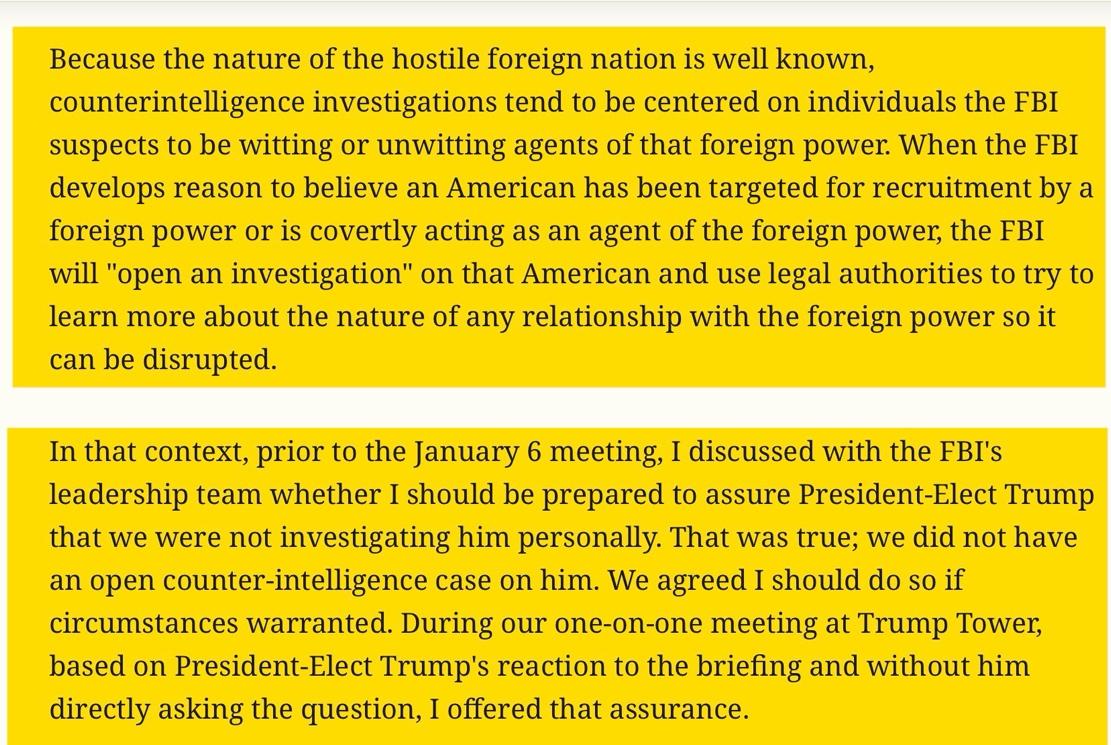 James Comey’s testimony before the Senate Intelligence Committee, June 7, 2017. Used under Fair Use provisions of U.S. Copyright Law. Highlighting added.
Back to “A Higher Loyalty,” Comey clearly understands why Trump might be especially wary of what the FBI could do with the information they gathered on his past:
I long ago learned that people tend to assume that you act and think the way they would in a similar situation. They project their worldview onto you, even if you see the world very differently. There was a real chance that Donald Trump, politician and hardball deal-maker, would assume I was dangling the prostitute thing over him to jam him, to gain leverage … it was really going to suck …
In fact, Comey notes:
We did not have a counterintelligence case file open on him. We really didn’t care if he had cavorted with hookers in Moscow, so long as the Russians weren’t trying to coerce him in some way … We gathered in a small conference room belonging to the Trump Organization … His suit jacket was open and his tie too long, as usual. His face appeared slightly orange, with bright white half-moons under his eyes where I assumed he placed small tanning goggles, and impressively coiffed, bright blond hair, which upon close inspection looked to be all his. I remember wondering how long it must take him in the morning to get that done …
Director Clapper presented the intelligence community assessment … During the discussion of Russia’s involvement in the election, I recall Trump listening without interrupting, and asking only one question, which was really more of a statement: ‘But you found there was no impact on the result, right?’ Clapper replied that we had done no such analysis … What we could say is that we found no evidence of alteration of the vote count … They were about to lead a country that had been attacked by a foreign adversary, yet they had no questions about what the future Russian threat might be … Instead, with the four of us still in our seats … the president-elect and his team shifted immediately into a strategy session about messaging on Russia. About how they could spin what we’d just told them …
As I was sitting there, the strangest image filled my mind. I kept pushing it away because it seemed too odd and too dramatic, but it kept coming back: I thought of New York Mafia social clubs, an image from my days as a Manhattan federal prosecutor in the 1980s and 1990s. The Ravenite. The Palma Boys. Café Giardino. I couldn’t shake the picture. And looking back, it wasn’t as odd and dramatic as I thought it was at the time. The Italian Mafia, as noted earlier, called itself La Cosa Nostra—’this thing of ours’—and always drew a line between someone who was a ‘friend of yours,’ meaning someone outside the family, and someone who was a ‘friend of ours,’ meaning an official member of the family. I sat there thinking, Holy crap, they are trying to make each of us an ‘amica nostra’—friend of ours …
I should have said something right then … But in that moment, I convinced myself that speaking up would be crazy … At that point, Reince Priebus asked if there was anything else that we should tell them … Clapper said, ‘Well, yes, there is some additional sensitive material that we thought it made sense for Director Comey to review with you in a smaller group … When we were alone, the president-elect spoke first, throwing out compliments. ‘You’ve had one heck of a year,’ he said, adding that I handled the email investigation ‘honorably’ and had a ‘great reputation’ … He said that the people of the FBI ‘really like you’ and expressed his hope that I would stay on as director. I replied, ‘I intend to, sir’ … I then began to summarize the allegation in the dossier that he had been with prostitutes in a Moscow hotel in 2013 and that the Russians had filmed the episode. I didn’t mention one particular allegation in the dossier—that he was having prostitutes urinate on each other on the very bed President Obama and the First Lady had once slept in as a way of soiling the bed. I figured that single detail was not necessary to put him on notice about the material. This whole thing was weird enough. As I spoke, I felt a strange out-of-body experience, as if I were watching myself speak to the new president about prostitutes in Russia. Before I finished, Trump interrupted sharply, with a dismissive tone. He was eager to protest that the allegations weren’t true.
I explained that I wasn’t saying the FBI believed the allegations. We simply thought it important that he know they were out there and being widely circulated … it was important that he know Russians might be saying such things. I stressed that we did not want to keep information from him, particularly given that the press was about to report it. He again strongly denied the allegations, asking—rhetorically, I assumed—whether he seemed like a guy who needed the services of prostitutes … He then began discussing cases where women had accused him of sexual assault, a subject I had not raised. He mentioned a number of women, and seemed to have memorized their allegations. As he began to grow more defensive and the conversation teetered toward disaster, on instinct, I pulled the tool from my bag: ‘We are not investigating you, sir.’ That seemed to quiet him. My job done, the conversation ended, we shook hands and I left the conference room …
On January 10, four days after my meeting with Trump, the online publication BuzzFeed published in full the thirty-five-page dossier that I had briefed Trump on.
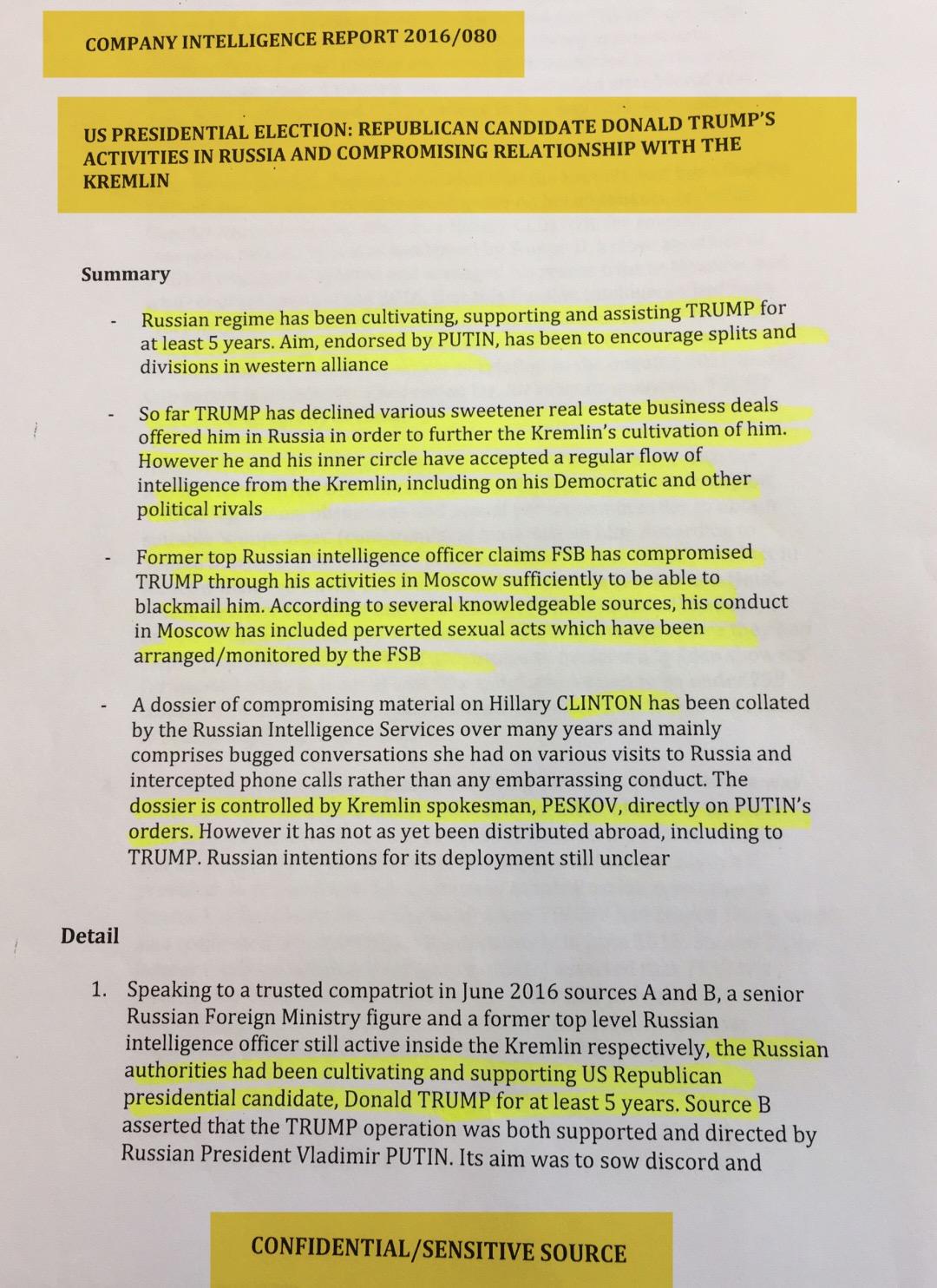 BuzzFeed news publishes the Steele Dossier, Jan. 10, 2027. Used under Fair Use provisions of U.S. Copyright Law. Highlighting added.
BuzzFeed reported:
A dossier making explosive — but unverified — allegations that the Russian government has been ‘cultivating, supporting and assisting’ President-elect Donald Trump for years and gained compromising information about him has been circulating among elected officials, intelligence agents, and journalists for weeks.
The dossier, which is a collection of memos written over a period of months, includes specific, unverified, and potentially unverifiable allegations of contact between Trump aides and Russian operatives, and graphic claims of sexual acts documented by the Russians …
The document was prepared for political opponents of Trump by a person who is understood to be a former British intelligence agent. It is not just unconfirmed: It includes some clear errors.
Comey continues:
In response, the president-elect tweeted: ‘FAKE NEWS—A TOTAL POLITICAL WITCH HUNT!’ The following day, January 11, I had another conversation with the future president … He said he was very concerned about the ‘leaking’ of the Russian ‘dossier’ and how it happened … I explained that the dossier was not a government document. It had been compiled by private parties and then given to many people, including in Congress and the press … He had been talking to people who had gone with him on the trip to Moscow for the Miss Universe 2013 pageant. He now recalled that he had not even stayed overnight in Moscow … And then he surprised me by bringing up the one allegation I had specifically tried not to discuss with him. ‘Another reason you know this isn’t true: I’m a germophobe. There’s no way I would let people pee on each other around me. No way.’ … I stared out at the monuments and wondered what had happened to me and our country that the FBI director was talking about this with our incoming president …
Here is how Comey described to the Senate his private dinner with the president on January 27, 2017:
The President began by asking me whether I wanted to stay on as FBI Director, which I found strange because he had already told me twice in earlier conversations that he hoped I would stay, and I had assured him that I intended to.
He said that lots of people wanted my job and, given the abuse I had taken during the previous year, he would understand if I wanted to walk away. My instincts told me that the one-on-one setting, and the pretense that this was our first discussion about my position, meant the dinner was, at least in part, an effort to have me ask for my job and create some sort of patronage relationship.
That concerned me greatly, given the FBI’s traditionally independent status in the executive branch. I replied that I loved my work and intended to stay and serve out my ten-year term as Director. And then, because the set-up made me uneasy, I added that I was not ‘reliable’ in the way politicians use that word, but he could always count on me to tell him the truth. I added that I was not on anybody’s side politically and could not be counted on in the traditional political sense, a stance I said was in his best interest as the President.
A few moments later, the President said, ‘I need loyalty, I expect loyalty.’ I didn’t move, speak, or change my facial expression in any way during the awkward silence that followed. We simply looked at each other in silence … Near the end of our dinner, the President returned to the subject of my job, saying he was very glad I wanted to stay, adding that he had heard great things about me from Jim Mattis, Jeff Sessions, and many others. He then said, ‘I need loyalty.’ I replied, ‘You will always get honesty from me.’ He paused and then said, ‘That’s what I want, honest loyalty.’ I paused, and then said, ‘You will get that from me.’ As I wrote in the memo I created immediately after the dinner, it is possible we understood the phrase ‘honest loyalty’ differently, but I decided it wouldn’t be productive to push it further. The term – honest loyalty – had helped end a very awkward conversation and my explanations had made clear what he should expect.
During the dinner, the President returned to the salacious material I had briefed him about on January 6, and, as he had done previously, expressed his disgust for the allegations and strongly denied them. He said he was considering ordering me to investigate the alleged incident to prove it didn’t happen. I replied that he should give that careful thought because it might create a narrative that we were investigating him personally, which we weren’t, and because it was very difficult to prove a negative. He said he would think about it and asked me to think about it.
As was my practice for conversations with President Trump, I wrote a detailed memo about the dinner immediately afterwards and shared it with the senior leadership team of the FBI.
Comey adds in “A Higher Loyalty” what he understood from this conversation with the president:
[I] needed to protect the FBI and myself because I couldn’t trust this person to tell the truth about our conversations … and I was concerned that having accurate recollections of conversations with this president might be important someday, which, sadly, turned out to be true …
And then Comey found himself yet again having to meet with Donald Trump:
This time the focus was on a television interview he had given to Bill O’Reilly on Fox News several days earlier … During the interview, O’Reilly had pressed President Trump as to whether he ‘respected’ Russian president Vladimir Putin: ‘I do respect him,’ Trump said, ‘but I respect a lot of people. That doesn’t mean I’m going to get along with him.’ ‘But he’s a killer,’ O’Reilly said. ‘Putin’s a killer.’
‘There are a lot of killers. We’ve got a lot of killers,’ Trump replied. ‘What do you think? Our country’s so innocent?’ As I sat there, I watched the president building with his words a cocoon of alternative reality that he was busily wrapping around all of us … ‘What am I going to do?’ Trump asked no one in particular. ‘Say I don’t respect the leader of a major country I’m trying to get along with?’
Looking at me, he said, ‘You think it was a great answer, right?’ and started to move on. I jumped on it and did something I might never have done as a younger person—especially to a president of the United States … but I interrupted his monologue. ‘The first part of your answer was fine, Mr. President,’ I said, as he took a breath and looked at me with a blank expression. ‘But not the second part. We aren’t the kind of killers that Putin is.’
At that remark, Trump stopped talking altogether. In that brightly lit room, with its shiny gold curtains, a shadow seemed to cross his face. I could see something change in his eyes. A hardness, or darkness. In a blink, the eyes narrowed and his jaw tightened. He looked like someone who wasn’t used to being challenged or corrected by those around him. He was the one who was supposed to be in complete control. With a small comment, I had just poured a cold dose of criticism and reality on his shameful moral equivalence between Putin’s thugs and the men and women of our government …
Still, the encounter left me shaken. I had never seen anything like it in the Oval Office
… At the end of the low-energy session, he signaled that the briefing was over … Then, pointing at me, he added, ‘I just want to talk to Jim. Thanks, everybody … I want to talk about Mike Flynn,’ he said. Flynn, his national security adviser, had been forced to resign the previous day … Flynn, who was a retired U.S. Army general, had spoken to the Russian ambassador to the United States multiple times during December 2016, to seek the Russians’ help in derailing a United Nations resolution … and also to urge the Russians not to escalate their response to Obama administration sanctions imposed as a result of Russian interference in the 2016 election.
The conversations about sanctions had become the subject of intense public interest after they were reported in the media in early January and Vice President–Elect Pence went on television to deny Flynn had talked about sanctions with the Russians. Pence said he knew this because he had talked to Flynn. On January 24, as part of our continuing investigation of Russian influence efforts, I dispatched two agents to the White House to interview Flynn about his conversations with the Russians. He lied to the agents, denying that he had discussed the very topics he had talked about in detail with the Russian ambassador. The president began by saying General Flynn hadn’t done anything wrong in speaking with the Russians, but he had to let him go because he had misled the vice president …The president then returned to the topic of Mike Flynn, saying, ‘He is a good guy and has been through a lot … I hope you can see your way clear to letting this go, to letting Flynn go. He is a good guy. I hope you can let this go.’ At the time, I had understood the president to be requesting that we drop any investigation of Flynn in connection with false statements about his conversations with the Russian ambassador in December. I did not understand the president to be talking about the broader investigation into Russia or possible links to his campaign. Regardless, it was very concerning, given the FBI’s role as an independent investigative agency …
[Emphasis added.]
Flynn though had his own agenda: an alliance with Russia to better fight Islamic extremism. The last thing he wanted was the Obama sanctions and increasing hostility between the U.S. and Russia. Here is a photo from March 2015 when Flynn was sitting next to Putin at a dinner for the Russian propaganda TV network, RT:
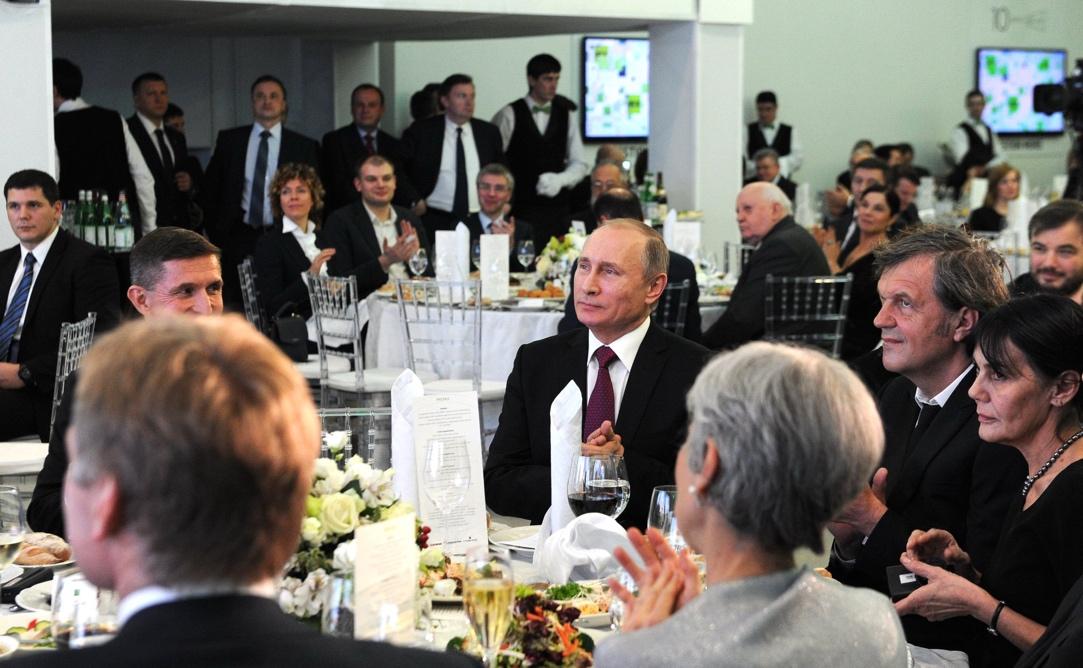 Flynn (left, obscured) attending RT’s 10th anniversary gala in December 2015. Photo used under the provision of CC by 4.0.
Comey continues:
In the car, I emailed my staff that the counterterrorism briefing they had spent so much time preparing me for had gone well, but ‘now I have to write another memo.’ What I meant was that I had another conversation with the president that I needed to document … I had now written multiple memos about encounters with Donald Trump. I knew I would need to remember these conversations both because of their content and because I knew I was dealing with a chief executive who might well lie about them. To protect the FBI, and myself, I needed a contemporaneous record …
On March 30, Trump called me at the FBI to describe the Russia investigation as ‘a cloud’ that was impairing his ability to act on behalf of the country. He said he had nothing to do with Russia, had not been involved with hookers in Russia, and had always assumed he was being recorded when in Russia. For about the fourth time, he argued that the ‘golden showers thing’ wasn’t true, asking yet again, ‘Can you imagine me, hookers?’ In an apparent play for my sympathy, he added that he has a beautiful wife and the whole thing has been very painful to her … He repeatedly told me, ‘We need to get that fact out …’
On the morning of April 11, the president called to ask what I had done about his request that I ‘get out’ that he is not personally under investigation. In contrast to most of our other interactions, there were no compliments thrown, no cheery check-ins just to see what I was up to. He seemed irritated with me. I replied that I had passed his request to the acting deputy attorney general, but I had not heard back … I said that was the way his request should be handled. The White House counsel should contact the leadership of DOJ to make the request, which was the traditional channel. He said he would do that. Then he added, ‘Because I have been very loyal to you, very loyal. We had that thing, you know …’
That was the last time I spoke with President Trump. We reported the call to the acting deputy attorney general. He had apparently done nothing since March 30, replying, ‘Oh, God, I was hoping that would just go away.’ It wouldn’t go away.
Fittingly, it all finally ended in a blizzard of awful behavior. I was in Los Angeles on May 9, 2017, to attend a Diversity Agent Recruiting event … On the TV screens along the back wall I could see COMEY RESIGNS in large letters. The screens were behind my audience, but they noticed my distraction and started turning in their seats. I laughed and said, ‘That’s pretty funny. Somebody put a lot of work into that one …’ The FBI director travels with a communications team so he can be reached by the Justice Department or White House in seconds, any time of day or night. But nobody called. Not the attorney general. Not the deputy attorney general. Nobody. I actually had seen the attorney general the day before. Days earlier, I had met alone with the newly confirmed deputy attorney general at his request so he could ask my advice on how to do his job …
My amazing assistant, Althea James, got the letter from the White House guy at the front door down on Pennsylvania Avenue [see here]. … I was fired, effective immediately, by the president who had repeatedly praised me and asked me to stay, based on a recommendation from the deputy attorney general, who had praised me as a great leader, a recommendation accepted by the attorney general, who was both recused from all Russia-related matters and who, according to President Trump at our dinner, thought I was great. The reasons for that firing were lies, but the letter was real. I felt sick to my stomach and slightly dazed …
[Emphasis added.]
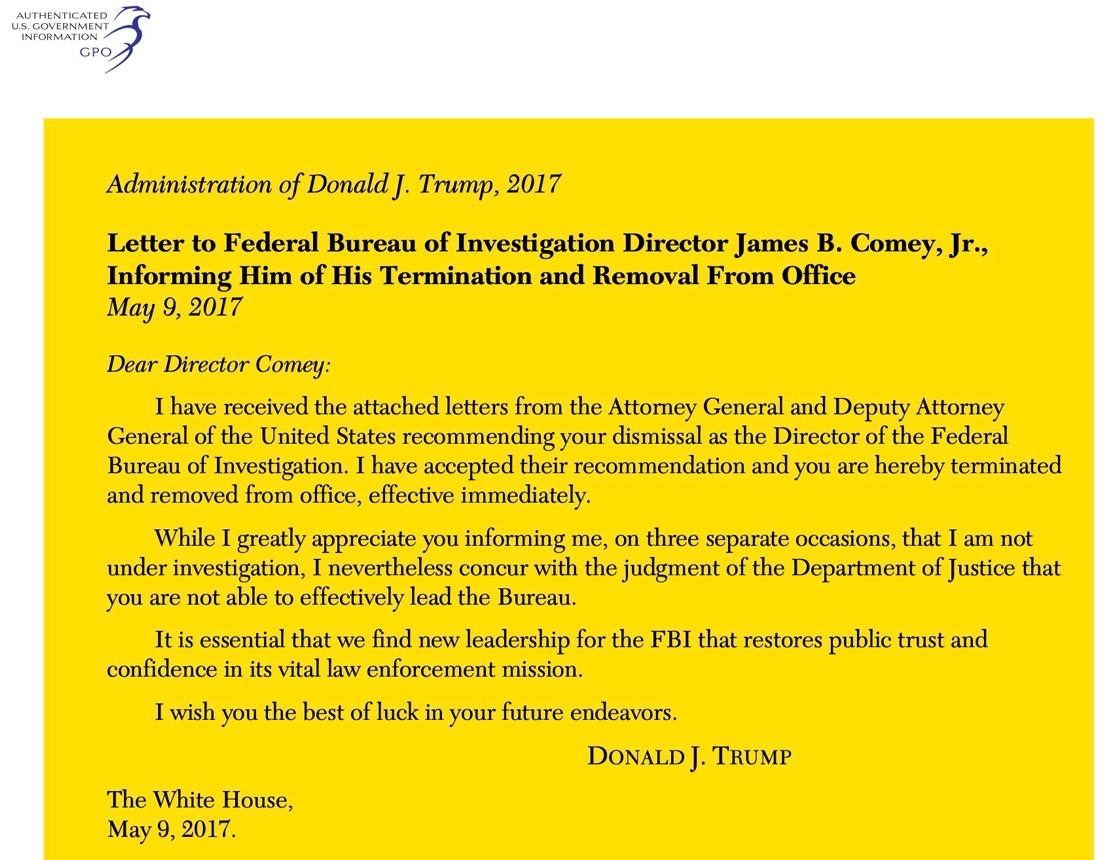 Donald Trump’s May 9, 2017, letter firing James Comey. Used under Fair Use provisions of U.S. Copyright Law. Highlighting added.
Donald Trump has been remarkably successful when it comes to denying the obvious reality that the Russians have an enormous stake in his presidency. Most Americans have forgotten that the intelligence services were in unanimous agreement that the Russians did everything they could to defeat Hillary Clinton. And Republicans, with the fewest of exceptions, have fallen into lockstep when it comes to allowing, enabling, and encouraging Trump to question the 2020 election. They have allowed him to perpetuate the myth that he was somehow cheated by mail-in-voting, compromised voting machines, and corrupt election workers. And they have moved so very quickly from appreciating the danger they were in when the MAGA mob invaded the Capitol to conveniently accepting Trump’s presidential pardon to those who viciously beat the very Capitol Police who risked their lives protecting them from the insurrectionists.
Yes, most Americans have grown used to the Trumpian lies that it was a cabal of swampy liberals like Comey and Brennan and Andrew McCabe and Robert Mueller and Adam Schiff and Jack Smith who broke the law. Almost no one remembers the astounding evidence of the Mueller Report. And thanks to Judge Aileen Cannon, the Appeals Court in Georgia, and the “never less Supreme” Court, much of the truth about Donald Trump’s extensive and illegal election interference activities have gone unpunished.
Donald Trump promised us a second term devoted to revenge and retribution, and his second go-around has been marked by near-constant nastiness. He has demeaned the Democrats and doubled down on his slander of any and every immigrant without papers. Whatever patience Donald Trump had developed has seemed to have evaporated.
During Comey’s testimony before the Senate Intelligence Committee, Senator Diane Feinstein asked him why he thought he had been fired:
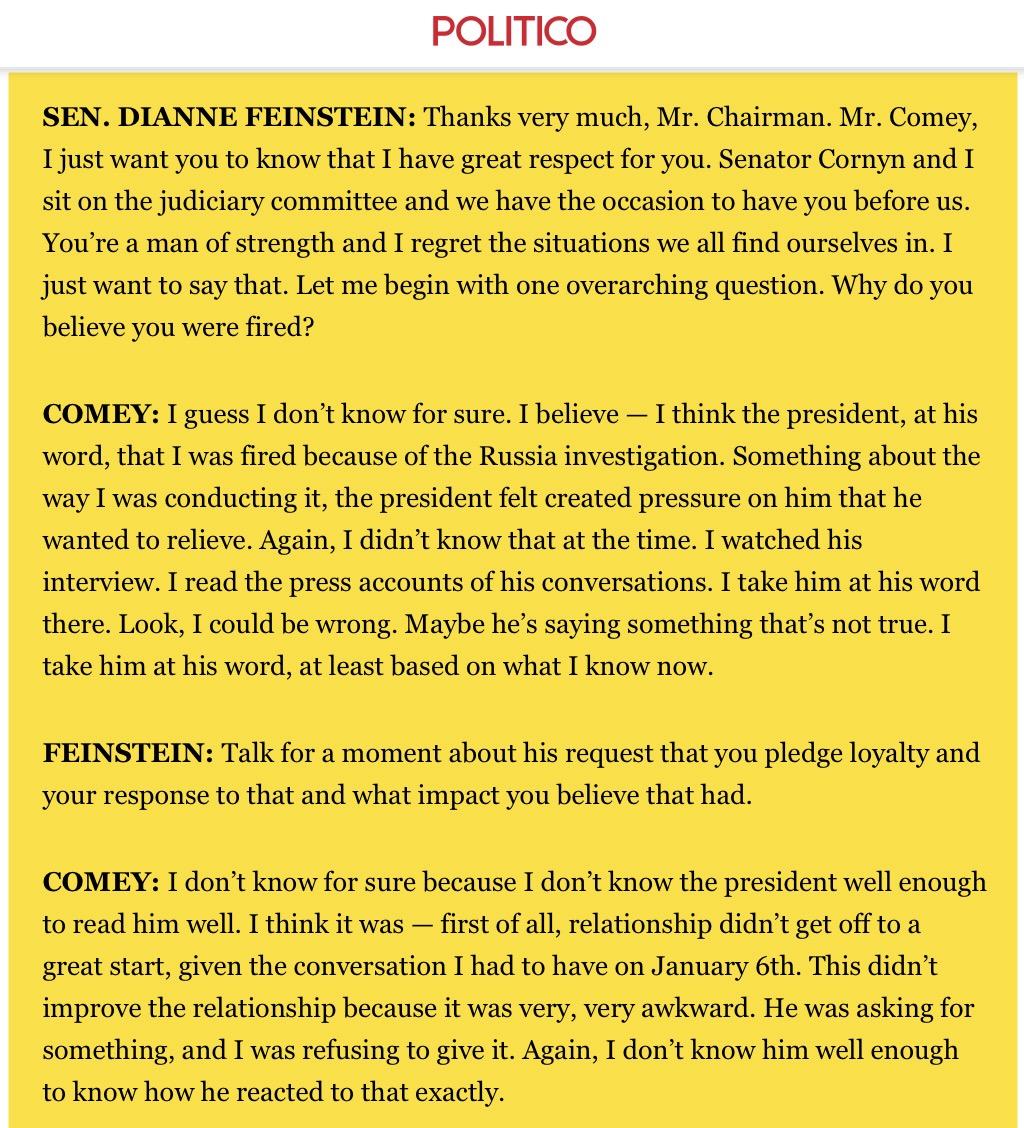 James Comey’s testimony before the Senate Intelligence Committee, Politico, June 7, 2017. Used under Fair Use provisions of U.S. Copyright Law. Highlighting added.
Comey did his best, but we know so much more today than he did in 2017. Comey did not know Donald Trump well enough to predict how the president would react to learning what the FBI knew about Russia’s significant effort to defeat Hillary Clinton and elect him. Nor did he know Donald Trump well enough to know the long-term consequences of his unwillingness to pledge unambiguous loyalty to him.
Well, all these years later, we can see how tenaciously Donald Trump clings to his need to insist that any implication of Russian interference is the never-ending “Russia, Russia, Russia Hoax.” And we so very recently watched as he rolled out the Red Carpet for Vladimir Putin in Alaska.
It is clear to me that at the very root of Donald Trump’s maniacal need to continue to punish Jim Comey is the fact that deep down Donald Trump is aware of what Comey knows about him—and that Jim Comey can never be trusted.
Next week, we will take a closer look at how Donald Trump’s persecution and prosecution of Jim Comey is doing—and what that says about his diminishing power.