
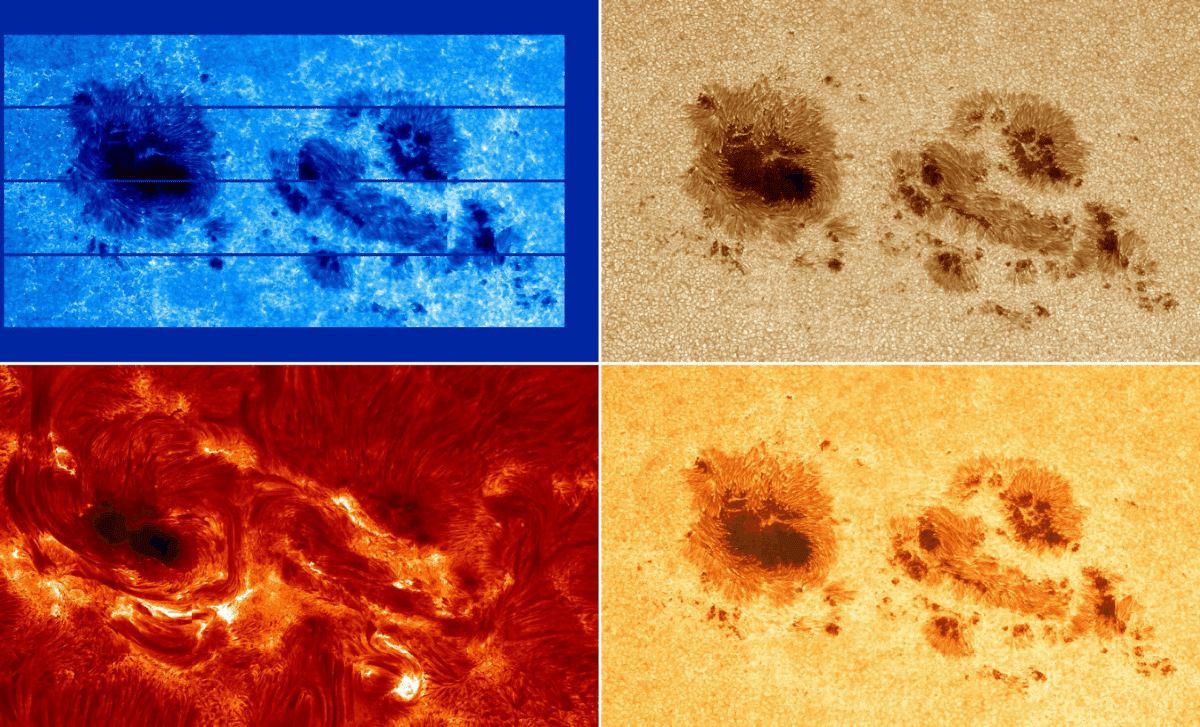
In an exciting breakthrough, scientists have captured a rare, high-resolution glimpse into one of the most active solar regions that has been producing powerful X-class solar flares. These flares, some of the most intense solar events, offer valuable insights into the Sun’s unpredictable behavior. The detailed observations were made possible through the use of advanced solar telescopes at the Teide Observatory in Tenerife, Spain. Published in Research Notes of the AAS, the study sheds light on the complexities of solar flare phenomena and their potential impacts on space weather.
The Challenges of Observing Solar Flares
Observing solar flares is no easy feat. “Strong flares occur either on the backside of the Sun, or during the night, or when the weather is cloudy, or when the seeing conditions are poor, or when they are just outside the field of view, where the telescope is pointing,” says Prof. Carsten Denker, head of the Solar Physics section at the Leibniz Institute for Astrophysics Potsdam (AIP) and the study’s first author. These challenges make it rare to capture such events in real time, and even rarer to observe them in high resolution. The study focused on two X-class flares that erupted on November 10 and 11, 2025, both of which were captured using the 1.5-meter GREGOR solar telescope at the Teide Observatory.
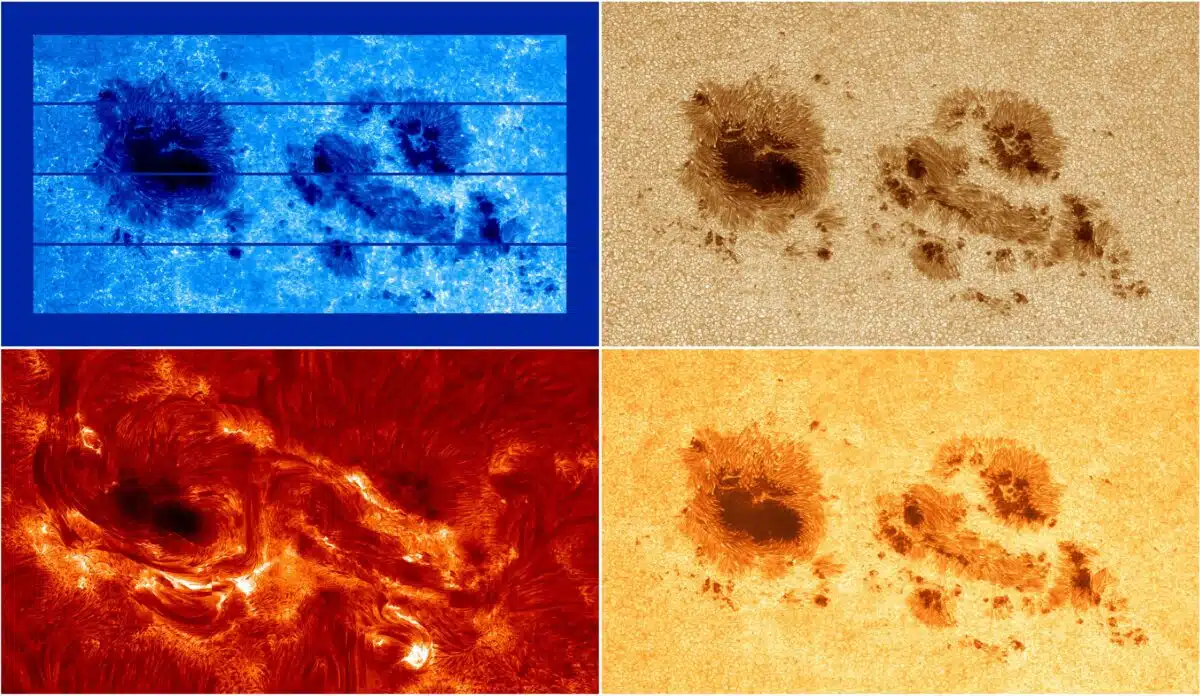 The mosaics of speckle-restored images have a combined FOV of 240″ × 150″ and shows active region NOAA 14274 at around 08:33 UT on 2025 November 10, about 30 minutes before an X1.2 flare began.
Magnetic Forces Behind the X-Class Flares
The X-class flares observed were not only significant for their intensity but also for the way they highlighted the Sun’s intricate magnetic structures. According to Dr. Meetu Verma, a solar scientist at AIP and co-author of the study,
“The penumbral fibrils, which typically extend radially from the dark umbral core, were strongly curved and braided. This indicates a highly stressed magnetic field structure.”
These braided fibrils suggest that the Sun’s magnetic fields are undergoing immense stress, building up energy until it is released in the form of a flare.
This discovery is a pivotal moment for solar physics. By understanding the patterns of these stressed magnetic fields, scientists can predict the likelihood of future flares and assess the potential risks posed by such events. Flares of this magnitude could have significant implications for space weather, impacting satellite communications, power grids, and even astronauts in space. The study, published in Research Notes of the AAS, deepens our understanding of the Sun’s violent outbursts and emphasizes the need for further study to anticipate their effects on Earth’s atmosphere.
Unprecedented Technology for Uncovering Solar Mysteries
The high-resolution observations made possible by the GREGOR solar telescope represent a major leap in solar research. The GREGOR telescope, with its 1.5-meter aperture, is one of the most powerful solar telescopes in the world, capable of capturing minute details on the Sun’s surface. This allows scientists to observe phenomena like solar flares with unmatched clarity. The ability to capture such fine details enables a deeper analysis of the Sun’s magnetic fields, helping scientists to understand the buildup of energy in active regions that eventually leads to explosive flares.
This technological advancement has revolutionized solar observation, providing scientists with tools that were previously unavailable. The study’s authors note that while solar flares have been observed before, the level of detail captured in these latest observations will have profound implications for future solar research. With advanced telescopes like GREGOR, scientists are now better equipped to study the Sun’s complex dynamics and the mechanisms behind its most extreme events.
Understanding the Impact of Solar Flares on Space Weather
Solar flares, particularly X-class flares, can have significant impacts on space weather, which can affect everything from global communications to satellite navigation systems. These flares release enormous amounts of energy, which can interfere with Earth’s magnetic field, creating disturbances known as geomagnetic storms. Understanding the causes and behavior of such flares is essential for predicting these storms and mitigating their potential impact on technology and infrastructure.
As space exploration continues to expand, the risk posed by solar flares becomes a more pressing concern. The insights gained from this study offer a clearer picture of how solar flares develop, enabling researchers to improve forecasting models for space weather. Given the increasing reliance on technology that could be vulnerable to solar activity, understanding solar flares is more important than ever.