
Unlock the Editor’s Digest for free
Roula Khalaf, Editor of the FT, selects her favourite stories in this weekly newsletter.
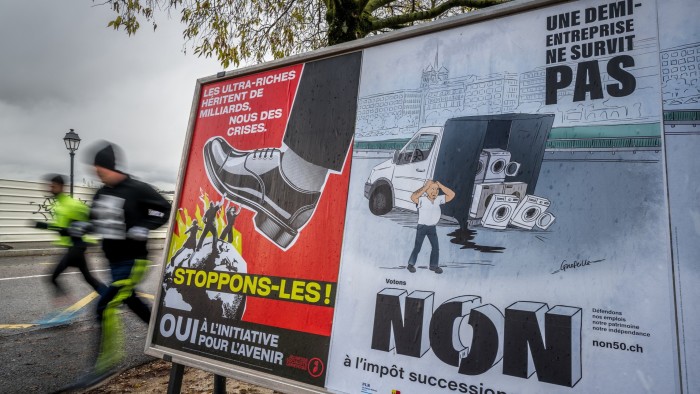
Switzerland votes on Sunday on whether to impose a 50 per cent inheritance levy on the super-rich, as governments around the world wrestle with how to tax the wealthy.
The referendum, one of the most divisive in recent Swiss political memory, comes amid a global split between countries competing to lure wealthy families with fiscal incentives and those seeking to tax what they see as excessive fortunes.
The proposal from the far-left Young Socialists party would introduce a federal inheritance and gift tax of 50 per cent on estates and transfers above SFr50mn (£47mn), marking a dramatic break from Switzerland’s tradition of decentralised, low-burden taxation. Revenue would be earmarked for climate-related spending.
The federal government opposes the initiative, warning it would damage Switzerland’s appeal as a stable home for internationally mobile wealth. The proposal was originally drafted to be retroactive — a clause that provoked a fierce backlash from business groups and tax lawyers and was later softened.
There has been deep anxiety among Swiss family offices and wealthy residents, some of whom are reviewing relocation options, the Financial Times reported in June. Economists and lawyers have warned the measure could affect succession planning for family-owned companies whose wealth is tied up in illiquid assets.
Peter Spuhler, owner of stock giant Stadler Rail and one of Switzerland’s richest people, has publicly slammed the proposal as “a disaster for Switzerland”.
The public is expected to vote the proposal down in the referendum but opponents of the measure fear that if it is only narrowly defeated on Sunday that would invite another similar initiative in a few years.
The Swiss vote lands at a moment when governments’ approaches to high-net-worth individuals have diverged sharply.
In some financial centres the race to attract wealthy families is accelerating. Dubai, Abu Dhabi, Hong Kong and Singapore are offering tax concessions and light-touch regulation to draw single-family offices — the private investment vehicles of the global super-rich. Hong Kong, which hosted an estimated 2,700 family offices in 2023, aims to attract 200 more by the end of 2025.
Elsewhere, countries are tightening rules or increasing levies. Italy has drawn a surge of arrivals under its flat-tax regime for foreign income, centred on Milan, but the government announced in October it plans to increase the levy by a further 50 per cent to €300,000 from next year.
In her first Budget last year, UK chancellor Rachel Reeves hit the super-rich by confirming the abolition of “non-dom” status, which allowed UK residents who declared their permanent home as being overseas to avoid paying UK tax on foreign income and gains.
Swiss lawyers said the referendum proposal had undermined Switzerland’s chances of attracting tax exiles from the UK following the non-dom change, with many opting for Italy rather than Switzerland.
Meanwhile, in late October the French parliament voted to reject a Socialist proposal for a tax of 2 per cent on wealth of more than €100mn. Another proposal for a 3 per cent tax on wealth over €10mn was also rejected.
Switzerland has long relied on a competitive tax environment, predictable rules and political stability to attract wealthy residents and their businesses. The proposed federal levy would be layered on top of cantonal inheritance taxes, prompting concerns about potentially punitive overall rates and what advisers describe as “extreme structural uncertainty”.