
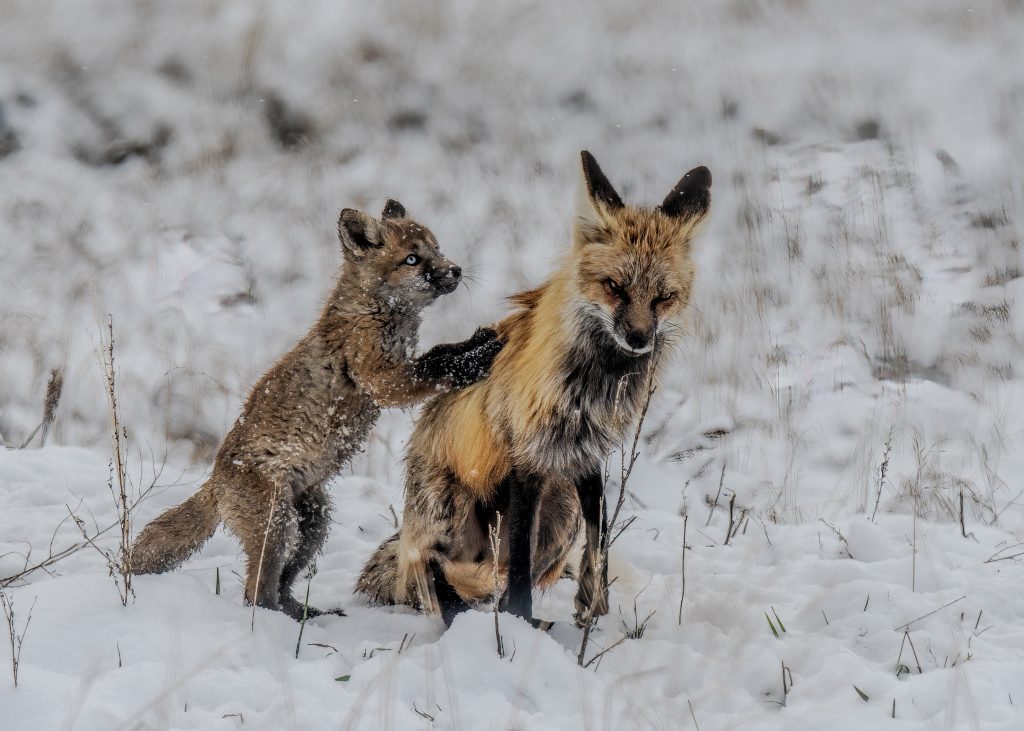
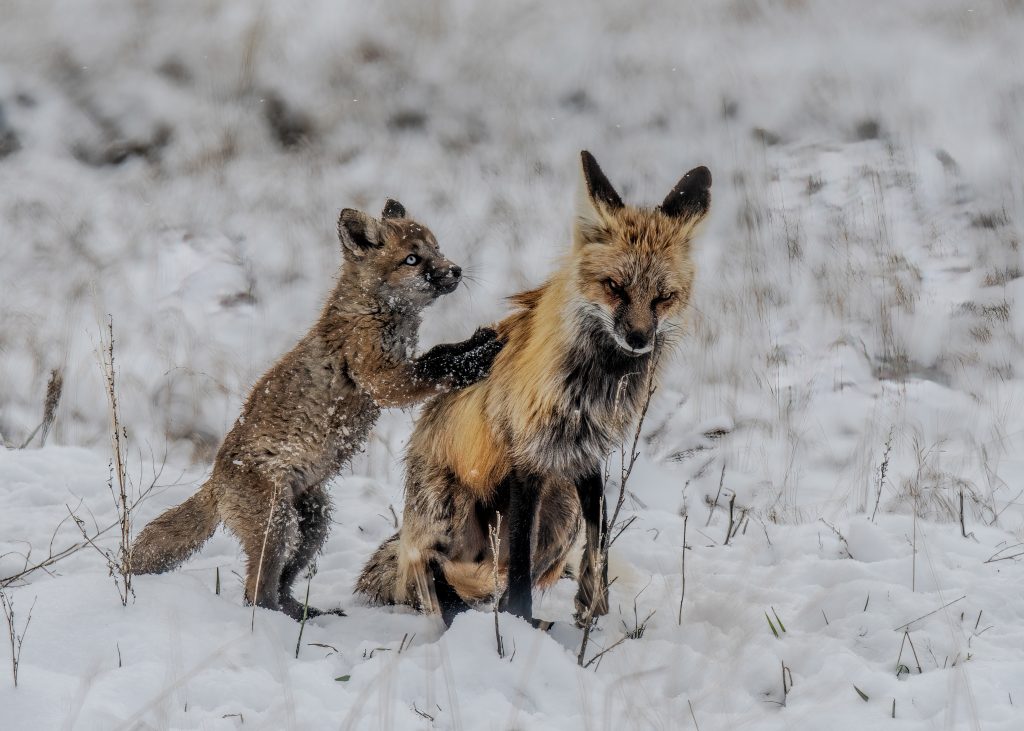
 A kit seeks attention from its mother during a Summit County winter. Foxes are among the animals that stick around in the cold.
Stephen Johnson/Courtesy photo
It might seem tempting to be the cool friend who gets a video of snowboarding right next to a moose when you spot one on the way down a slope of a Summit County ski resort. Wildlife enthusiasts promise that interaction will be anything but fun.
Friends of the Dillon Ranger District education and youth programs manager Maddie Retrosi said Summit County has hearty winter wildlife able to stick around through intense weather conditions, and it’s likely someone here all winter will at least have one sighting. She said it’s important for people to know the safest ways to spot them for the sake of themselves and the animal.
Here’s what to know about winter wildlife in Summit from professionals in nature-related industries.
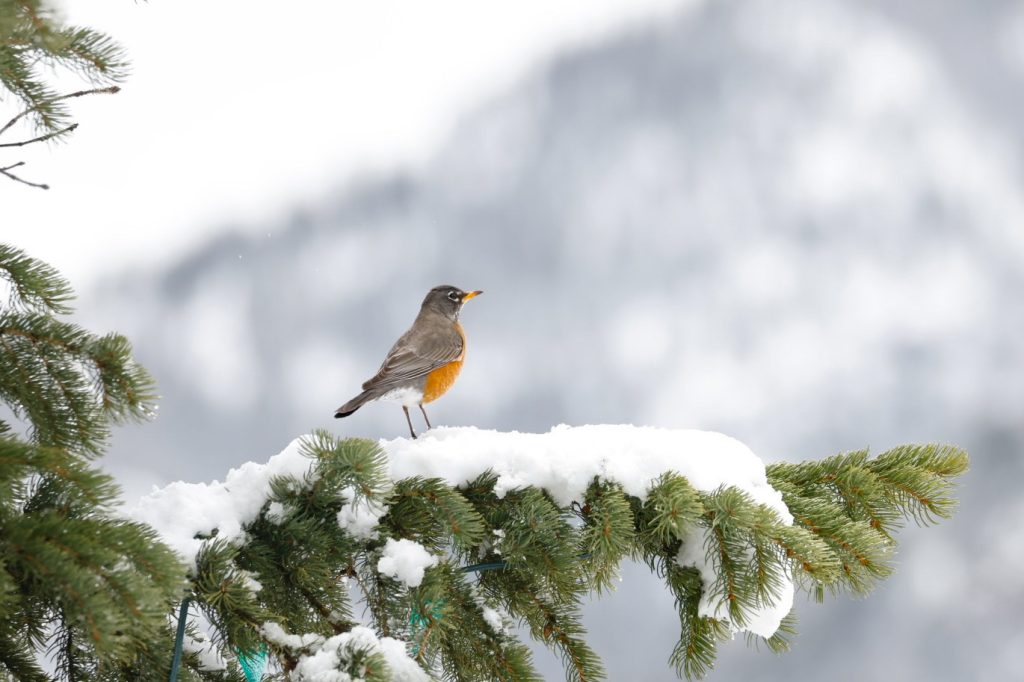 A mountain robin rests on a snowy tree in Frisco during early spring. Clint Giberson/Courtesy photo
What you could see and where to see it
Retrosi said while deer and elk migrate down to lower elevation areas during winter, moose can stay at higher elevation because of their long legs and ability to navigate deep snow packs. Additionally, moose like wetlands, which she said can be found on many of Summit County’s ski areas. This is why it’s not uncommon to see moose while Alpine skiing.
“Moose can be a really dangerous animal for people,” she said. “And moose are also starving over the wintertime, and so they’re going to protect their resources.”
Breckenridge Open Space and Trails coordinator Alex Stach said moose are the type of animal that might also be seen within town limits and in residential neighborhoods. He said they can be unfazed by human activity, until they aren’t. An angry moose might trample something that upsets it and can do some serious damage.
Stach said while it might seem tempting to let a dog run around an unfenced area off-leash during the winter, an interaction with an excited dog is the type of situation that could agitate a moose. He said even the most highly trained, well-behaved dogs can scare a moose. He said it doesn’t matter if an owner has fantastic voice control over a dog — leash laws exist for the safety of everyone.
He said his department has dealt with its fair share of moose charges.
A common rule of thumb recommended by wildlife enthusiasts for moose interactions is the literal rule of thumb. If you hold up your thumb in front of your face and you can’t see the moose behind it, then you are a safe distance away.
Coyotes and foxes are other animals that can be found roaming within town limits and residential areas, particularly in Breckenridge.
“I’m pretty sure foxes run that town,” Retrosi said. “We see so many foxes over the winter.”
She said they might be cute, but don’t feed them. Feeding foxes will draw more of them to approach people looking for food and this creates the potential to also draw their predators.
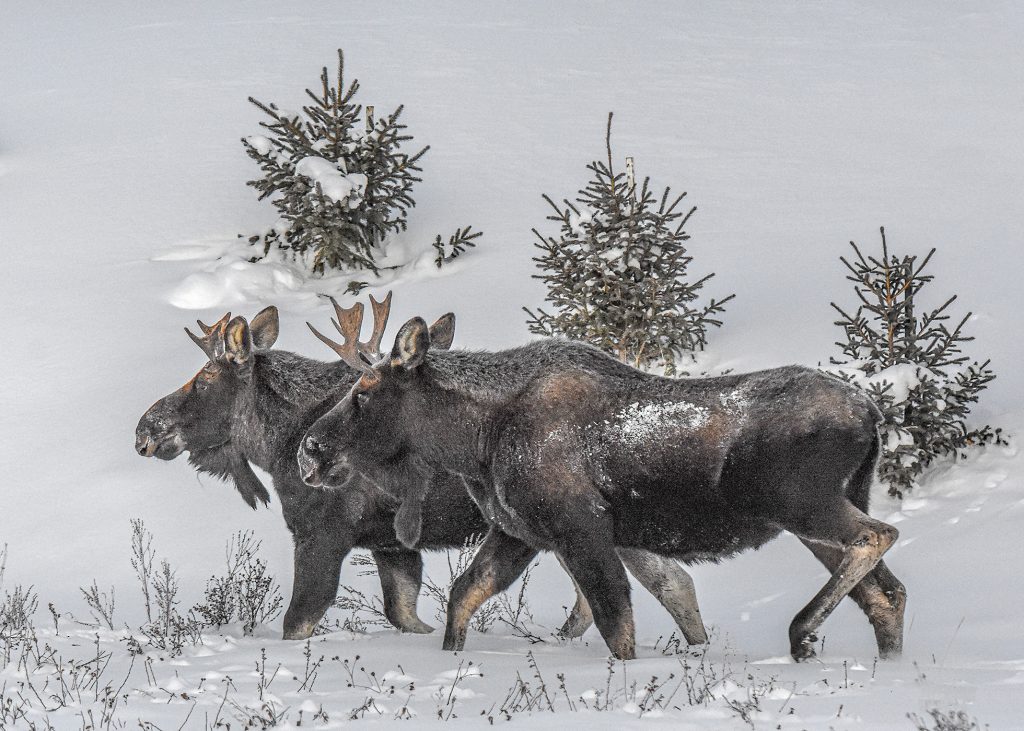 A couple of bull moose trudge through snow in Summit. Stephen Johnson/Courtesy photoo
The other large animal people might see in Summit is an elk, which Retorsi said is a prey animal that doesn’t have the same predatory instincts as a moose. They typically shy away from humans. Stach said they sometimes can be spotted on open space parcels near the Vista Verde apartments in Breckenridge, but the Heeney and Green Mountain areas are typically the best place to see them.
Board member for volunteer organization Eagle Summit Wildernest Alliance Karn Stiegelmeier said one of her favorite places to spot wildlife is at nordic centers like the Frisco Nordic Center or Gold Run Nordic Center. The animal she’s most excited about seeing? The ermine.
She said these “spectacular” weasels turn bright white in the winter to blend in with the snow. Stach said another animal with this ability is the ptarmigan bird, which can be found in various places around Summit. Another animal with similar abilities that is less popular to spot is the snowshoe hare, which can occasionally be seen near nordic trails.
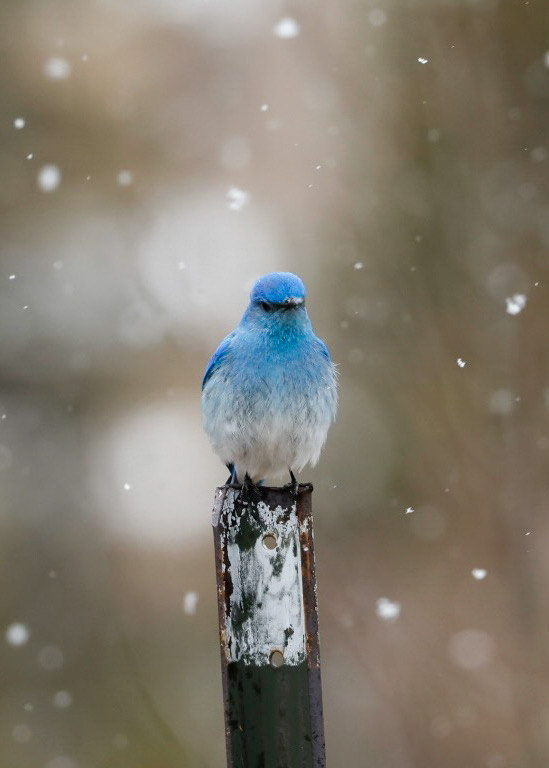 A mountain bluebird sits on a stump in Frisco in early spring. Usually these birds are further south during the winter and their appearance is rare. Clint Giberson/Courtesy photo
How they survive
Retrosi said most animals just “tolerate the winter,” with many on a “starvation diet.” She said some mammals stock up on fat to keep them through the winter while others hibernate.
“Food is really scarce … No one’s really thriving throughout the winter up here,” she said, highlighting the importance of leaving animals alone as they try to survive colder conditions.
Steilgmeier said the birds that hang around Summit in winter, namely the chickadees, stand out as being particularly resourceful in the wintertime. She said they can even lower their body temperature to get through a cold night. She said birds spend the summer stashing away food for the winter and they can remember where several stashes are by the time winter comes around.
Stach said coyotes and foxes use their phenomenal hearing to be able to track critters underground to hunt, and that’s a major way they are able to survive.
Overall, it’s never a bad idea to steer clear of interacting with winter wildlife in Summit County while they’re in survival mode.
This story previously published in the winter 2025 edition of Explore Summit County magazine.