
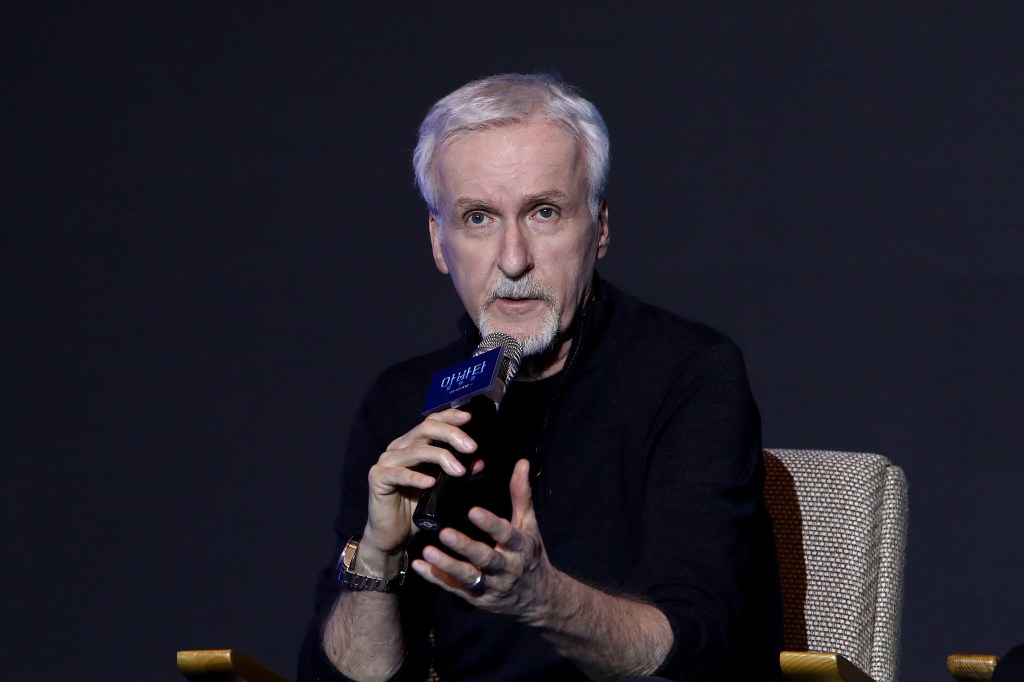
Though James Cameron — who sits on the board of Stability AI — has expressed positive sentiments about artificial intelligence usage in filmmaking, he calls the prospect of the technology replacing actors “horrifying” and maintains its implementation will inevitably raise the bar for our standards on human-made art.
In an extended interview with CBS Sunday Morning promoting the forthcoming Avatar: Fire and Ash, the three-time Oscar winner segued into talk about generative AI while discussing his affinity for motion capture, which he described as the “purest form” of performance.
At the time of Avatar‘s 2009 release, Cameron recalled his hesitance “to pull the curtain back” on motion capture in hopes the “magic [would] be unblemished” for audiences. Now calling that decision a “mistake,” he said it led to a misconception around the CGI-assisted tool.
“For years, there was this sense that, ‘Oh, they’re doing something strange with computers and they’re replacing actors,’ when in fact, once you really drill down and you see what we’re doing, it’s a celebration of the actor-director moment, and the actor-to-actor moment. It’s a celebration of, I call it, the sanctity of the actor’s performance moment,” the Titanic filmmaker explained.
“Now, go to the other end of the spectrum, and you’ve got generative AI,” he continued, “where they can make up a character, they can make up an actor. They can make up a performance from scratch with a text prompt. It’s like, no. That’s horrifying to me. That’s the opposite. That’s exactly what we’re not doing.”
When questioned why he’s strongly opposed to artificially created actors, he said, “I don’t want a computer doing what I pride myself on being able to do with actors. I don’t want to replace actors, I love working with actors.”
At the same time, Cameron insisted that the nascent tech could be helpful in “making VFX cheaper,” a sentiment he’s previously expressed.
“Right now, imaginative films, fantastic films, science-fiction films — they’re starting to die off as a breed because they’re expensive and the theatrical marketplace has contracted,” the director stated, “and now studios are only comfortable spending those kinds of dollar amounts with blue-chip IP, that which we’ve seen, that which we know. I mean, a movie like Avatar would never get made in that environment. That was brand-new IP; nobody had ever heard of it.”
Speaking to concerns that gen AI could undermine his work, he answered, “It might, but it also causes us to have to set our bar to a very disciplined level, and to continue to be out-of-the-box imaginative … what generative AI can’t do is create something new that’s never been seen. If you think about it, the models — it’s a magic trick, what they can do is quite astonishing. But the models are trained on everything that’s ever been done before that; it can’t be trained on that which has never been done. So you will innately see, essentially, all of human art and human experience put into a blender, and you’ll get something that is kind of an average of that. So what you can’t have is that individual screenwriter’s unique lived experience and their quirks. You won’t find the idiosyncrasies of a particular actor.”
He likens the possible effect on art and filmmaking as akin to going “acoustic.”
“The act of performance, the act of actually seeing an artist creating in real time will become sacred, more so,” Cameron concluded.
As industry professionals reckon with AI potentially encroaching on their livelihoods, numerous high-profile filmmakers — Guillermo del Toro, Celine Song and Denis Villeneuve among them — have slammed the technology and declared it has no place in the moviemaking process.
Avatar 3 is due in theaters Dec. 19.