
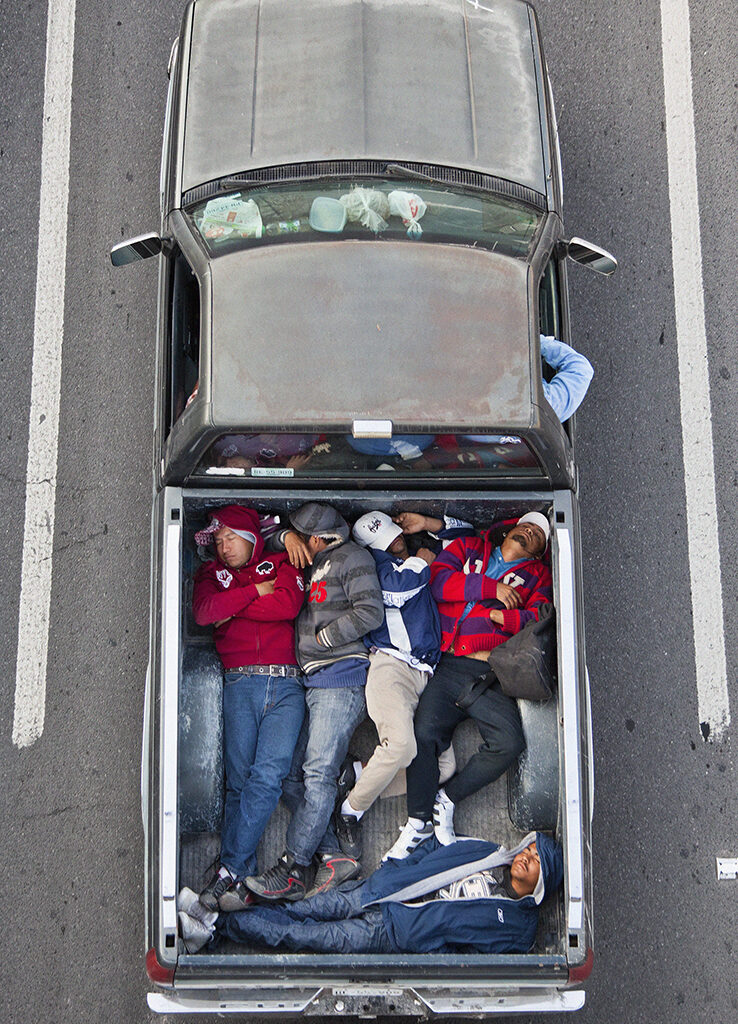
Alejandro Cartagena hasn’t picked up a camera in six years, he told a slightly baffled audience gathered for the opening of his photography exhibit, “Ground Rules,” on display at the SFMOMA until April 19.
Instead, the Dominican Republic-born Mexican photographer continued, he’s turned his attention towards a new art from: AI. At this news, some sitting in the audience visibly shuddered.
In the early 2000s, Cartagena began documenting the everyday dramas surrounding his family home in Juarez — what at the time was a small border town. When he picked up his camera and began documenting the world around him, AI was in its infancy, and social media, inciting a proliferation of iPhone photographers, was limited to MySpace.
Shortly before Cartagena moved with his family to Mexico, the Mexican government embarked on an ambitious plan to build hundreds of housing developments across the country. These new suburbs were meant to be affordable to Mexico’s working class, but ultimately saddled new homeowners with properties they couldn’t afford to care for, and couldn’t get rid of either.
Every year, their loans got bigger, and their quality of life declined. Beneath the surface of seemingly pristine cookie-cutter homes, poor construction yielded homes that would burst into flames, many had no running water, and houses quickly fell into disrepair.
In Cartagena’s early photos of Juarez, idyllic portraits of families pose against a backdrop of sprawling, nearly identical, cube-shaped homes. But over the years, his later work depicts Mexico’s burgeoning change.
Over the next decade, Juarez grows rapidly from a town of 60,000 people to a booming metropolis of over half a million people — and the city’s infrastructure struggles to keep up. The once pristine homes begin to display signs of turmoil. In one series of photos and stills from news footage, rows of houses are razed to the ground by a hurricane. In another, a home is subsumed in vines. Some photos show nothing but a pile of ash after faulty electrical wiring caused homes to burst into flames.
For Cartagena, picking up the camera began as a way to understand his home, and the changes he saw happening before his eyes.
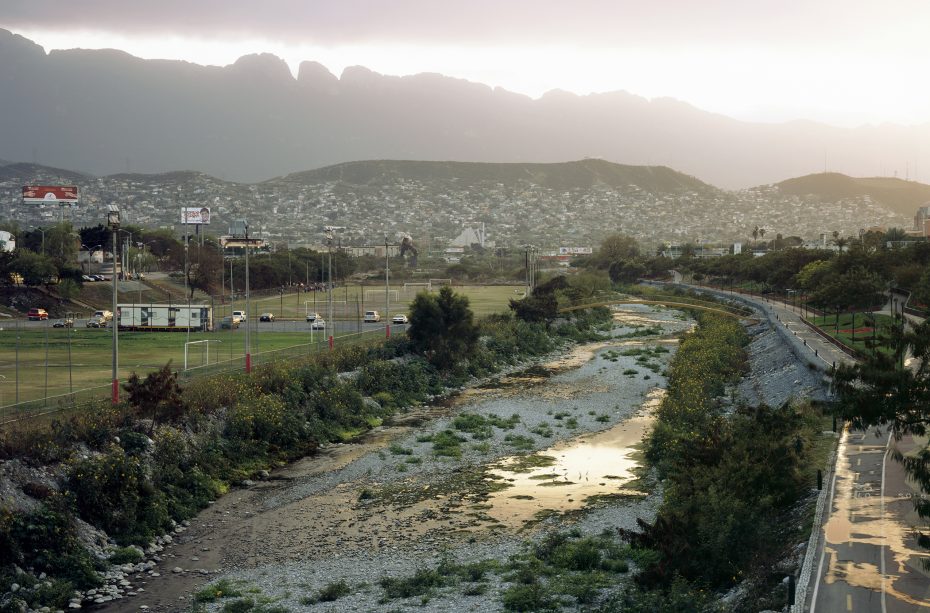 Alejandro Cartagena, Rivers of Power #71, from the series Rivers of Power, 2010–16© Alejandro Cartagena, courtesy the artist
His photos of the growing city are interlaced with everyday portraits — workers piled into the back of a truck bed, a family sitting at their kitchen table, a child in their bedroom. He plays with light in a way that makes scenes of a border wall, or weary travelers on a crowded bus on an hours-long commute, beautiful.
But for Cartagena, that beauty began to feel dishonest. In 2016, he abruptly stopped documentary photography altogether. “I felt like I was romanticizing northern Mexico,” he explained.
Instead, he began to cut up and manipulate his earlier images.
In one installation, “Latent Space,” (2025) Cartagena feeds six images of suburban homes built during Mexico’s housing program into an AI model. A participant, taking construction paper and moving the papers under a camera, generates an image of a new home, reflected on a large screen. The images are similar to the six photos of the homes Cartagena took years ago — with some eerily surprising twists. Images of people who Cartagena have never photographed before have emerged, standing in front of their new home, and writing has magically appeared on its walls.
For Cartagena, AI manipulations like this help him further understand the world around him.
“There’s a debris of photography,” said Cartagena. “Everyone has a photographic practice.” With so many photos already in existence, Cartagena is, as he put it, “Interested in what the machine can see.”
In another installation, “Suburban Bus,” Cartagena fed 3,600 images he took of people going about their daily commute in Juarez into an algorithm that read the time-stamp of each image and sequenced them into chronological order. The final product is a colossal floor to ceiling mural of thousands of tiny images of commuters crowded together for hours, looking out at scenes of the urban street outside as the sun began to set.
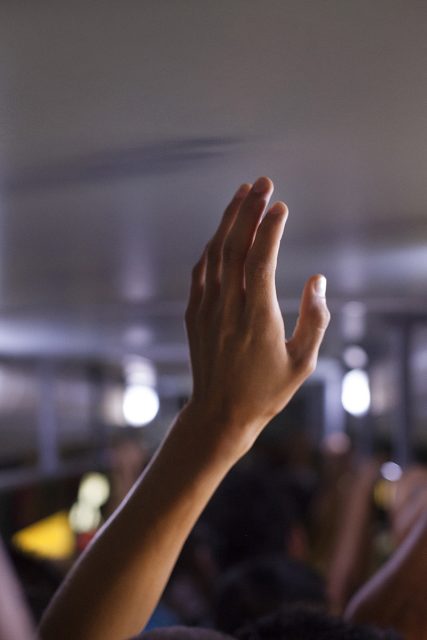 Alejandro Cartagena, Suburban Bus #56, from the series Suburban Bus, 2016; © Alejandro Cartagena, courtesy the artist
He’s weaved in his own, updated work with images from strangers — stills from broadcast news, newspaper clips, family photos he’s purchased at flea markets — often with the help of technology. He sees this as a new artform — an improvement on the documentary photography that he once loved.
During the Q&A period, some in the audience pushed back. One intrepid audience member asked if Cartagena, like Andy Warhol, wanted to “be a machine?” Cartagena laughed, “I am not a machine. Perhaps I’m a bit obsessive though.” But, he continued, “What is the point of art if a machine can do something that looks like art?”