
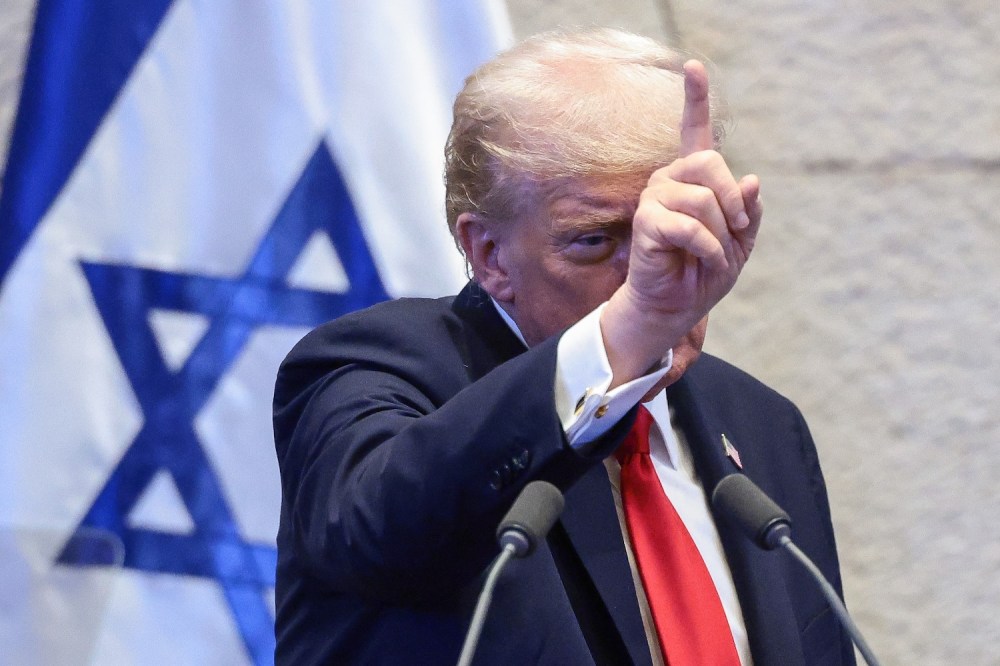
Just as Americans across the political spectrum are increasingly expressing criticism of Israel, Israelis are debating whether many of Washington’s recent policy decisions in the Middle East are to their detriment. The U.S. government is often depicted as attempting to control Israeli policy and limit its freedom of action. Commentary in Israeli and Arab press has questioned whether the United States is treating Israel as its 51st state rather than an independent sovereign country.
According to a recent poll by the Israel Democracy Institute, nearly half of Israelis believe that the United States has a “greater influence on security decisions” than their own government.
Just as Americans across the political spectrum are increasingly expressing criticism of Israel, Israelis are debating whether many of Washington’s recent policy decisions in the Middle East are to their detriment. The U.S. government is often depicted as attempting to control Israeli policy and limit its freedom of action. Commentary in Israeli and Arab press has questioned whether the United States is treating Israel as its 51st state rather than an independent sovereign country.
According to a recent poll by the Israel Democracy Institute, nearly half of Israelis believe that the United States has a “greater influence on security decisions” than their own government.
In the United States, criticism of Israel is rising across the ideological divide. According to the Pew Research Center, negative views toward Israel have risen among Republicans, mostly among the younger demographics, over the last three years. Evangelical Christians—traditionally the strongest pro-Israel demographic in the United States—have also been angered by U.S. President Donald Trump’s bombings of Iran, seen as a betrayal of the promise to end “forever wars,” under pressure from Israel.
A tougher challenge yet emanates from an anti-Israel and pro-Trump MAGA base. Former Fox News host Tucker Carlson, former Trump advisor Steve Bannon, and Rep. Marjorie Taylor Greene have questioned U.S. support for Israel. Yet others in the vast MAGA universe are using that disagreement with policy as an excuse to spew antisemitic commentary. In October, Carlson interviewed Nick Fuentes, a far-right white nationalist, offering him a platform. Fuentes delivered blatantly antisemitic views, accusing American Jews of refusing to assimilate and “organized Jewry” as the main obstacle toward national unity.
Experts agree that U.S. support for Israel will continue under the Trump administration but that the Israeli government may change tack to be more demonstrative for the MAGA base about how Israel serves U.S. interests. “We need to shift away from the model of economic aid to a model of mutual cooperation on the military side,” said Eran Lerman, a former deputy Israeli national security advisor and vice president of the Jerusalem Institute for Strategy and Security (JISS). “As long as Trump himself is in full control of dynamics, relations with Israel are safe.”
But others say Trump is the biggest part of the problem. His relationship with Israeli Prime Minister Benjamin Netanyahu has been far from friendly. “Fuck him,” Trump said of Netanyahu in an interview he gave to Israeli journalist Barak Ravid for his book Trump’s Peace: The Abraham Accords and The Reshaping of The Middle East. A bigger concern is that his support for Israel isn’t a matter of principle, based on a commitment to back a community historically discriminated against or to support a democracy in the Middle East, but instead to present himself as a man of peace and ensure himself a Nobel prize.
In fact, much to the consternation of the Israeli strategic community, Trump has also lent his ear to the Arab leaders who want more weapons, more U.S. support to improve their economies, and have managed to keep Trump from abandoning Palestinian aspirations all together. Despite his recognition of the occupied Golan Heights as Israeli (rather than Syrian) land and relocating the U.S. Embassy from Tel Aviv to Jerusalem in his last administration, the Arabs continue to effectively whisper in Trump’s ears, impressing him with abundant praise and even a luxurious airplane.
Trump told Ravid that he didn’t believe Netanyahu wanted to make a deal and end the conflict with the Palestinians while opposition leader Benny Gantz did. Mostly, his criticism seemed to emerge from Netanyahu’s congratulatory message to Joe Biden after he won the U.S. presidential election in 2020. Although Ravid also noted that, in a later conversation, Trump’s tone toward Netanyahu was far softer, the book’s account revealed darker shades of a relationship often represented as strong.
Trump has come out in support of Netanyahu in recent days and this month asked the Israeli president to pardon him in corruption cases. But experts believe that is a part of the larger gambit: to keep Netanyahu from annexing the West Bank and sustain the cease-fire, irrespective of the delay—or even certainty—of Hamas’s disarmament.
Soon after the cease-fire was agreed, Trump rushed several of his team members—including Secretary of State Marco Rubio and Vice President J.D. Vance—to Bibi-sit, or keep Netanyahu, whose nickname is Bibi, from attacking Hamas. Eliminating Hamas was an Israeli war goal, but with Hamas still in control of 47 percent of Gaza, some Israelis say it is now on Trump to achieve that objective.
“Trump is the head of the board of peace. So he has to deliver on Hamas’s disarmament,” said Yossi Kuperwasser, the director of JISS. But he admitted that Trump’s plan was not clear about a timeline or the process of such disarmament.
About 20 miles from Gaza, the United States has set up a Civil-Military Coordination Center, where 200 U.S. soldiers and representatives from various Western countries are milling about. The idea behind setting up a logistical center is to plan the next phases of Trump’s peace plan—but it also places Israeli policy and the Israel Defense Forces under the gaze of foreign forces and ties their hands.
Many other policy areas of disagreement have emerged. Trump’s decision to sell state-of-the-art F-35 fighter jets to Saudi Arabia has rattled many in Israel. Even though Israel is keen to normalize ties with Riyadh, it doesn’t want to lose its qualitative military edge in the region. Trump’s lifting of sanctions against Syria and embrace of a former jihadi-turned-president, Ahmed al-Sharaa, has sparked concern in Israel.
Moreover, Trump’s backing of Qatar and Turkey, which the United States sees as key players that can influence Hamas but Israel sees as Hamas sympathizers, is proving to be hard to navigate. After what appeared to be a forced apology from Netanyahu to Qatar—for bombing Hamas leaders in Doha—now the United States is reportedly supporting Turkey’s inclusion in the International Stabilization Force to be deployed in Gaza while Israel has refused to accept Turkish boots on the ground.
Some say cracks in U.S. support for Israel are exaggerated and that the outcome of Trump policy still by far favors Israel.
Yet there is no denying that a confluence of factors—including a high death toll in Gaza, with more than 69,000 Palestinians dead; a right-wing coalition in Israel that is pushing for annexation of the West Bank and the expulsion of Palestinians; fear of the United States entering another war against Iran on behalf of Israel; and a splintering of support for Israel among Trump’s MAGA fanbase—is, for the first time, leading Americans to question the basis of U.S. support to Israel. In a 60 Minutes interview with Lesley Stahl last month, Jared Kushner, Trump’s son-in-law and one of his two top Middle East negotiators, said Trump felt that “the Israelis were getting a little bit out of control in what they were doing and that it was time … to be very strong and stop them from doing things that he felt were not in their long-term interests.”
Yossi Mekelberg, a senior consulting fellow at Chatham House, said Israelis have varying views on Trump’s Israel policy. But it was hard to argue that a decline in Israeli support among Americans was “strategically very dangerous,” he said, and that must initiate a change in Israeli government policy. Israel receives 69 percent of its weapons from the United States as well as all kinds of diplomatic support, Mekelberg added.
There is no fallback for Israel if the United States wants to drive regional policy without factoring in all of Israel’s wishes. Israel has no choice but to work with whoever is in the Oval Office, even a president who on one hand is extremely popular—since he secured a deal that brought back the hostages—but on the other appears to be interfering in the legal system of the country. Trump seems to have offended some Israelis, who felt he had no business seeking a pardon for Netanyahu in legal cases. “It was bizarre that Trump asked to pardon Netanyahu, completely oblivious to the fact that he has no legal standing to do this,” Mekelberg said.
On its part, instead of a visionary policy shift to ending the war in a way that ushers in peace, thus regaining some of the support lost in the United States, the Netanyahu government is accused of hiring public relations firms to create pro-Israel content online and change the narrative there.