
Gbps: A measure of network transmission speed, representing one billion bits of data transferred per second. Because one byte equals eight bits, 100 Gbps corresponds to roughly 12.5 GB/s of data throughput under ideal conditions.
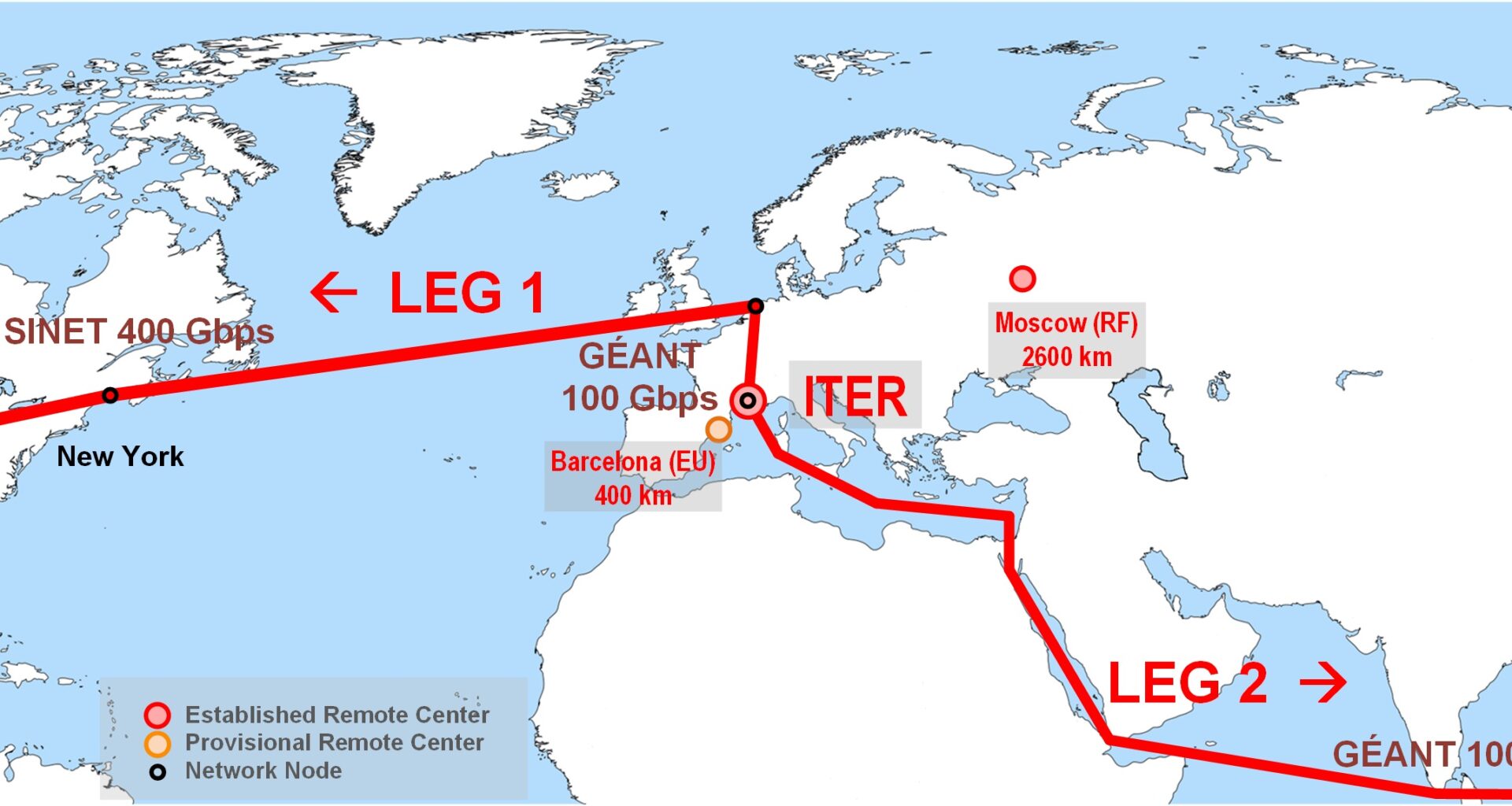
High-latency: High-latency describes network links where data packets experience long delays—typically due to the physical distance between systems or the number of hops through intermediate routers. Transferring data between France and Japan, for instance, involves a 10,000-kilometre journey across multiple submarine cables, introducing latency of more than 200 milliseconds. Such delays can degrade throughput unless the transfer software compensates with optimized buffering and parallel streams. ITER.sync is specifically engineered to maintain high performance even on these long, high-latency paths.
Massively Multi-Connections File Transfer Protocol (MMCFTP): A high-performance data transfer protocol engineered to maximize throughput by opening and coordinating a very large number of simultaneous network connections. Unlike traditional file-transfer tools, which typically rely on a handful of parallel streams, MMCFTP can orchestrate hundreds or even thousands of concurrent flows.
Parallelization: The process of dividing a large data transfer into multiple simultaneous streams to increase overall throughput. Instead of sending one massive file sequentially, ITER.sync splits and distributes the data across several network threads or channels, each handled independently.
Rsync: An open-source software utility designed to synchronize files and directories between two systems efficiently by sending only the data blocks that have changed. It’s widely used for backups and mirroring because it minimizes network load while ensuring data integrity. ITER.sync builds on rsync’s core principles but adds advanced tuning and multi-streaming capabilities for long-distance, high-speed scientific data transfers.
Saturation speeds: The point at which a network link is fully utilized, with data flowing as fast as the physical and protocol limits allow.