
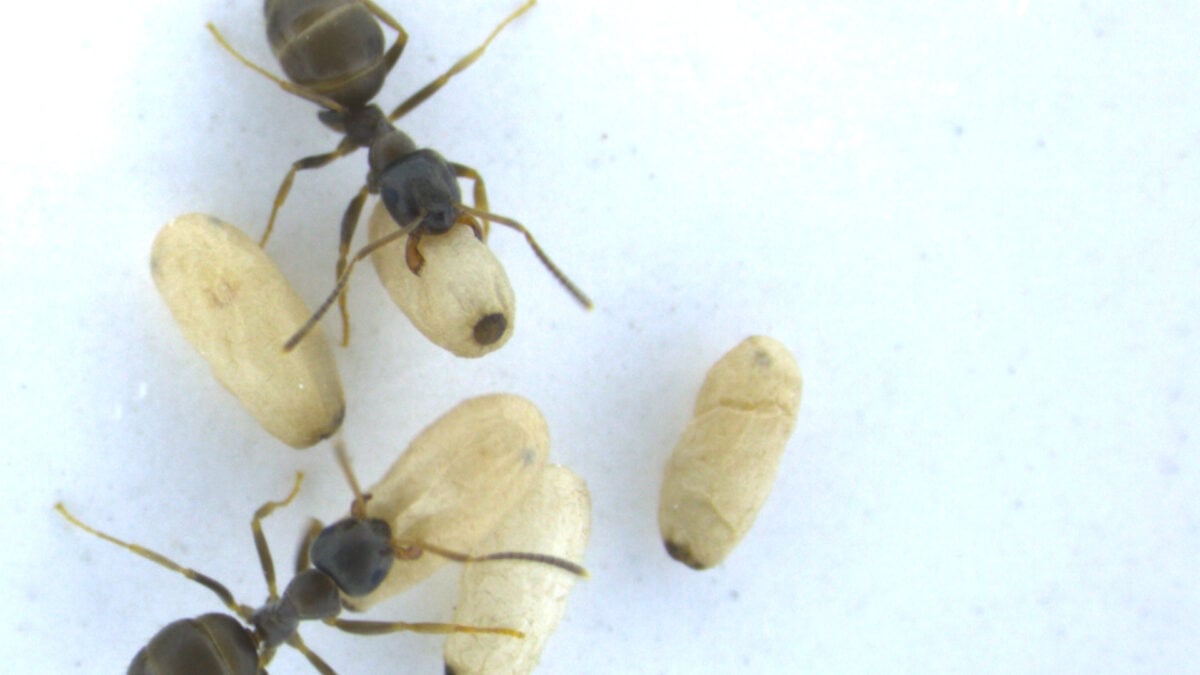
New research shows that terminally ill baby ants tell other ants to kill them, potentially protecting the rest of the colony from their infection.
In a study published today in the journal Nature Communications, researchers revealed that ant pupae—what a larva grows into before becoming an adult—of the Lasius neglectus ant species actively produce a chemical signal that causes other colony members to destroy them. The findings further solidify the view of an ant colony as a “superorganism” behaving as a single entity rather than a community of many individuals.
Selfless ants
“Sick individuals often conceal their disease status to group members, thereby preventing social exclusion or aggression,” the researchers wrote in the paper. On the other hand, researchers have documented sick adult ants leaving their colony to avoid spreading their disease. Pupae, however, are encased in a cocoon and cannot leave, so they resort to a rather extreme strategy—emitting a chemical signal essentially calling for self-destruction.
“Adult ants that approach death leave the nest to die outside the colony. Similarly, workers that have been exposed to fungal spores practice social distancing,” Sylvia Cremer, co-author of the study and group leader of the Cremer Group at the Institute of Science and Technology Austria (ISTA), said in an ISTA statement. “Yet, this is only possible for mobile individuals. Ant brood within the colony, like infected cells in tissue, are largely immobile and lack this option.”
Once worker ants receive the signal, they take the pupae from the cocoon, punch holes into them, and inject them with formic acid—an antimicrobial poison that works like a self-produced disinfectant. This kills the pathogens but also the pupae.
While previous research had demonstrated that worker ants can recognize sick pupae and kill them to disinfect the nest, scientists didn’t know if passive cues or intentional signaling by the sick pupae triggered this dynamic. To shed light on the matter, the scientists behind the new study infected Lasius neglectus ants with a fungal pathogen.
BO as a warning
During the experiment, sick worker pupae emitted a modified body smell (the chemical signal) that warned the adult ants to destroy them. Only sick ants near adult worker ants produced this signal, indicating that the cue isn’t just an immune response or side effect of infection. When the researchers applied the smell to healthy pupae, they were also destroyed, confirming the chemical’s role in triggering the response.
Because workers destroy specific pupae within an entire brood (eggs, larvae, and pupae) pile, “the scent cannot simply diffuse through the nest chamber but must be directly associated with the diseased pupa,” explained Thomas Schmitt, co-author of the study and a chemical ecologist from the University of Würzburg. “Accordingly, the signal does not consist of volatile compounds but instead is made up of non-volatile compounds on the pupal body surface.”
While colonies are technically communities made of many individual ants, they work as a single superorganism. Ants within a colony are like the cells in our body. For example, ant queens are responsible for producing offspring, and non-fertile workers are responsible for the colony’s maintenance and health. Similarly, our germline cells are responsible for the production of offspring, and our somatic cells execute all the other important tasks. Along those same lines, the signaling from terminally ill pupae mirrors the way our body’s cells release chemical cues—called the “find-me and eat-me signal”—for our immune cells, which then identify and destroy the signaling cells to eliminate the risk of infection.
Queen ants don’t need to be destroyed
For ants, “what appears to be self-sacrifice at first glance is, in fact, also beneficial to the signaler: it safeguards its nestmates, with whom it shares many genes. By warning the colony of their deadly infection, terminally ill ants help the colony remain healthy and produce daughter colonies, which indirectly pass on the signaler’s genes to the next generation,” explained Erika Dawson, first author of the study and a behavioral ecologist at ISTA. If a terminally ill ant pretended to be healthy and died, it could become infectious and endanger the whole colony.
Interestingly, the researchers did not observe queen pupae emit the chemical signal. They have stronger immune defenses than worker pupae and can restrict the infection independently. Worker pupae, however, couldn’t control the infection and warned the colony.
Sick pupae only emit the signal when the infection is uncontrollable, empowering fellow ants to intervene in situations of real threats while avoiding the destruction of pupae that can recover. “This precise coordination between the individual and colony level is what makes this altruistic disease signaling so effective,” Cremer concluded.