
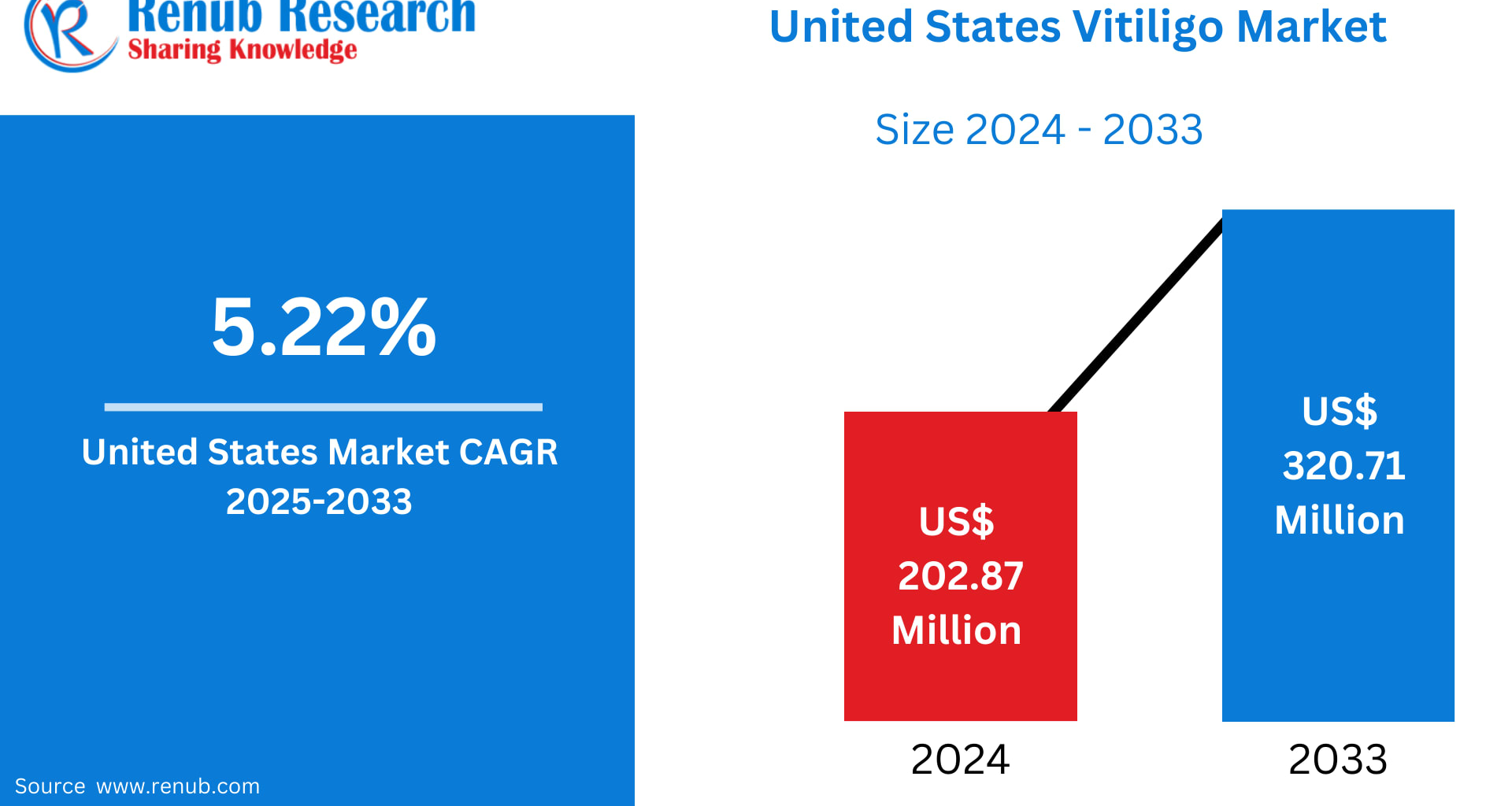
The United States vitiligo market is entering a transformative era defined by technological innovation, rising awareness, and growing therapeutic demand. According to Renub Research, the United States Vitiligo Market is projected to reach US$ 320.71 million by 2033, rising from US$ 202.87 million in 2024, marking a CAGR of 5.22% between 2025 and 2033. This growth reflects not only improved access to dermatological care but also a deeper societal and medical understanding of vitiligo—a chronic autoimmune condition characterized by the loss of skin pigmentation.
While vitiligo is not life-threatening, its psychological and social implications are significant. Millions of Americans experience the condition, navigating challenges related to appearance, self-confidence, and long-term treatment needs. Today, advancements in biologics, phototherapy, and novel targeted therapies are providing unprecedented hope for effective and lasting management. As awareness rises and care pathways strengthen, the U.S. vitiligo market is moving toward a future driven by accessibility, innovation, and personalized care.
United States Vitiligo Industry Overview
The U.S. vitiligo market continues to grow steadily, fueled by increasing disease awareness, improved diagnostic practices, and expanding therapeutic options. Vitiligo impacts a considerable segment of the American population, with symptoms ranging from small depigmented patches to widespread pigment loss. Its chronic nature often requires long-term treatment, ongoing monitoring, and multidisciplinary care involving dermatologists, psychologists, and primary care providers.
Public advocacy and education—led by patients, nonprofits, dermatological associations, and social media influencers—have significantly contributed to awareness. This has encouraged more individuals to seek medical advice early, leading to quicker diagnosis and improved treatment outcomes.
Therapeutically, the U.S. healthcare system offers a robust range of options, including:
Topical corticosteroids and calcineurin inhibitors
Excimer laser and narrowband UVB light therapy
Surgical procedures for stable vitiligo
Advanced targeted therapies such as JAK inhibitors and biologics
The arrival of JAK inhibitors—particularly in topical forms—has been one of the most notable breakthroughs in recent years. Paired with advances in research, growing clinical evidence, and personalized medicine approaches, these developments are reshaping the vitiligo treatment landscape.
However, the market continues to face hurdles. Limited curative solutions, high treatment costs, inconsistent insurance coverage, and therapy adherence issues remain significant challenges. Yet ongoing collaborations between pharmaceutical companies, dermatologists, research institutions, and advocacy groups continue to pave the way for a more accessible and effective vitiligo treatment environment.
Key Factors Driving the U.S. Vitiligo Market Growth
1. Advancements in Treatment Technologies
Technological innovation remains one of the most powerful drivers of market expansion. Improvements in light therapy—especially Excimer lasers—have demonstrated remarkable efficacy in treating localized vitiligo. Clinical research suggests these treatments can achieve up to 60% repigmentation in some cases, significantly enhancing patient outcomes.
Pharmaceutical giants such as Eli Lilly, Incyte, Pfizer, and Astellas Pharma are actively developing next-generation therapies. Notably, Tofacitinib, a promising JAK inhibitor, has shown encouraging results in clinical trials and is being closely watched by the medical community.
These advancements not only provide more effective care but also expand the therapeutic toolbox available to dermatologists, enabling more tailored treatment plans for patients.
2. Rising Prevalence of Autoimmune Disorders
Autoimmune diseases are on the rise across the U.S., with an estimated 24 million Americans living with autoimmune-related conditions. Vitiligo often coexists with these disorders, making it one of the most recognized autoimmune-linked dermatological conditions.
Organizations such as the American Autoimmune Related Diseases Association (AARDA) have played a key role in raising awareness about autoimmune illnesses and their interconnected nature. As more people understand these links, the number of individuals seeking diagnosis and treatment for vitiligo has increased—significantly expanding the patient pool and driving demand for advanced therapies.
3. Increasing Awareness of Vitiligo and Skin Health
Over the past five years, national awareness campaigns from organizations like the National Institute of Arthritis and Musculoskeletal and Skin Diseases (NIAMS) have reached more than 10 million people, boosting recognition and understanding of vitiligo.
This heightened awareness has several downstream effects:
More people seeking early diagnosis
Greater acceptance and reduced stigma
Stronger patient advocacy movements
Increased demand for advanced therapies like JAK inhibitors
As a result, proactive treatment-seeking behavior is at an all-time high, supporting strong market growth across both traditional and modern therapy categories.
Challenges in the U.S. Vitiligo Market
1. Limited Curative Treatment Options
Despite meaningful progress, the industry faces a major challenge: no fully curative therapy exists for vitiligo. Current treatments focus on:
Restoring pigmentation
Controlling flare-ups
Improving cosmetic appearance
The chronic nature of vitiligo means that many patients require long-term care—often leading to frustration and treatment discontinuation. Variability in treatment response further complicates disease management, emphasizing the need for more targeted and reliable solutions.
2. High Costs and Insurance Barriers
Advanced treatments such as biologics and JAK inhibitors can be cost-prohibitive, limiting access for many patients. Insurance coverage for vitiligo can vary widely:
Some plans classify treatments as “cosmetic”
Certain advanced therapies lack universal reimbursement
Off-label medications may not be covered
These financial barriers result in significant patient inequity and often prevent individuals from receiving optimal care. Addressing insurance and affordability challenges will be critical to ensuring equitable access to vitiligo treatment nationwide.
United States Vitiligo Market Overview by Leading States
California
California remains one of the top-performing states in the vitiligo market, thanks to:
A diverse and large patient population
Advanced healthcare systems
Numerous dermatology clinics and phototherapy centers
Strong clinical research and biotech presence
Urban hubs like Los Angeles and San Francisco show especially high demand for advanced therapies, making California a key driver of market leadership.
Texas
Texas is an emerging giant in the vitiligo treatment landscape. Major cities such as Houston, Dallas, and Austin offer:
High-quality dermatology services
Expansive phototherapy access
Growing teledermatology adoption
Participation in clinical trials
Its large, ethnically diverse population is driving increased awareness and diagnosis, positioning Texas as one of the fastest-growing markets in the country.
New York
As a leader in healthcare infrastructure and medical innovation, New York is a central hub for vitiligo treatment. The state boasts:
Top-tier research institutions
Advanced dermatology clinics
Widespread adoption of biologics and JAK inhibitors
Strong patient advocacy and awareness
New York’s varied population and research-driven environment make it one of the most influential states in the U.S. vitiligo market.
Florida
Florida’s vitiligo market is expanding rapidly due to:
A large, diverse, and aging population
Growing telemedicine access
Strong dermatology networks
Year-round sun exposure encouraging skin health awareness
Its population’s demographic mix—particularly the sizable elderly community—supports ongoing demand for effective skin therapies and long-term care.
Market Segmentations
By Disease Type
Segmental
Non-Segmental
By Treatment Type
Topical Treatments
Light Therapy
Surgical Procedures
Others
By End User
Hospitals
Ambulatory Clinics
Others
By States
California, Texas, New York, Florida, Illinois, Pennsylvania, Ohio, Georgia, New Jersey, Washington, North Carolina, Massachusetts, Virginia, Michigan, Maryland, Colorado, Tennessee, Indiana, Arizona, Minnesota, Wisconsin, Missouri, Connecticut, South Carolina, Oregon, Louisiana, Alabama, Kentucky, Rest of the United States
Major Companies Covered
Incyte Corporation
Bristol-Myers Squibb
Clinuvel Pharmaceuticals Ltd
Astellas Pharma Inc.
Baxter International Inc.
Pfizer Inc.
Dr. Reddy’s Laboratories Ltd.
Each company profile includes:
Overview, Key Personnel, Recent Developments, SWOT Analysis, and Revenue Analysis.
Final Thoughts
The United States vitiligo market is on a clear upward trajectory. With increasing awareness, rapid technological innovation, and broader therapeutic acceptance, patients now have more options—and more hope—than ever before. While financial and access-related challenges remain, the industry is gradually shifting toward a future defined by precision dermatology, advanced biologics, and personalized care approaches.
As clinical research accelerates and patient advocacy grows stronger, the next decade promises unprecedented advancements for individuals living with vitiligo. The market’s projected growth to US$ 320.71 million by 2033 underscores this momentum, highlighting both the medical and societal importance of advancing vitiligo treatment in the United States.