

‘Fair to all generations’
Lawmakers in France are sparring this week over a highly contentious plan to freeze inflation adjustments on pension payments next year, part of a wide-ranging effort to trim billions of euros from the budget and get the deficit below 5 percent of gross domestic product.
The debate in France echoes similar conversations in Germany, where Winkel is among a group of young conservatives who rebelled against a pension reform package put forth by Merz’s government, saying current benefits for older people are too generous and asking for a plan that is “fair to all generations.”
A group of leading economists argued in an op-ed in German newspaper Handelsblatt that Merz’s proposed pension package would be “to the detriment of the younger generation, who are already under increasing financial pressure.”
The leaders of Germany’s coalition set out to resolve the dispute last week, with Merz vowing to take on a second, more far-reaching set of pension reforms as early as next year.
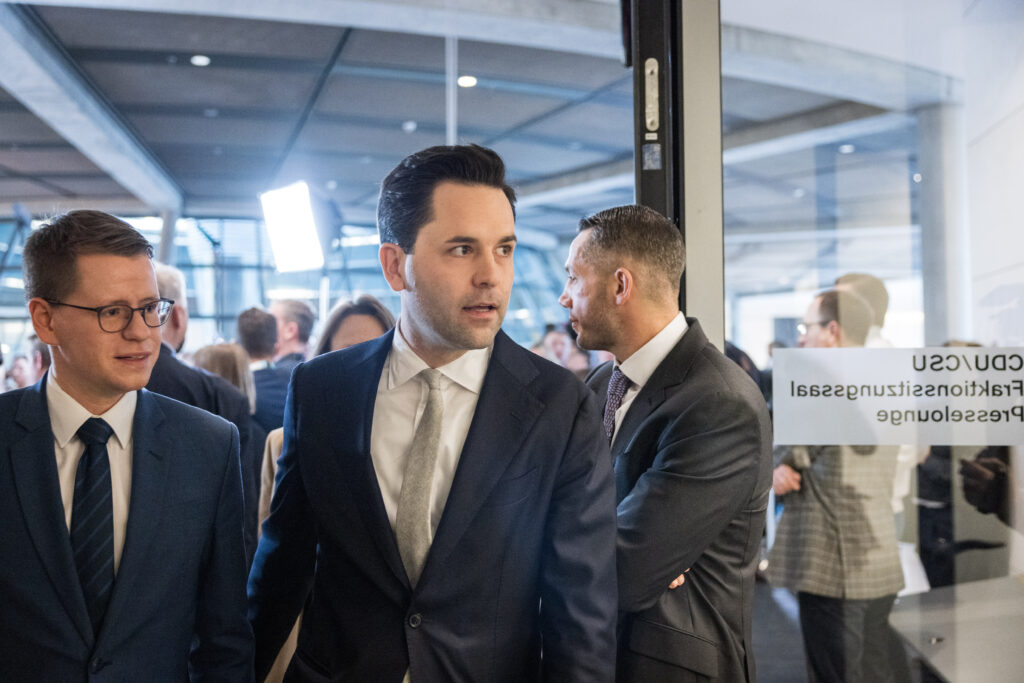 Winkel is among a group of young conservatives who rebelled against a pension reform package put forth by Merz’s government, saying current benefits for older people are too generous and asking for a plan that is “fair to all generations.” | Photo by Nadja Wohlleben/Getty Images
But it’s unclear whether that proposal has appeased all young conservatives. In a letter this week, the group said its 18 lawmakers would decide individually how they will vote on the immediate pension package, which is set to go for a vote on Friday. Every vote will matter, as Merz’s fragile coalition has a majority of only 12 parliamentarians.
On Tuesday, Merz’s center-right bloc held a test vote to see if there was enough conservative support to pass the pension reform package. The results of the internal vote were unclear.
Opinion surveys in Germany and France show that much of the public favors protecting existing pension systems and benefits. Leftist parties in both countries have also strongly pushed back against measures that would freeze or lower pension benefits, arguing that the public pension system is a core element of social cohesion.