
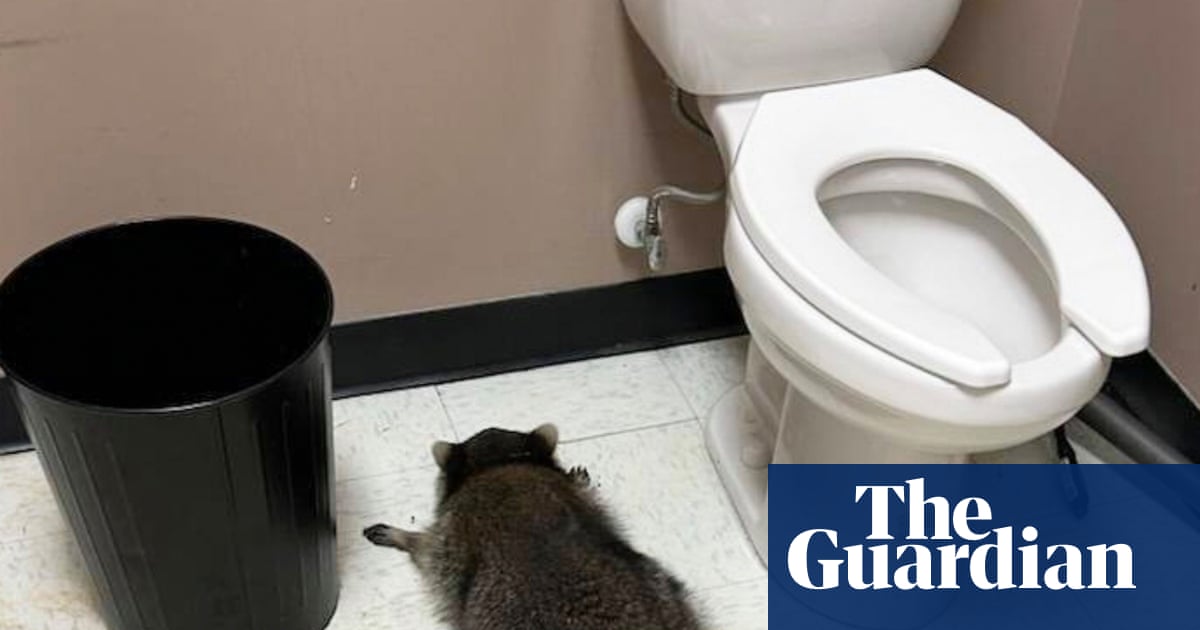
A liquor store employee in Virginia was startled on Saturday to discover smashed whisky bottles on the floor of the shop and, upon entering the bathroom, an apparently drunk, sleeping and spread-eagled raccoon.
“He fell through one of the ceiling tiles and went on a full-blown rampage, drinking everything,” Samantha Martin, an local animal control officer, told the Daily Mail.
The Hanover county animal protection and shelter confirmed the raccoon was drunk and said it had since become sober.
“After a few hours of sleep and zero signs of injury (other than maybe a hangover and poor life choices), he was safely released back to the wild, hopefully having learned that breaking and entering is not the answer,” the agency said.
The aftermath of the raccoon’s wild Friday night. Photograph: AP
Raccoons have adapted to living in urban areas to such an extent that they are now showing physical changes that resemble early signs of domestication, a recent study found.
Their snouts had become shorter than raccoons living in wild environments – a trait that domesticated animals tend to develop. Other traits are smaller teeth, curlier tails, smaller brains and floppier ears.
Raccoons have proved remarkably successful at living alongside humans, in part because of their adaptability at surviving on human refuse.
“Wherever humans go, there is trash,” Dr Raffaela Lesch, an assistant professor of biology at the University of Arkansas at Little Rock, recently told the Guardian. “Animals love our trash. It’s an easy source of food. All they have to do is endure our presence, not be aggressive, and then they can feast on anything we throw away.”
In Toronto, Canada, raccoons have become so numerous that a popular T-shirt boasting “Toronto v Everybody” has now been widely supplanted by one that now reads “Raccoons v Toronto”.
Alcohol consumption is abundant in the natural world, according to a recent study. It occurs in nearly every ecosystem, with most animals that eat sugary fruits and nectar likely to be regularly drinking it.
A rampage by a feral pig that stole three six-packs of beers in the DeGrey River rest area in Western Australia prompted warnings for campers to secure their food and alcohol. One camper said the pig drank all 18 beers, then got involved in an altercation with a cow.
In Turkey, an obviously intoxicated brown bear cub was rescued from a forest by people after eating “mad honey”, or “deli bal” in Turkish – a substance produced in small quantities by beekeepers in the Kaçkar mountains above the Black Sea, where rhododendrons produce a potent neurotoxin and the honey that bees produce from it can induce a mildly hallucinogenic or euphoric state.