
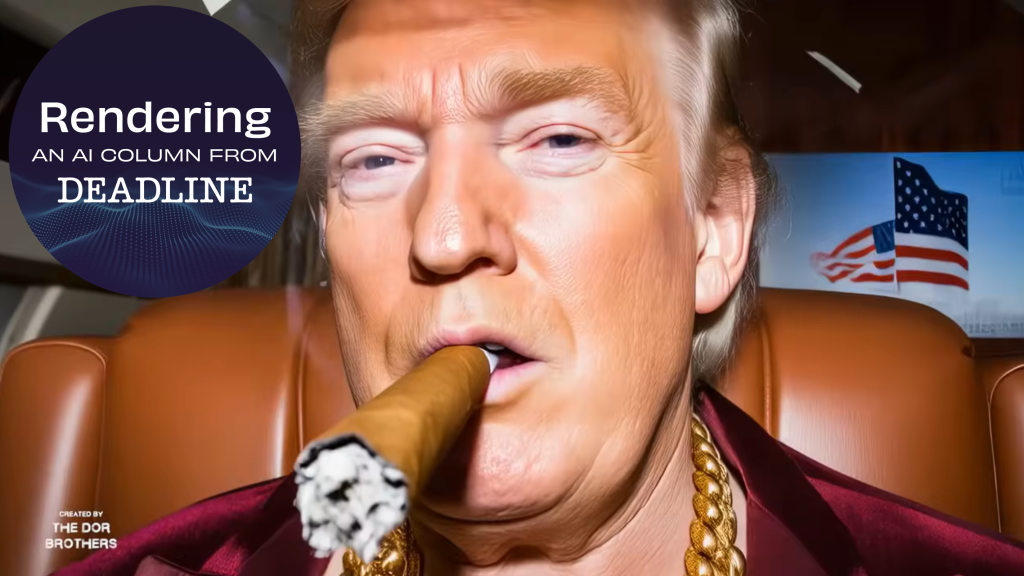
Welcome to Rendering, a new Deadline column reporting at the intersection of AI and showbiz. Rendering will examine how artificial intelligence is disrupting the entertainment industry, taking you inside key battlegrounds and spotlighting change makers wielding the technology for good and ill.
Got a story about AI? Want to tell us about the next big innovation or why AI robbed you of opportunity? Rendering wants to hear from you. Get in contact: jkanter@deadline.com.
This week: An interview with The Dor Brothers co-founder Yonatan Dor, whose AI videos have stormed the internet and are opening doors in Hollywood.
You are unlikely to know the name Yonatan Dor, but there’s a good chance you will have stumbled across his work when roaming the internet. Whether it’s a deepfake drill video of Donald Trump honking on a cigar in the back of a limo, or Kanye West riding a pink bike in a Nazi uniform, Dor’s generative AI creations racked up half a billion views last year alone.
These are the kind of numbers that bring AI haters out in hives, but it is winning Dor admirers. Joe Rogan eulogizes over his “f*****g incredible” videos, while Dor collaborated with Snoop Dogg on a music video and oversaw an ad campaign for Hugo Boss. Dor says Hollywood studios have now fixed their eye on his output, and he is closer to realizing his ultimate ambition: an artificial intelligence movie.
The Dor Brothers’ Snoop video
We sit in London’s Caravan Fitzrovia nursing peppermint tea, and in our short time together, Dor’s contradictions and forthright views make him fascinating company. The Lisbon-based creator is smartly dressed, but his beard, a blaze of red on his face, evokes his love of progressive metal music. He describes himself as an open book, but is coy about why his Israeli roots got him canceled from an AI conference in the UK that week. He talks about AI filmmaking as an art form that could herald the next Quentin Tarantino, but is withering about companies making billions from the technology (at one point, he compares OpenAI to Skynet).
Dor, 27, was an early adopter of generative AI, boasting that he was among the first 100 users of Midjourney, Stable Diffusion, and Runway. He became obsessed with the “magic” of converting written prompts into images, spending 12 hours a day “grinding” to hone his skills. Nowadays, he’s a heavy user of Google’s Veo 3.1 and China’s Hailuo AI, but says his entire workflow could be upended overnight by an unknown new platform.
He refines his prompts using ChatGPT, but says the craft is in the edit. Dor demands the “diamond in the rough,” the footage that is “absolute cinema.” His video Riot, released after the unrest in LA this year, showcases how he fast cuts between uncanny valley shots of a gun-toting Trump and a crazed Gavin Newsom wearing a rainbow headband. It teeters on the tangible. “AI is like your director of photography. You don’t sit on the DoP’s shoulder and mess around with his camera. You wait for him to get the shots, and then you sift through what you got,” Dor explains.
The Dor Brothers’ ‘Riot’ video
Does his work risk altering perceptions of reality by feeding the disinformation machine? “I hope it does,” he responds unapologetically, before comparing himself to a court jester, poking fun at the kings of culture, politics, and big tech.
In evidence to a Texas AI select committee last year, he advocated for invisible watermarks on artificial content to help distinguish it from genuine footage, but what about those who are not internet literate? “Every video we make has one extraordinary scene, which is unrealistic as f***. Even if you’re like a 90-year-old grandma, if you see that, you’ll be like, okay, that doesn’t make sense.”
Dor, who founded AI production company The Dor Brothers with his silent partner sibling, thinks hatred of artificial intelligence is at its peak right now. He claims to be working on several hush-hush projects with major consumer brands that will never surface because they are too wary about the backlash against generative AI.
They are “warming the engines” for when AI is a more accepted part of filmmaking, he says. Not that this stopped Coca-Cola from producing an AI Christmas ad, which Dor says suffered blowback because it was not original or creative. “Why just remake an ad you produced with a camera? It just makes people feel like they’re losing their jobs,” he argues.
Hollywood has come calling, with The Dor Brothers talking to studios and actors about animated shorts. It rings true, given that just days before our interview, Disney said it was experimenting with technology that will enable viewers to “create” and “consume” short-form AI videos. But The Dor Brothers’ ambitions lie elsewhere.
“Our main goal is making films,” Dor explains. “A checklist for me is a movie that gets [a score of] eight-plus on IMDB.” He has several scripts in development (a sequel to 20th Century Fox’s Idiocracy is a dream project) and is collaborating with an Oscar-winning writer. Dor won’t name the writer, but he has already forged connections with the likes of Roger Avary, the Pulp Fiction co-writer who judged The Dor Awards earlier this year. Logan Paul was also among the judges.

Yonatan Dor (credit: Upscale Conf)
Dor admits that AI movie-making remains elusive because the technology is not yet ready, and generative storytelling is not “speaking to people’s hearts right now.” He predicts that both things will change over the next two years, but suspects AI filmmaking will only thrive if done in collaboration with human performers. He sides with much of Hollywood when it comes to the question of AI actors like Tilly Norwood. “It’s the most uninteresting thing to me ever,” he says, leaning back in his chair. “It’s a pile of garbage.”
The Dor Brothers is currently looking for investment after turning down five approaches because Dor was unable to secure the guarantees he needed on creative freedom. The company’s biggest expense is copyright lawyers, who ensure its videos are “clean,” but Dor is less concerned about provoking powerful people with his satirical videos. “We have a Banksy attitude to our work,” he says. “Comfort kills the necessity of getting better.”
If Dor does come for Hollywood, he is unlikely to do so quietly.