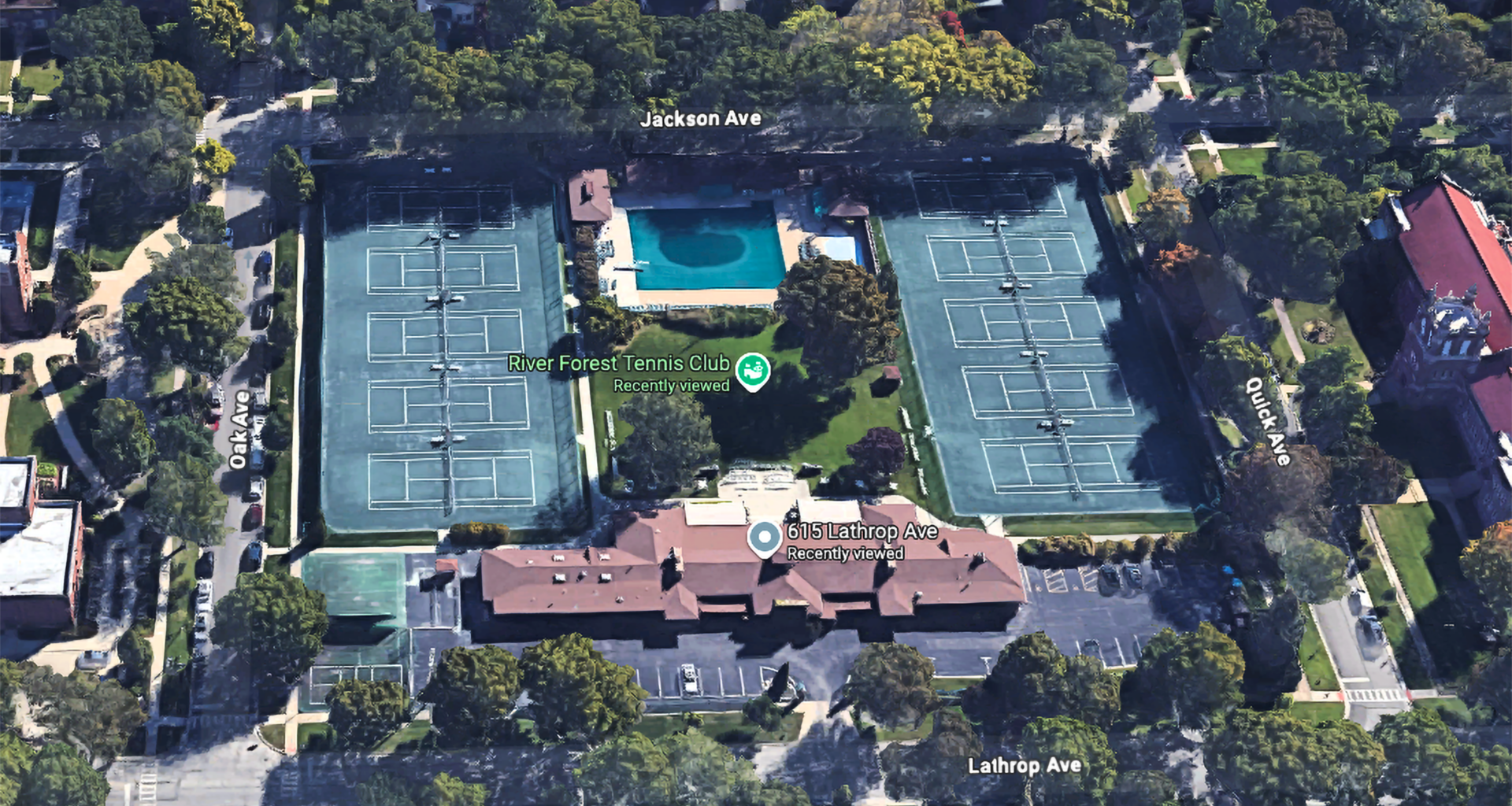
Controversy over a plan to add lighting at the River Forest Tennis Club will spark again this week as the facility’s application for lights comes back before the village’s Development Review Board.
Jason Jeunette is a lighting designer by trade, so he knows about industry terms like foot candles and light spill.
So when it comes to an application to amend an ordinance to add lights to the tennis courts at the tennis club, 615 Lathrop Ave., he has a keen eye for what will work, and what won’t.
Adding 24 poles at 30 feet tall, with two LED lights on each pole, covering all 10 courts, arranged around the outside fence, is problematic in his professional opinion.
“The way they are mounted, the lights falling on the property line is 32-foot candles and should be 0.50,” Jeunette said. “The way the manufacturer ran the calculations is just not helpful.”
Those calculations were made by Shinetoo Lighting USA LLC in Buffalo Grove. Jeunette’s recommendation? A larger number of shorter poles and smaller fixtures, “then you can get more control over where the light goes,” he said, adding “the tennis club has chosen to go with one company to do the design and installation, but it’s not the best solution.”
According to the application, dated Sept. 30, the proposed lighting is “in compliance with the Village’s Comprehensive Plan,” “strengthening our community character, identify, and unique sense of place,” and “strengthening our property values and enhancing our quality of life.” To that point, the application noted national Recreation and Parks Association statistics that state property values by tennis and golf clubs are 15% to 30% higher.
But according to Jeunette and other residents who live near the club, like Paul Harding, there is a larger issue.
The village of River Forest’s Development Review Board held a public hearing on the application Nov. 6, which had such a large turnout, it was scheduled for continuation at 7:30 p.m. Thursday in the first floor community room of village hall, 400 Park Ave.
According to Thursday’s meeting agenda, the body will listen to further public comments on the matter, then deliberate and make a recommendation to the village board.
According to Harding, four of the seven members of the development review board are club members, including Elias Yanaki, who served as proposal applicant and then recused himself from voting, and Maryanne Fishman, Jane McCole and Ron Lucchesi.
“It’s about ethics in River Forest government,” Harding said. “Nobody wants corruption and this is the poster boy for corruption. I respect the village government, but this is so ridiculous, it’s unbelievable.”
Resident Carey Palmer said during the Nov. 6 public hearing, neighbors asked the board members who were club members to recuse themselves. That apparently has not happened.
When reached via email Monday, McCole, a teacher at Lincoln Elementary School, responded with, “Sorry, I can’t talk about the proposal at this time.”
Multiple voicemails were left for Fishman, Yanaki and tennis club president Dan Baker, with no response. Lucchesi’s contact information was not publicly available.
When reached via phone Monday evening, development review board chairman David Crosby was asked whether the matter will come to a vote Thursday, and whether the board members who are also club members will recuse themselves.
“It’s Matt you have to direct those questions to,” Crosby said, referring to Village Administrator Matt Walsh.
Walsh said Tuesday morning that “the item may come to a vote on Thursday, depending on deliberations. If the (Development Review Board) is prepared to vote they would be able to, but they can also continue the topic to a future meeting.”
He also said that all improvements to properties zoned PRI (parks, recreational and institutional) are considered amendments to a planned development.
“The lighting proposal is considered an improvement to a PRI property,” he said. “All planned development reviews are considered by the Development Review Board. This planned development process is applied to university projects, park district projects and the Tennis Club’s last application in 2022. The recommendation from the (Development Review Board) then is forwarded to the village board.
“This is the process in our code, and the applicant does not select which board reviews their application.”
The lighting application does have a groundswell of support, as evidenced by the dozens of letters received by the development review board since Nov. 6. One of those letter writers was resident Andy Basney, who is a club member.
“As a member with a young family, I know that finding time for both personal wellness (like playing tennis) and quality family time can be a challenge,” Basney said. “With court lights, my spouse and I will be able to play after the kids are in bed or after dinner, rather than having to choose between a match and being home for our children’s evening routine. This simple enhancement greatly improves the quality of life for RFTC families by allowing us to do both.”
Resident Jeanne Calabrese, who lives across the street from the club, estimated that just 0.20% of the River Forest population will benefit from the lights.
“The question we all need to ask is why are the wants of so few taking the priority over the whole?” Calabrese said. “This is a small percentage of people, yet it has a huge impact on the community.”
For club members like Basney that want lights, Calabrese added, “I would first ask them, where do they live? If they do not live within 1,000 feet of the club, it’s not going to impact them. It’s a small community, we all live here together and we have to be mindful of all of us living here together.”
Harding thinks so, too.
“I can see where some things you’ve got a difference of opinion, but this isn’t even that,” he said. “The outcome is decided.”
Related