

Turn up that Zeppelin: A recent study found that older adults who regularly listen to or play music have a significantly lower risk of developing dementia.
A research team from Monash University in Australia looked at data from more than 10,800 adults over the age of 70 and found that those who listened to music most days experienced a 39% lower likelihood of developing dementia compared with those who sometimes, rarely or never listened to music.
Those frequent music listeners had a 17% lower incidence of cognitive impairment, along with higher overall cognitive scores and better episodic memory (used when we recall specific, everyday events).
Playing an instrument ― including singing ― was associated with a 35% reduction in dementia risk. Those who both listened to and played music on a regular basis had a 33% reduced risk of dementia and a 22% reduced risk of cognitive impairment.
For older adults worried about dementia ― a disease that affects 7 million people and is becoming more common as life expectancy increases ― turning on some music is an easy, low-effort way to ease a bit of that anxiety.
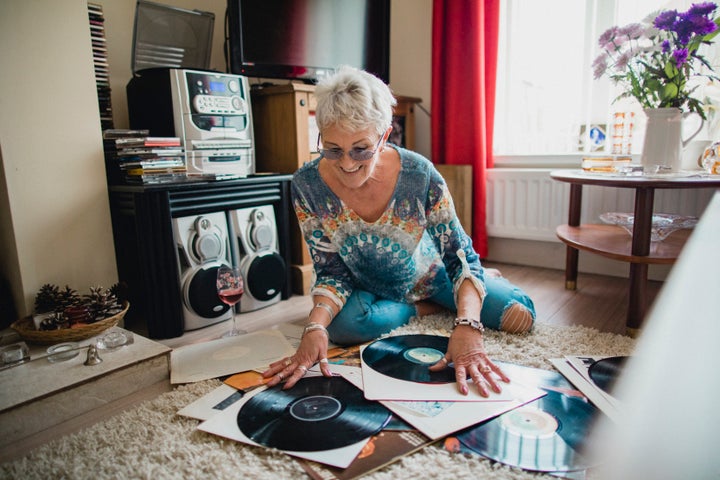
SolStock via Getty Images
“We know that listening to music engages multiple brain areas at once, acting like a full-brain workout,” said Emma Jaffa, a biomedical science Monash honors student who conducted the study alongside Joanne Ryan, a professor of biological neuropsychiatry at Monash.
Although the topic is still relatively underexplored, the study’s co-authors have several hypotheses — supported by earlier research — about why music might stimulate the brain.
“We know that listening to music engages multiple brain areas at once, acting like a full-brain workout,” said Emma Jaffa, a biomedical science Monash honors student who co-authored the study with Joanne Ryan, a professor of biological neuropsychiatry at Monash.
“Previous studies show it improves processing speed, language, memory and coordination,” she told HuffPost. “Plus, it often involves socializing with others, which helps protect brain health.”
As a bass player and singer herself, the findings were of particular interest to Jaffa.
She also loves the idea of tangible research ― research that you can actually do something with, that truly helps people. “I think that’s what drew me to this topic. It was the combination of a hobby and the possibility of delivering actionable insights to others,” she said.
![“Previous studies show [listening to music] improves processing speed, language, memory and coordination,” Jaffa told HuffPost. “Plus, it often involves socializing with others, which helps protect brain health.”](https://www.newsbeep.com/us/wp-content/uploads/2025/12/6930af5c19000078086a0e90.jpeg)
andreswd via Getty Images
“Previous studies show [listening to music] improves processing speed, language, memory and coordination,” Jaffa told HuffPost. “Plus, it often involves socializing with others, which helps protect brain health.”
Jaffa said the question she gets most often about the study is, “Are some genres of music more beneficial than others?” Is Coltrane or Clapton superior when it comes to improving cognitive function?
While she doesn’t have the answer (participants weren’t asked about what they were listening to), she said it’s definitely something she wants to explore in future research. (That and if listening to music has any bearing on reducing the risk of cognitive decline for those younger than 70.)
It’s no surprise that researchers like Ryan and Jaffa are exploring this topic, given how devastating dementia symptoms can be. People with the condition may develop speech difficulties, memory loss, mood changes and trouble completing everyday tasks.
Another recent study, published in October in the American Journal of Geriatric Psychiatry, found that having a sense of purpose may protect against dementia by keeping the brain more resilient and is linked to a lower risk of developing it. Other research-backed ways to support cognitive resilience during the aging process? Moderate to vigorous exercise, spending time with others ― hopefully while listening to music ― and even doing chores.