
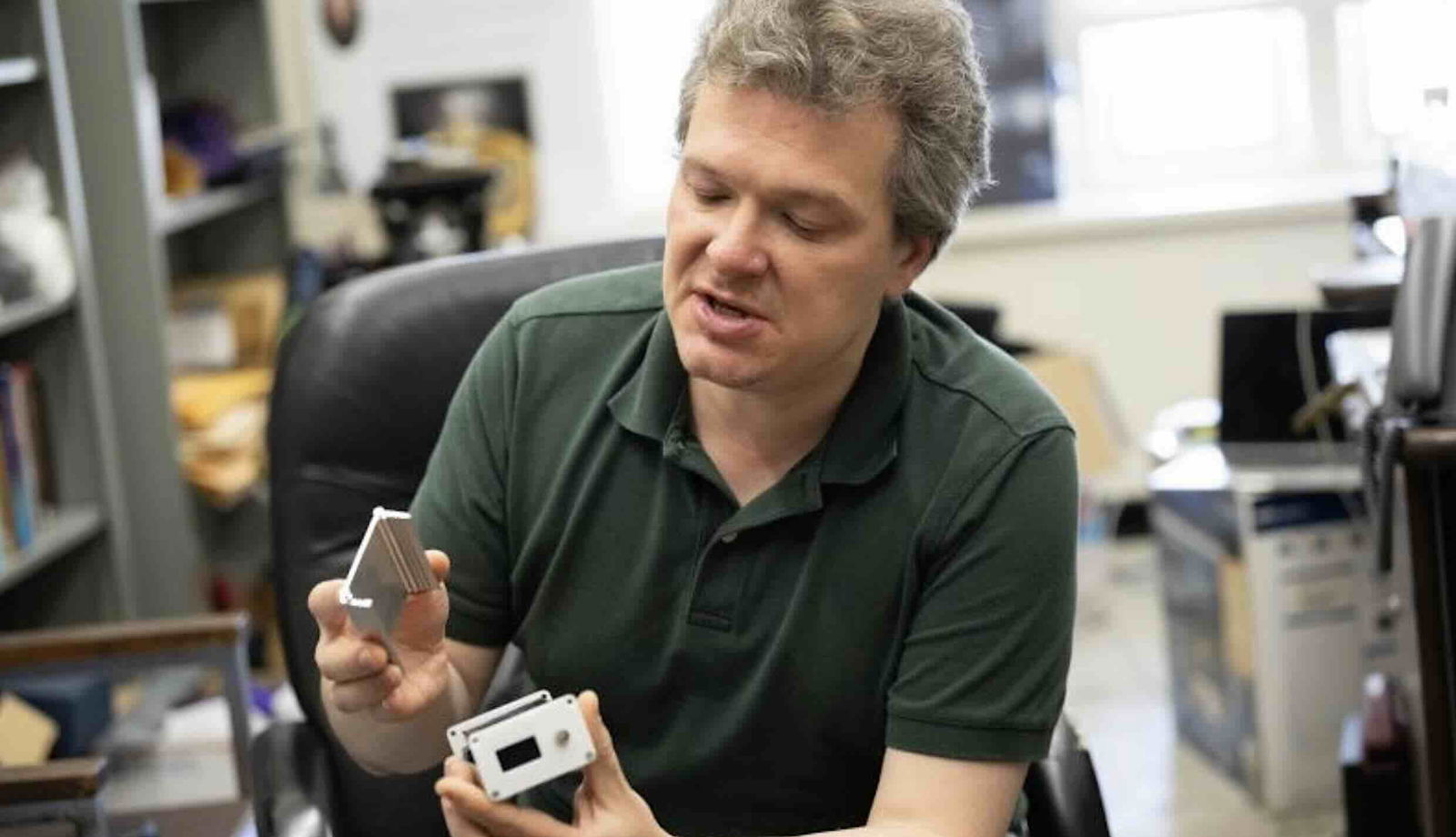
Physicists at the University at Albany, New York, have announced a new research initiative—dubbed UAlbany Project X—that marks the beginning of a long-term scientific study of unidentified anomalous phenomena (UAP).
The new project, officially launched last month, was made possible by an endowment gift that will provide ongoing funding for the team’s scientific investigation of aerial mysteries, which are currently also being investigated in a separate effort by the Pentagon’s All-domain Anomaly Resolution Office (AARO).
Kevin Knuth, Ph.D., a professor of physics at the University at Albany and one of the new project’s lead scientists, told The Debrief that UAlbany Project X (UAPx) is an outgrowth of many years of ongoing research that he and his colleagues behind the new effort have already undertaken.
“We’ve been working on studying UAP scientifically for about seven years now,” Knuth explained, adding that his entry into the study of aerial mysteries began with an examination of the many decades of information that have been collected on the topic.
“I started by just doing what a physicist ought to do, which is getting your head around the problem,” Knuth told The Debrief. This ultimately led to his collaboration with scientists from the Scientific Coalition for UAP Studies to author a 2019 paper that estimated the minimum speeds and accelerations of UAP observed in several notable cases. Among these was a 2004 incident involving an object observed by U.S. Navy personnel aboard the USS Nimitz (CVN-68) during training exercises off the southern California coast.
Footage of the object, popularly known today as the “Tic Tac,” was obtained by an FA/18 Super Hornet pilot named Chad Underwood and subsequently leaked online. In 2020, the Pentagon confirmed the footage was authentic in an official release accompanied by two other historic videos purportedly depicting UAP, while noting that the object in the 2004 video remained “unidentified.”
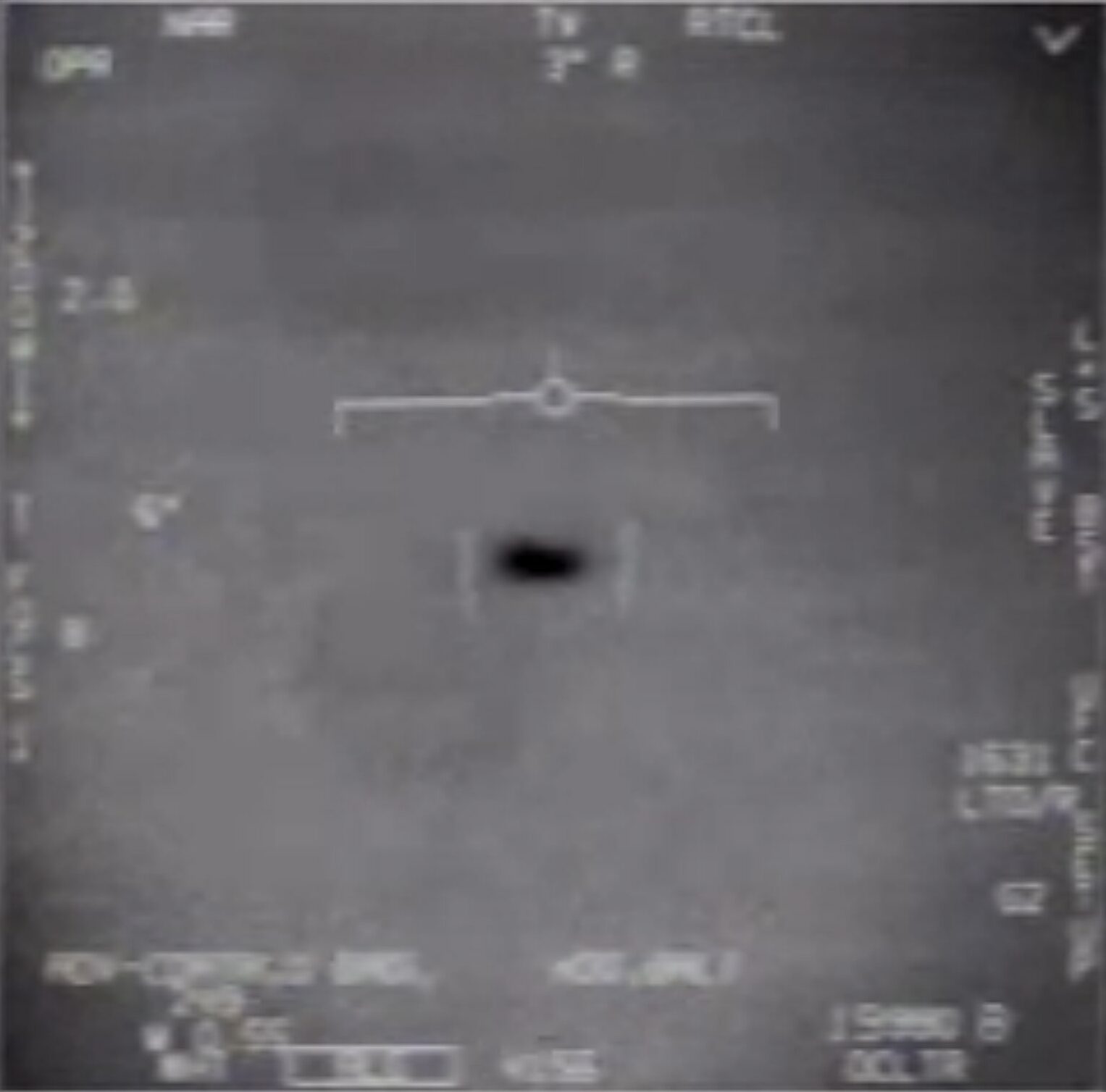 A still frame from the 2004 footage obtained by U.S. Navy pilot Chad Underwood, depicting a purported UAP encountered by personnel with the U.S. Navy’s Carrier Strike Group 11 (CSG-11) (Image Credit: U.S. Department of Defense).
That incident, Knuth says, had been part of what led him and fellow University at Albany physicist and associate professor Matthew Szydagis, along with several colleagues, to conduct a field expedition in 2021 off the coast of Santa Catalina Island with a non-profit scientific research organization called UAPx.
“We worked to have an updated collection mission over the Catalina Channel where the Nimitz Encounter occurred,” Knuth told The Debrief, during which the University at Albany researchers collected observable-light and infrared imagery, and other data that helped them develop a framework for the scientific documentation of UAP.
That work culminated in a paper by Szydagis and co-authored by Knuth and their colleague, University at Albany associate professor Cecilia Levy—the core of the new UAlbany Project X initiative—published in Progress in Aerospace Sciences earlier this year.
“This was a really seminal paper,” Szydagis told The Debrief, describing it as “a summary of UAPx’s first results from the Catalina-Laguna mission.”
“I can count on the fingers of one hand the number of scientists who have gotten their work on the UAP topic published in such a high-caliber journal,” Szydagis said. A second co-authored paper on the history of the UAP subject, with Knuth as the lead author, had appeared in the same edition of the journal, along with a separate study by Luc Dini, Geoffrey Mestchersky, and Jacques Vallée that provided estimates of energy values associated with a historic UAP incident.
“It’s a highly reputable journal that is cited by a lot of other scientists,” Szydagis said. “And yet, nobody talked about either that paper or Kevin’s history paper.”
“In the UAPx paper, we did something that we thought would be considered very important,” Szydagis said. “We concluded the paper with suggestions on how to quantify the meaning of extraordinary evidence, and very few people seem to be paying attention to that.”
Today, while UAP—or UFOs, as they are traditionally known—often succeed in dominating prime time television news segments, podcasts, and occasionally even mainstream publications like The New York Times, The Wall Street Journal and other peer-reviewed journals like Nature: Scientific Reports, the majority of the attention the subject receives goes toward the question of government secrecy, and how much more the U.S. intelligence community may know about UAP than it has disclosed to the public.
Such questions had been the focus of a recent documentary, The Age of Disclosure, by filmmaker Dan Farah, in which a trove of current and past U.S. government officials that included Marco Rubio, currently serving as U.S. Secretary of State, and James Clapper, former Director of National Intelligence, spoke on the record about the issue of transparency regarding information collected about UAP.
Yet, while the question over government secrecy involving UAP commands much of the attention in the media cycle, that isn’t to say that the work of scientists—particularly those with the University at Albany team—had been overlooked by everyone.
Enter Tony Gorman, a well-known Albany-area businessman with many years of experience who was previously a co-owner of The Gorman Group, a family-owned highway construction company that has operated in the area for many decades.
Gorman had seen a short local news story about the UAP research Knuth, Szydagis, and Levy were conducting at the University at Albany, which prompted him to reach out to the team to help ensure an ongoing source of funding for their work.
“I have always been curious about UAPs and what could possibly be out there,” Gorman said in a statement. “When I saw the UAP research the UAlbany team is doing, I wanted to learn more.”
Gorman reached out and, after a series of discussions with the UAlbany researchers, decided to put his money behind their scientific efforts.
“I gained so much respect for their work,” Gorman said. “Right there, I knew I wanted to get involved.”
 From left to right: Professor Matthew Szydagis stands alongside Albany businessman Tony Gorman, and Professors Cecilia Levy and Kevin Knuth (Photo by Zach Durocher/University at Albany. Used with permission).
“We received this donation from Tony Gorman,” Knuth told The Debrief. “A generous donation, which basically funds us for five years, and in addition to that, sets up an endowment that funds us in perpetuity.”
“So we’re here to stay.”
“We have money to help sustain us for the long term,” Szydagis told The Debrief. “With Tony’s very generous gift, we have the potential ability to be working on UAP for the rest of our lives.”
As for what the team specifically plans to work on, Szydagis explained that part of its plan is to leverage knowledge from past research while carefully plotting a course forward through strategic investigations that will help the physicists expand the data they are collecting on UAP.
“We’re planning a long-term, cautious, sustainable plan to keep working on UAPs for decades to come,” Szydagis said, though noting that the team is also working to ensure that it does not add to “the clutter of more projects and more silos.”
“So the old UAPx is closing down, and it’s being reborn,” Szydagis told The Debrief. “We are preserving UAPx’s original mission.”
“Through an incredibly generous gift from Tony Gorman, Professors Knuth, Matthew Szydagis, and Cecilia Levy have secured a major endowment to launch UAlbany Project X (UAPx)—the direct academic continuation of everything we’ve built from scratch,” wrote Gary Voorhis, a U.S. Navy veteran and former CEO and co-founder of the original nonprofit UAPx.

“They did it. They took our little rag-tag expedition team and turned it into a funded, university-backed research program with the potential to run for decades,” Voorhis wrote.
Knuth says the new UAlbany Project X will seek not only to collect more data on UAP but also to clarify the subject, how science can be applied to it, and to help dispel misconceptions about UAP.
In addition to the core University at Albany team, the researchers have announced they will receive input from experts, including physicist Eric W. Davis, who Szydagis said will work with the team on a volunteer basis as an adjunct researcher in an advisory position for the project.
“We are deeply honored to have him,” Dr. Szydagis told The Debrief.
“There has been a lot of excellent work done,” Knuth added, although noting that he hopes UAlbany Project X will be able to take scientific approaches to UAP research into new and exciting areas.
“I think the best thing to do is to learn from the mistakes of others, and to build on their successes,” Knuth said. “We’ve gotten diffraction gratings for high-quality cameras, and we plan to collect spectra. And magnetic and electric fields are often omitted from study, and so we plan to accommodate that as well, along with an excellent network of multiple cameras.”
“We have plans to build arrays of cameras to watch the sky and have this portable,” Knuth told The Debrief. “Basically, take your equipment and plant it somewhere for a couple of weeks, and collect data. That’s the way to do it.”
Thanks to Gorman’s endowment, the team also plans to ramp up publication of scientific papers on UAP.
“You should expect more papers from us, not just field expeditions,” Szydagis told The Debrief. “We’ve got all kinds of ideas on papers we want to publish on this topic broadly. And now we can start working on more of these things.”
“We no longer have to just work on this for free in our volunteer time,” Szydagis added, “which is not sustainable long-term.”
Fundamentally, Szydagis says that he, Levy, and Knuth will continue the mission that began during the original UAPx field expedition in 2021 and advance those efforts by collecting new data in the years ahead.
“UAPx is a phoenix being reborn,” Szydagis said. “It’s not dying, it’s not disappearing.”
“The mission will continue as a university effort.”
Micah Hanks is the Editor-in-Chief and Co-Founder of The Debrief. A longtime reporter on science, defense, and technology with a focus on space and astronomy, he can be reached at micah@thedebrief.org. Follow him on X @MicahHanks, and at micahhanks.com.