
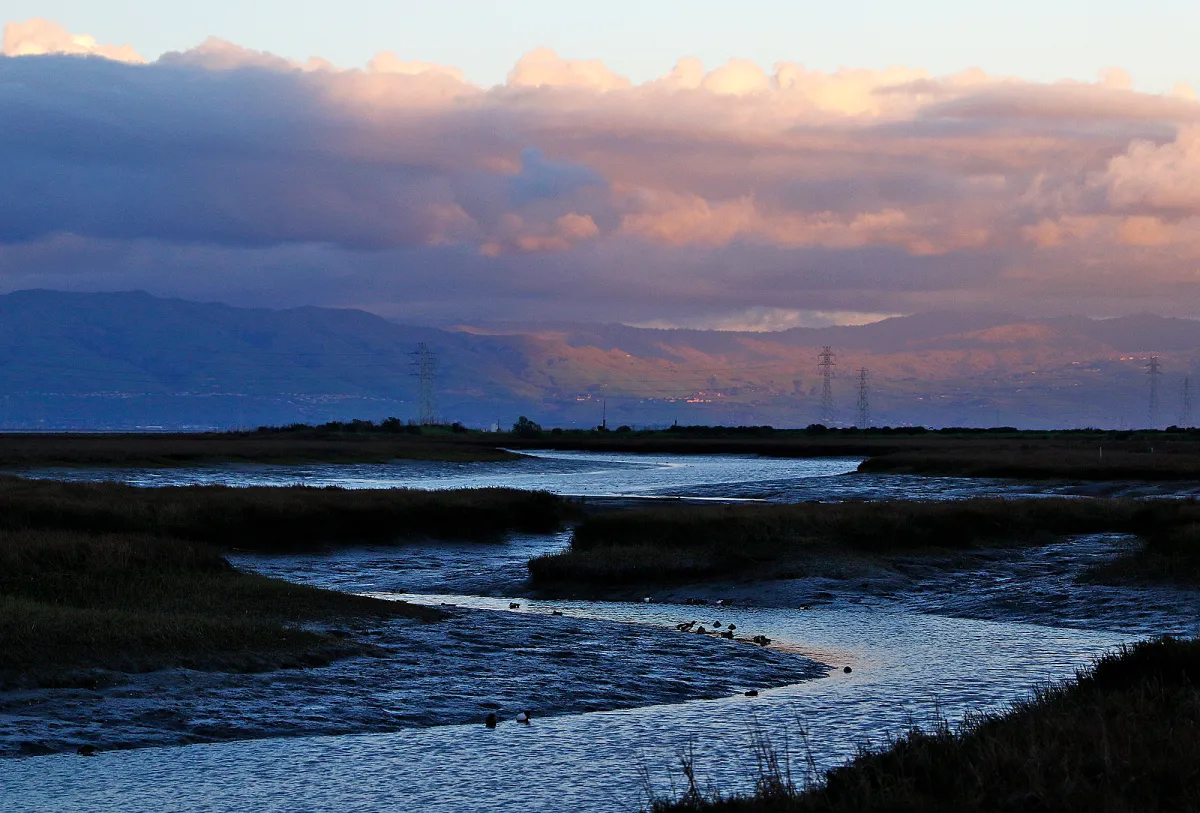
 Clouds drift past the many channels of the Palo Alto Baylands as the sun sets in this file photo. Photo by Veronica Weber.
In an effort to be not only be politically correct but also environmentally committed, the Palo Alto City Council is ready to adopt a new law that will impose a curfew on outdoor bright lights in this city, not only downtown but also on all residential streets. The result: a dimmer, darker community.
Why do this? So we can better see the stars at night, and also provide a safer environment for birds, animals and insects.
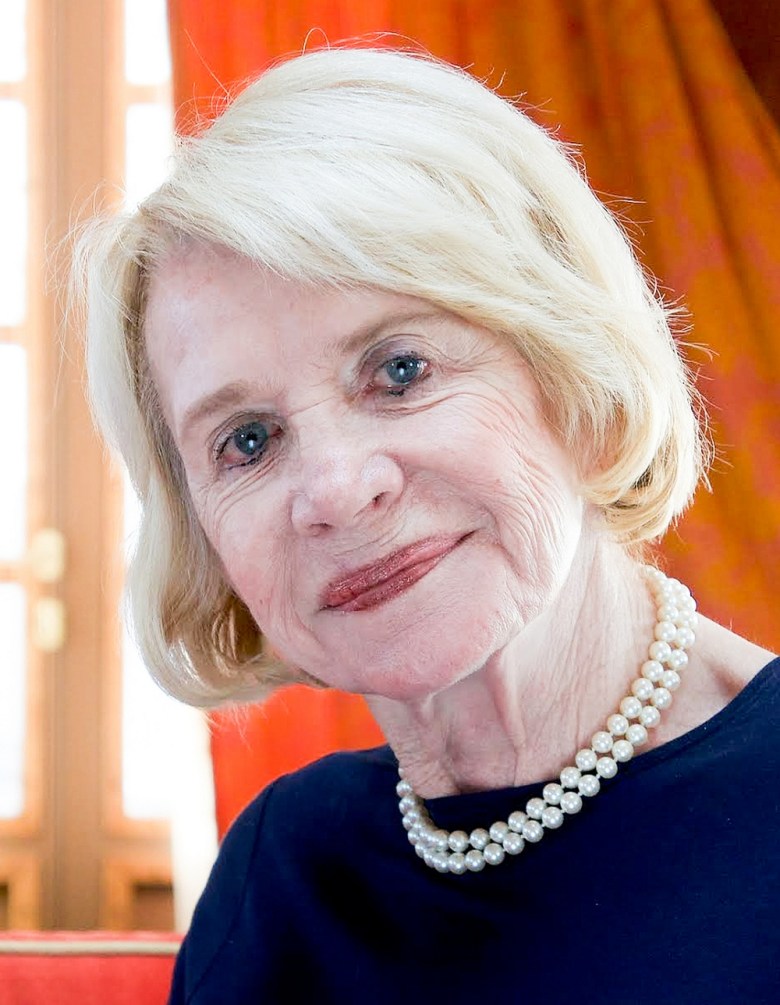 Diana Diamond is a longtime Palo Alto journalist, editor and author of the blog “An Alternative View” on Palo Alto Online. Image courtesy Diana Diamond.
Palo Alto’s proposed “Dark Skies” law aligns our city with a relatively new movement called DarkSky International. This organization claims that dimming or eliminating night lights will result in an increase in the health and well-being of residents, protect wildlife and ecosystems, reduce light pollution, allow for safer bird migration and, of course, enable residents to better see starry skies.
When this council first heard about “dark skies,” the idea immediately caught their interest, because it seemed so worthwhile, so environmentally attuned, that nearly all council members supported it. A 10 p.m. curfew was suggested, but recently changed to midnight. The City Council is scheduled to vote on dark skies law this coming Monday, Dec. 8.
Can dark skies at night really be beneficial? Or is this a far-fetched idea designed to fool people with half-truths and exaggerated claims – perhaps with a goal of making this a profitable undertaking for DarkSky International?
For starters, this organization posits that natural light, like the moon at night, is desirable, but all light created or produced by humans is artificial light, which is bad. Outdoor light from flashlights, light bulbs, front porch lights produce light pollution, according to DarkSky.
How bad? Their web site states, “Light pollution disrupts wildlife, impacts human well-being, wastes money and energy, contributes to climate change, and blocks our view of the universe” (emphasis theirs).
What is wrong with this?
Well, how about public safety? DarkSky proposes that front yard, back yard and porch lights be turned off unless absolutely necessary. Street lights are all right, but should shine down, not up. Automobile lights were not mentioned.
But if the streets are darker and yards are unlit, nighttime safety becomes an issue, since more crimes occur at night. Walking a dog, taking out the trash, or jogging around the block could cause some worries, especially if people routinely opt for a permanent no-outside-lights rule for their homes.
The moon is a natural light that does not disturb a dark sky, but any human-created light is artificial, such as a candle, or a flashlight, a front porch light, garden lights, outdoor holiday lights, etc. are bad and cause light pollution.
Hmmm. DarkSky seems to be saying that all lights used by humans cause light pollution. That’s a bold claim!
Let me rephrase this. By DarkSky reasoning, if human-made light is bad and causes light pollution, and that pollution is harmful for humans and other life, then humans have a problem, but only as defined by DarkSky.
I think their definition is the problem. By the way, Google’s definition of light pollution was defined by DarkSky. What a coincidence.
Maybe that’s why this organization can claim that 80% of our global population is affected by light pollution. If light pollution can hurt humans, how do so many people around the world stay reasonably healthy ?
Health effects
That brings me to the alleged health damage that DarkSky states can occur from bright night lights that lighten the skies.
For example, people absorb less melatonin, which our body needs, and light pollution “can hurt functions in our bodies, causing such problems as obesity, physical well-being, eye degeneration, mood disorder, as well as depression, hypertension, diabetes, and heart disease.”
No wonder a list like that scares people.
The organization does admit, “Bio biological changes may play a role in the development of some chronic diseases, many of which are currently under study.”
“Under study,” one should note, does not mean medically or scientifically proven.
My conclusion
The more I read the DarkSky International website, the more uncomfortable I felt. I came across statements that I found were half-truths or exaggerations, and also many of their claims did not provide any scientific evidence or cite references.
Even referring to human-made lights as pollutants bothered me. “Pollution,” according to the dictionary, is “the presence in or introduction into the environment of a substance or thing that has harmful or poisonous effects.”
One big question I have is if light pollution can affect the health of humans, how do people who live in areas where nights are very long, such as near the Arctic or the Antarctic circle, stay healthy? What about the summer months when daylight can last nearly 24 hours? Does too little light or too much light disturb their health? Or do DarkSky’s light pollution theories only apply to those of us living in temperate zones?
Lights are not poisonous. People have used what they call artificial lights for centuries. Lights are intrinsically good and help us find our way at night.
Dark skies in the galaxy will never disappear, as some DarkSky enthusiasts claim. A Palo Alto curfew will not keep us healthier. Don’t be afraid of DarkSky International’s dark threats.
Diana Diamond is a longtime Palo Alto journalist, editor and author of the blog “An Alternative View” on Palo Alto Online.
Most Popular