
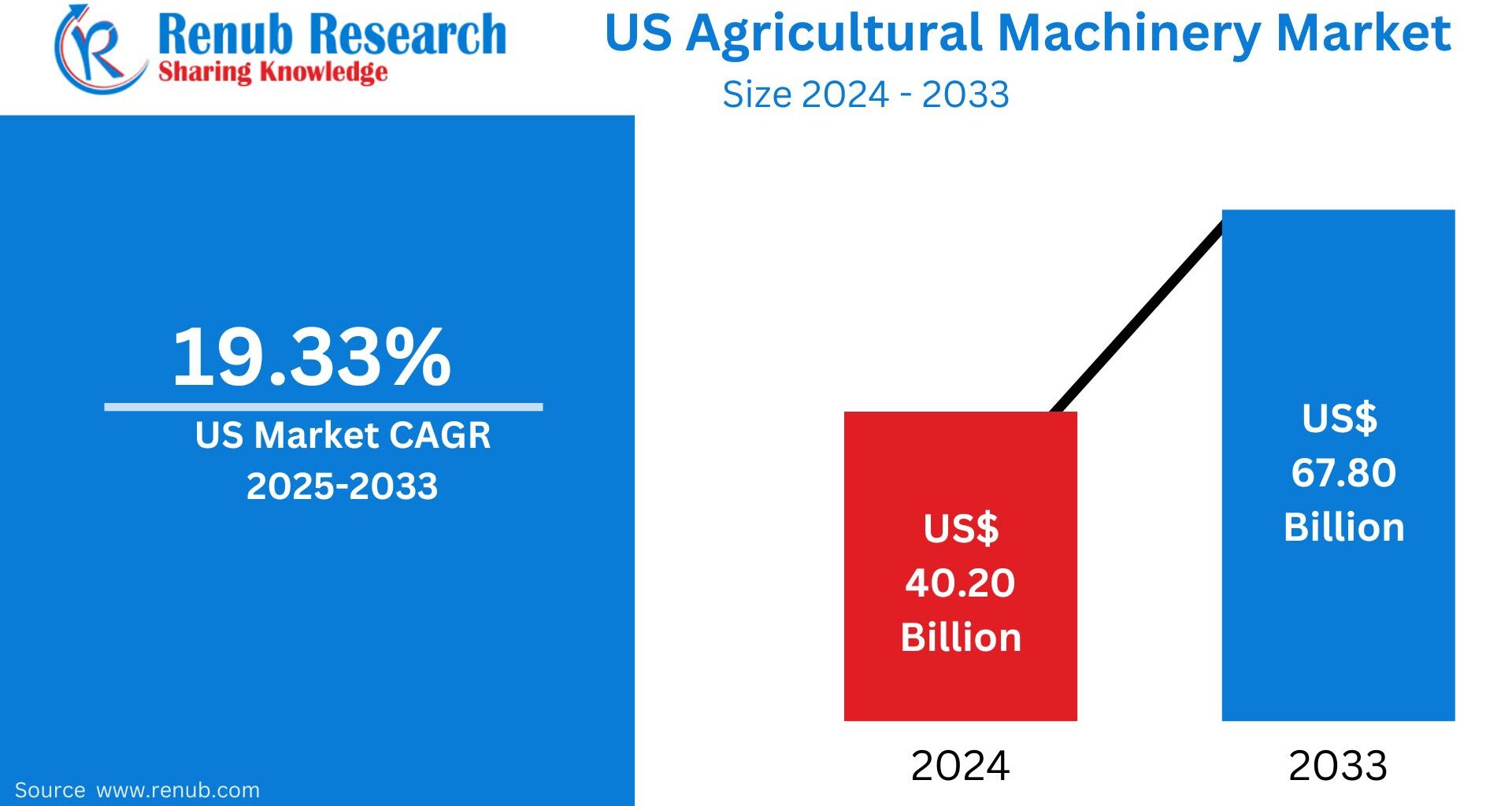
The United States Agricultural Machinery Market is entering a period of rapid transformation, powered by automation, precision agriculture, and sustainability-driven innovation. According to Renub Research, the market is projected to reach US$ 67.80 billion by 2033, rising from US$ 40.20 billion in 2024, at a strong CAGR of 5.98% during 2025–2033. This steady climb reflects growing demand for efficient, productive, and environmentally responsible farming systems across the U.S.
From automated tractors to AI-powered harvesters and smart irrigation systems, the modern American farm is evolving rapidly. As a result, machinery segments such as tractors, harvesting equipment, planting systems, and high-tech irrigation tools have become essential pillars of the agricultural supply chain. These innovations enable farmers to maintain productivity despite labour shortages, fluctuating climatic conditions, and environmental constraints.
This article provides an in-depth exploration of the factors driving market growth, the machinery categories shaping the industry, technology trends, challenges, and competitive dynamics.
United States Agricultural Machinery Market Overview
Agricultural machinery includes the equipment and tools used to automate farming operations, enhance productivity, and improve efficiency across planting, cultivation, irrigating, and harvesting. This category includes a wide array of machines such as:
Tractors
Ploughs and tillers
Harvesters
Sprayers
Seeders and planters
Irrigation systems
Modern agricultural machinery is deeply integrated with technologies like GPS, automation, IoT, and precision farming solutions, enabling farmers to reduce waste, conserve resources, optimize input usage, and increase yields.
As U.S. farms expand in size and complexity, the need for high-performance machinery becomes more urgent. Additionally, environmental concerns and the pressure to produce more food with fewer resources are pushing farmers to adopt machinery designed for sustainable and data-driven agricultural practices.
Key Growth Drivers of the U.S. Agricultural Machinery Market
1. Sustainable Farming Practices
Sustainability has become a major force shaping the U.S. agricultural machinery landscape. As farmers aim to reduce their environmental footprint and comply with sustainability norms, they are increasingly shifting toward equipment designed to:
Reduce water consumption
Minimize fertilizer and pesticide runoff
Lower carbon emissions
Improve soil health
Support renewable energy usage
The rise of precision farming machinery—such as GPS-guided tractors, variable-rate sprayers, and smart soil sensors—allows farmers to apply inputs with pinpoint accuracy. This reduces waste and environmental impact while enhancing production efficiency.
The development and adoption of no-till and low-till equipment also help protect soil structure, reduce erosion, and retain moisture—all crucial for long-term sustainability. As consumer and regulatory pressure continue to grow, sustainability-oriented agricultural equipment will remain a strong driver of market expansion.
2. Rising Food Demand
With the world population increasing and domestic food consumption rising, the U.S. agriculture sector must produce more with the same amount of land—or sometimes less. Demand for:
High-efficiency planters
High-capacity harvesters
Precision sprayers
Large-engine tractors
continues to rise as farmers aim to cover more acreage in less time, boost yields, and reduce labour dependency.
In an era where arable land is limited, the push toward mechanical advancement becomes essential. Automation, high-speed planting, and digitally integrated machinery are no longer optional—they are critical for meeting national and global food supply demands.
3. Technological Advancement and Automation
Technology remains the most influential growth catalyst in the U.S. agricultural machinery industry. Innovations across automation, robotics, and smart farming tools have modernized the entire farming lifecycle.
Today’s machinery can autonomously:
Steer tractors
Monitor crop conditions
Measure soil health
Adjust planting speed
Determine irrigation needs
Optimize harvesting operations
Precision agriculture technologies, including real-time data analytics, drone surveillance, IoT-enabled devices, and AI-powered robotics, have transformed traditional farming.
A landmark moment came in December 2022, when CNH Industrial expanded its Ag-Tech solutions in Phoenix, introducing advancements such as:
Autonomous tillage systems
Driverless harvest solutions
Balers with automated functionality
Backed by Case IH, New Holland, and Raven, these technologies allow farmers to overcome labour shortages and adopt fully autonomous operations on the field. As innovations continue to evolve, adoption of advanced machinery will grow exponentially.
Challenges Impacting the U.S. Agricultural Machinery Market
1. High Maintenance and Repair Costs
As machinery becomes more advanced and technologically sophisticated, maintenance and repair costs have also increased. Modern agricultural equipment often requires:
Specialized technicians
Proprietary parts
Software updates
Diagnostic tools
For small and medium farms, these costs can place sizable pressure on budgets. Equipment downtime can disrupt critical farming cycles, particularly during planting and harvest seasons. The shortage of skilled technicians in rural areas adds another layer of difficulty, further intensifying repair challenges.
2. High Initial Investment Costs
One of the biggest barriers to adoption is the high upfront cost of advanced machinery. Cutting-edge solutions like autonomous tractors, combine harvesters, and precision irrigation systems require significant capital investment.
Although they offer long-term savings, productivity improvements, and resource efficiency, small-scale farmers often struggle to afford these technologies. As a result, the unequal adoption of modern machinery between large and small farms remains a persistent challenge in the U.S. agricultural landscape.
Market Segmentation: United States Agricultural Machinery Market
Below is a detailed breakdown of the market based on machinery types and categories:
By Machinery Type
Irrigation Machinery
Tractors
Ploughing and Cultivation Machinery
Harvesting Machinery
Haying and Forage Machinery
Planting Machinery
Sprayers
Irrigation Machinery
Gravity Irrigation
Micro-Irrigation
Sprinkler Systems
Micro-irrigation systems, particularly drip irrigation, are seeing fast adoption due to their ability to save water and maximize plant health.
Tractors by Engine Power
Less than 40 HP
41 to 100 HP
More than 100 HP
The mid-power segment (41–100 HP) remains dominant in the U.S., given its suitability for mixed and large-scale farming operations.
Ploughing and Cultivation Machinery
Cultivators and Tillers
Harrows
Ploughs
Others
Advanced tillage machinery helps improve soil aeration and preparation while supporting minimum tillage practices for sustainability.
Harvesting Machinery
Combine Harvesters
Harvesting Robots
Self-Propelled Forage Harvesters
Robotic harvesting technologies are gaining traction, especially in labour-intensive crop segments.
Haying and Forage Machinery
Mowers
Balers
Tedders and Rakes
Forage Harvesters
These machines support livestock-dependent farms and play a vital role in the feed production supply chain.
Competitive Landscape: Major Companies
Companies in the market have been analysed across five viewpoints:
Company Overview
Key Personnel
Product Portfolio
Recent Developments
Sales Analysis
Key Players
John Deere
CNH Industrial
AGCO Corporation
Kubota Corporation
Titan Machinery Inc.
CLAAS
Lindsay Corporation
Alamo Group Inc.
These companies are leading the technological race, focusing on automation, sustainability-driven machinery, and advanced power systems to enhance productivity across U.S. agricultural landscapes.
Final Thoughts
The United States Agricultural Machinery Market is entering a transformative decade as farmers rapidly adopt automation, precision technology, and sustainability-focused equipment. With production demands growing faster than ever, advanced machinery has become indispensable. Renub Research’s projection of the market reaching US$ 67.80 billion by 2033 reflects a sector powered by innovation and necessity.
As climate challenges, labour shortages, and food demand pressures intensify, U.S. farmers will continue to invest in cutting-edge technologies. Manufacturers that prioritize autonomy, AI, precision tools, and eco-friendly equipment will shape the future of modern agriculture.
The next decade will not just redefine machinery—it will redefine farming itself.